





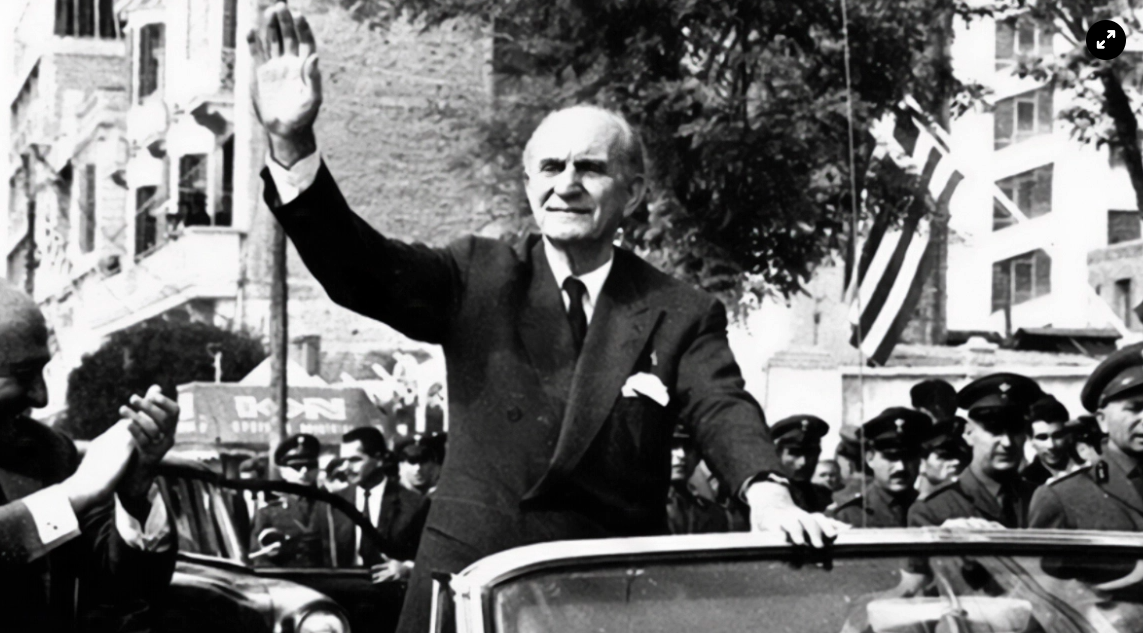
Politically positioned in the center but lacking a clear and unified ideological direction the Center Union included politicians from various backgrounds, ranging from the left (like Ilias Tsirimokos) to the anti-Karamanlis right (like Stefanos Stefanopoulos). The unifying factor for all these groups was the charismatic personality of Georgios Papandreou.
We turn to history for one simple reason. Just as in 1964, today we hear increasing calls for a center-left coalition capable of defeating Kyriakos Mitsotakis’s New Democracy. Before 1964, Konstantinos Karamanlis, as the leader of the National Radical Union (ERE), had been dominant, winning three consecutive elections (1956, 1958, 1961). He lost in 1963, but Georgios Papandreou, who won, did not achieve a parliamentary majority. Because he refused to govern with the communist-influenced EDA, Greece was led to the 1964 elections, resulting in the Center Union’s victory.
Many may see striking similarities between that period and today, especially if Kyriakos Mitsotakis wins a third consecutive election, as polling suggests. Of course, some may argue that the conditions are not the same. Fair enough. However, there are aspects we cannot ignore, particularly the inability of today’s opposition parties to capitalize on the government’s growing unpopularity.
Firstly, Division
Except for the Communist Party (KKE), which opposes any form of collaboration, five anti-right-wing parties in parliament (PASOK, SYRIZA, New Left, Plefsi Eleftherias, Movement for Democracy) could theoretically form a political-electoral majority. Yet, even behind closed doors, their discussions seem futile, echoing the old saying, “You can knock on a deaf door all you want.” They not only refuse to cooperate but, in many cases, one party seeks to undermine another. Adding the likes of MERA25 (Yanis Varoufakis) and KOSMOS (Petros Kokkalis) to this fragmented picture, the challenge of forming a united anti-right-wing front becomes even more apparent.
Secondly, A Lack of Leadership
There is no political figure like Georgios Papandreou in 1964 who could unite these forces or at least convince them of the necessity of a new progressive government proposal. Nikos Androulakis, who might have taken the lead (with PASOK, according to polling, in second place), does not appear willing to take that step, either due to personal reluctance or doubts about his leadership abilities. Not only do leaders of other parties question his capacity, but even within his own party, many do not see him as a viable candidate for prime minister—his “prime ministerial” rating is in single digits and half the popularity of his own party. When even half of PASOK’s voters do not see Androulakis as prime minister material, it’s clear he cannot inspire and unite the broader forces needed to challenge right-wing dominance.
Similarly, for SYRIZA, the leader, Sokratis Famellos, despite being a moderate and courteous individual, has yet to show the kind of leadership capable of uniting the progressive forces of the broader center-left. Moreover, SYRIZA, especially after the departure of Stefanos Kasselakis, currently fluctuates between third and seventh place in the polls, which severely limits his influence over other potential coalition partners.
Thirdly, Internal Struggles and Ego
Among the progressive opposition parties, there is an abundance of petty rivalries, egos, and self-interest. This is evident in recent events, such as the presidential election and the aftermath of the tragic Tempi train crash. The impression given, especially by PASOK and SYRIZA, is that they were more focused on establishing dominance in their internal rivalry than addressing the national crisis. For instance, after the Prime Minister’s decision to nominate Konstantinos Tasoulas for President of the Republic, PASOK chose Tasos Yannitsis, while SYRIZA nominated Louka Katseli.
Even in matters as simple as these, they failed to agree, primarily because both parties had different political readings of the implications of a shared candidate. The same internal wrangling occurred regarding the Tempi tragedy, with parties arguing over whether to submit a motion of censure or to hold a pre-investigation committee. Rather than focusing on the government’s responsibilities, they bickered over minor details. This only benefits the government, allowing it to avoid greater scrutiny. Their priority seems not to form a united anti-government front, but to outmaneuver each other within the opposition, focusing more on which party will come second.
Fourthly, Lack of a Clear, Realistic Government Proposal
Even with high-level strategies and ambitious political plans, what matters most to the electorate, especially in these uncertain times, is a specific, realistic alternative government proposal. When the numbers don’t add up for forming a government majority, PASOK, SYRIZA, and other contenders must explicitly state with whom and how they will govern. The tactic of simply “kicking the can down the road” is no longer viable for the opposition.
As the formation of a progressive coalition and the crafting of a government program continue to be delayed, the political space for extremist or anti-establishment voices will grow, potentially boosting the rise of smaller parties. This dynamic further complicates the already fractured opposition’s ability to benefit from the government’s unpopularity. The more time passes, the more the political fragmentation deepens.
Fifthly, Rise of Extremist Parties
The rise of extremist or anti-establishment parties is also fueled by the fact that both PASOK and SYRIZA are in search of a “mediator” leader. Because neither Androulakis nor Famellos is seen as someone who could defeat Mitsotakis, members of their parties are imagining someone else who could take the reins. This not only weakens their existing leadership but also boosts the appeal of smaller, more radical parties. The result? The already fragmented political landscape becomes even more fluid, making it difficult for PASOK and SYRIZA to capitalize on the government’s weaknesses.
In conclusion, the current state of the center-left is in disarray. Without a clear leader or unified strategy, they risk further diminishing their influence and losing touch with the electorate. As one seasoned politician from the opposition points out, “Instead of the government collapsing under the weight of the Tempi disaster and rising prices, it’s the opposition that may fall apart—leaving a space for more extreme voices to rise.”
If the center-left does not act decisively, the gap between the political elites and the people will only grow, leading to higher voter apathy and further political fragmentation. That would not be good for the country or for democracy, and certainly not for the established political parties.
Ask me anything
Explore related questions




