





A significant first step toward securing the country’s sovereign rights derived from the Law of the Sea is the approval of the Maritime Spatial Planning (MSP) and its expected submission to the European Commission, as it outlines the existing and potential maritime zones of the country, with the map now gaining official European standing.
The MSP map depicts the delimited EEZ with the two agreements with Italy and the partial delimitation agreement with Egypt, while in all other areas it shows the potential EEZ, as defined under Law 4001/2011, which sets the external boundary of the EEZ at the median line with countries with which no delimitation agreement exists.
See the map
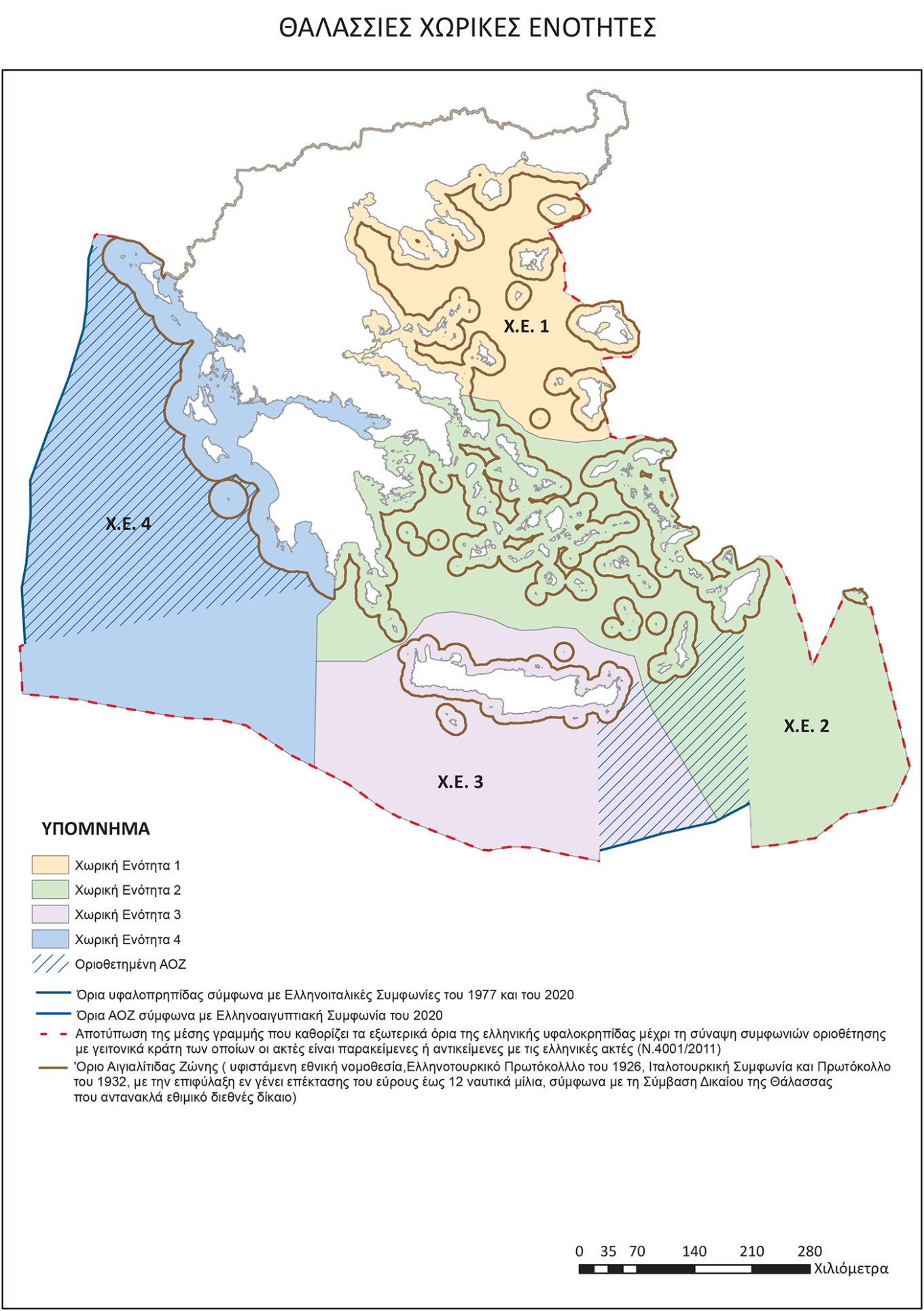
With the map that has been approved and made public, Greece effectively depicts for the first time its claims on the continental shelf/EEZ based on the Law of the Sea. This serves as the most authoritative response to Turkey’s unilateral attempt to impose faits accomplis by submitting to the UN the “external boundaries” of its EEZ, calculated based on the Turkey-Libya Memorandum, while also disputing Greece’s delimitation agreement with Egypt.
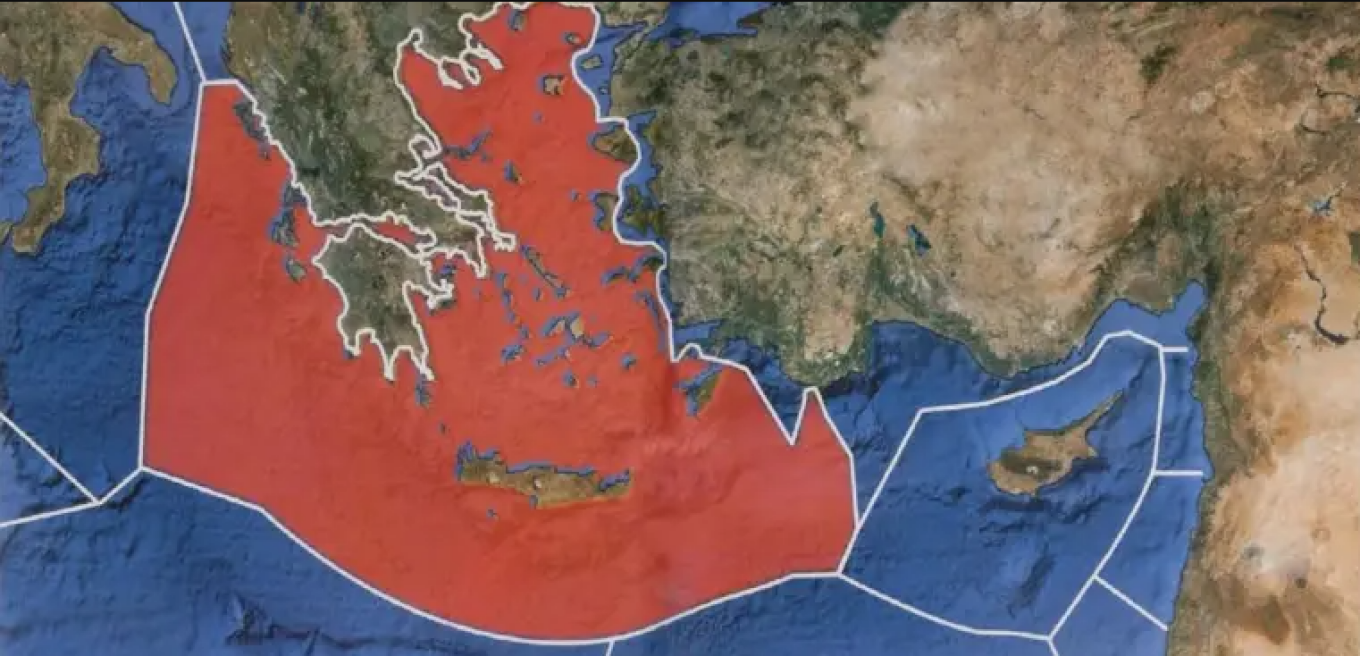
Turkey’s “nightmare,” otherwise known as the “Seville Map,” now also appears in an official Greek document published in the Government Gazette and submitted to the EU. Furthermore, Greece grants full effect to its mainland coasts, all its islands and islets, and Kastellorizo, thereby extending Greece’s potential EEZ up to the western boundary of Cyprus’s EEZ.
The so-called Seville Map:
The map also reflects the country’s existing territorial waters—12 nautical miles in the Ionian Sea and 6 nautical miles elsewhere—with a special note on “reserving the right to extend up to 12 nautical miles,” based on the Law of the Sea, which—as highlighted—is customary international law. This underlines the binding nature of the Law of the Sea, even for countries like Turkey that are not signatories to the Convention.
The approval of the MSP does not constitute a declaration or delimitation of the EEZ. However, by mapping the existing delimited boundaries and the potential ones according to the Law of the Sea in the remaining areas, Greece’s positions are now recorded in a European document and form the basis for any discussion with Turkey or Libya regarding the delimitation of maritime zones.
In the fall, when the Commission first released a technical map for Greece’s MSP, Turkey reacted strongly, declaring the map “unacceptable,” warning it would not accept any faits accomplis, and once again invoking the theory of “grey zones,” claiming that the map includes island formations of “undefined sovereignty.”
At a particularly delicate moment for Greek-Turkish relations, Turkey’s response to the approval of the MSP is of particular interest, especially with the upcoming visit of Kyriakos Mitsotakis to Ankara and the convening of the High-Level Cooperation Council.
It’s no coincidence that Milliyet, in its report today, referred to Turkey’s final steps toward publishing its own Maritime Spatial Planning, which, according to the paper’s sources, will be based on the “median line” between the two mainland coasts—thus fully depriving islands and islets of maritime zones. Naturally, Turkey’s plan will also feature its entire “Blue Homeland” doctrine, the Turkey-Libya Memorandum, and the unilateral and arbitrary definition of so-called external boundaries of its EEZ, which overlaps much of Greece’s and Cyprus’s continental shelf/EEZ.
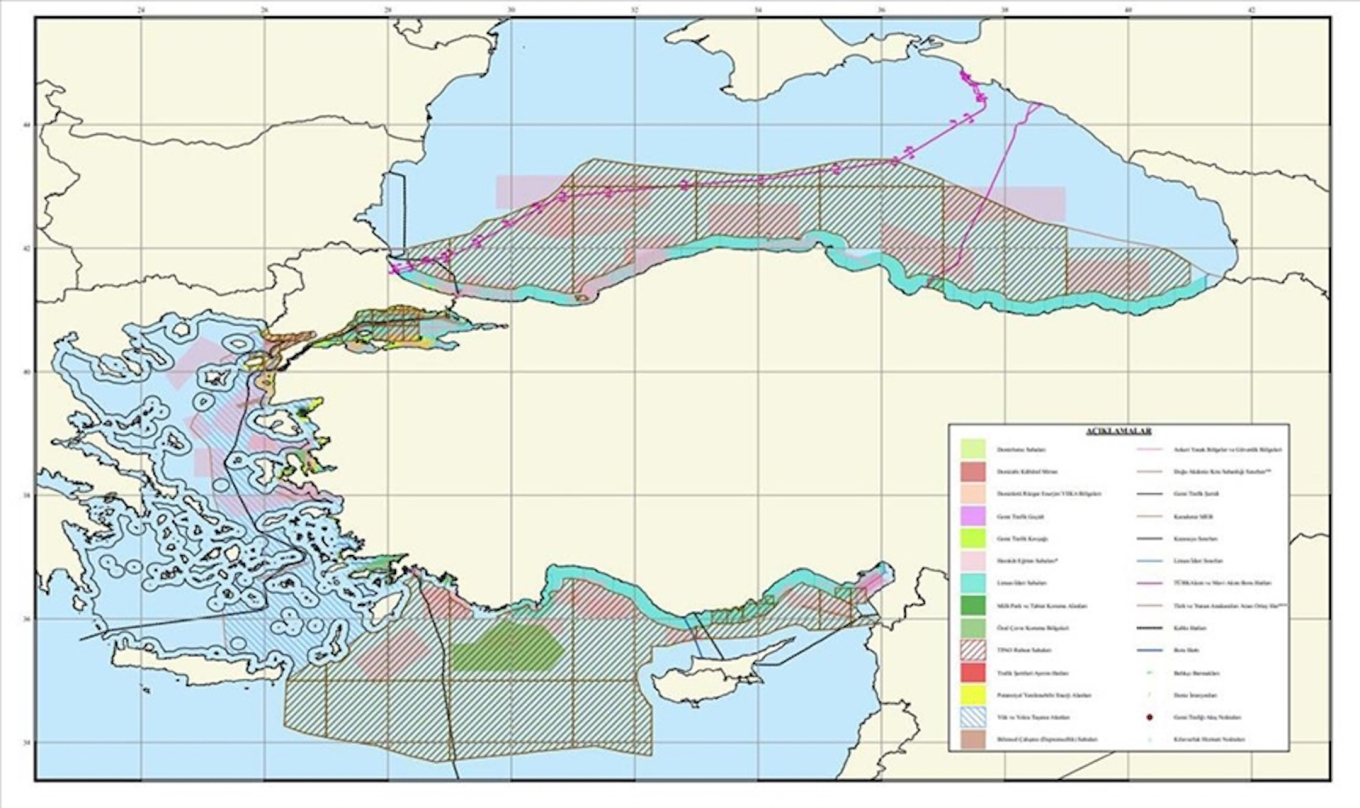
The Milliyet map that leaked following the Greek announcements
The approval of the MSP is not directly related to the issue of surveys for the laying of the Cyprus–Crete electricity interconnection cable, which have been postponed partly due to Turkey’s threats. However, it is a move that, aside from resolving a serious pending matter between Greece and the EU, sends the message that there will be no backing down from the sovereign rights granted to Greece by the Law of the Sea.
The approval of the MSP does not create an immediate obligation to carry out activities in the mapped areas—and theoretically at least, this might defuse a Turkish on-the-ground reaction. However, there’s no way of predicting how Turkey will choose to “send its messages.”
The Maritime Spatial Planning (MSP) outlines human activities across all maritime zones of Greece, with a focus on protecting the environment and promoting the sustainable development of marine areas and the utilization of maritime resources.
This process is outlined in Directive 2014/89/EU, and through it, Greece fulfills its European obligation.
The MSP defines all activities such as protecting the marine environment from the impacts of climate change—among other things—through the establishment of marine parks, the safeguarding of our cultural heritage, especially underwater antiquities, the improvement and protection of maritime transport, sustainable tourism development, exploitation of the country’s energy resources—especially potential natural gas deposits and offshore wind farms—the laying of pipelines and cables, aquaculture, and more.
Greece has been overdue in fulfilling this obligation to the EU, as the submission deadline for the MSP expired in 2021, and the European Court of Justice has issued a ruling, setting April 27th as the deadline for the approval and submission of the Maritime Spatial Planning. The plan had been completed by the relevant departments of the Ministry of Environment and Energy, but final political approval from the Ministry of Foreign Affairs was still pending.
Ask me anything
Explore related questions




