





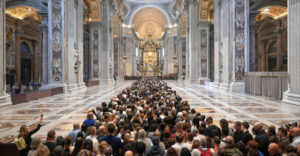
A huge influx of faithful continues to flood into the Vatican to pay their respects to Pope Francis, as his funeral is scheduled for 10 a.m. (local time) this coming Saturday.
The overwhelming number of visitors has sparked discussions about possibly extending the public viewing at St. Peter’s Basilica, especially after over 20,000 people accompanied Pope Francis’s body shortly before the succession process was set to begin.
Cardinal Kevin Farrell, the Camerlengo of the Roman Catholic Church, led the ceremony transferring the Pope’s body from the Santa Marta guesthouse to St. Peter’s Basilica, where it will lie in state for public viewing until tomorrow night as part of a three-day mourning period.
At the same time, the Pontiff’s funeral is taking on global political significance in addition to its spiritual importance for Christianity and millions of faithful around the world. U.S. President Donald Trump announced yesterday that he plans to meet with various world leaders while in Rome, as he and his wife Melania prepare to attend the funeral.
However, Trump said he is unsure whether he will meet with Ukrainian President Volodymyr Zelenskyy during the Pope’s funeral, though such a meeting is not out of the question given his recent remarks concerning Kyiv.
Meanwhile, amid mourning and prayers, thousands of Catholic faithful, including cardinals and other clergy, are visiting the Pope’s coffin — and are not being restricted from using their mobile phones to capture the moment. Four members of the Swiss Guard, dressed in their traditional red, blue, and yellow uniforms, stand vigil around the casket.
The Pope’s final wishes are being emphasized throughout the proceedings: he had requested a simpler funeral, avoiding the grandiosity of those held for his predecessors, as much as possible.
The Vatican announced that the 88-year-old Argentine Pope died of a stroke and heart failure. He was last seen on Easter Sunday, when he gave his traditional Easter blessing from the balcony of St. Peter’s.
Regardless, his death initiates a discussion about the future direction of the Catholic Church. Cardinals are expected to gather in Rome soon to elect his successor through the conclave — a millennia-old process.
Specifically, the cardinals — high-ranking church officials appointed by the Pope — will come from around the world to participate in the conclave, where Pope Francis’s successor will be chosen. Typically, this process takes two to three weeks, though it can extend if consensus proves difficult.
The voting process remains secret, but global attention will be focused on the Vatican, which had become more accessible and welcoming under Francis’s leadership. The sealing of the Papal Apartment in the Apostolic Palace, the Pope’s traditional residence, officially marks the beginning of the mourning period and the transition to the next papacy.
This period, known as the Papal Interregnum — the time between the death of one pope and the election of another — began with Francis’s passing last Monday. According to tradition, nine days of mourning (Novendiales) follow the death of a pope, and burial typically occurs between the fourth and sixth day afterward.
Pope Francis had expressed his wish to be buried in a simple grave in the Basilica of Santa Maria Maggiore in Rome. Additionally, an anonymous benefactor, as per his will released by the Vatican, will cover the funeral expenses.
Ask me anything
Explore related questions




