





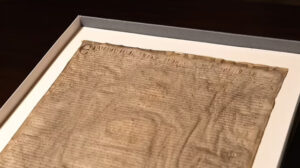
The value of a signature and a few lines of ink can surpass any imagination. And Harvard has just found a priceless treasure in its archives.
A manuscript, thought for decades to be a mere “copy” of the “Magna Carta” (Great Charter, also called the Magna Carta Libertorum or the Great Charter of Liberties), has turned out to be real. It dates from around 1300 and is estimated to be worth over $21 million.
Nearly 650 years later, in 1946, Harvard University bought the document at an auction for less than $30, without knowing its significance and true value, according to the Daily Mail.
How did he end up at Harvard?
Professor David Carpenter, an expert in medieval history from King’s College London, began studying unofficial copies of the Magna Carta when he stumbled across the digitised version on the Harvard Law School Library website.
He quickly noticed something unusual about this particular edition, however. He immediately contacted Professor Nicholas Vincent, a medievalist at the University of East Anglia, and together they began to compare the structure, size, and writing with the other six known originals to determine its authenticity.
The dimension of the document (48.7 x 47.2 cm) is perfectly consistent with the other authentic “Magna Carta” documents that have survived from the 1300s. In addition, the handwriting – especially the initial capital “E” of the word Edwardus and the elongated letters on the first line – are typical of original documents of the period.
Thanks to ultraviolet light and spectral imaging techniques, it was determined that the text was nearly identical to the originals, proving that Harvard is in possession of a rare, authentic historical relic and not just a forged copy.
The document appears to have once belonged to Rear Admiral Forster “Sammy” Maynard, who had inherited it through the Clarkson family, prominent British anti-slavery activists, and sent it to auction in 1945.
The importance of the “Magna Carta” as the original “document of liberties”
The Magna Carta was first drawn up in 1215 by the Archbishop of Canterbury on behalf of King John and was intended to make peace with the rebellious barons. and is credited with laying the foundations of many constitutions around the world.
Although the first edition was cancelled, it was reissued in 1300 by King Edward I, promising protection of church rights, restrictions on taxes, and access to impartial justice.
The “Magna Carta” is considered one of the foundations of modern democracy, constitutional law, human rights, and the rule of law in Britain. It includes, among other things, the right to an impartial trial and the limitation of the ruler’s power.
To this day, four of its clauses are still in force in British law.
According to Professor Carpenter: “Harvard’s Magna Carta is not just another old, soiled piece of paper.
The Magna Carta Charter is not just another old, stale piece of paper.
It is an authentic record of the freedoms of the past, the present, and what struggles are yet to be given.”
To date, it is estimated that only six original copies of the groundbreaking landmark document remain.
A similar original “Magna Carta”, auctioned in 2007, was sold for 19 million euros.
Appleby’s lost “Magna Carta”;
Investigators suspect the document may be the lost “Magna Carta”, which was sent to Appleby, a former parliamentary constituency in Westmorland. If this hypothesis is confirmed, it will be one of the most important archival discoveries of the 21st century.
Ask me anything
Explore related questions




