





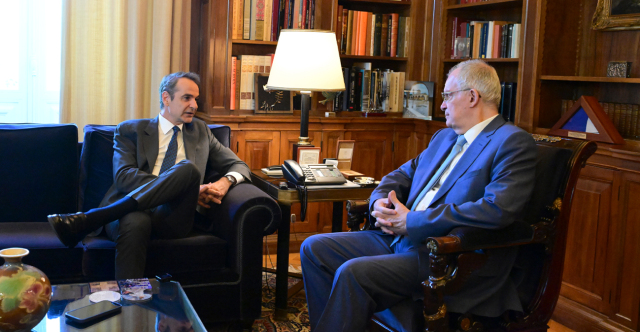
Kyriakos Mitsotakis characterized the subject of constitutional revision—an initiative he launched in an interview on Thursday—as important. As he said in his dialogue with the President of the Republic, Konstantinos Tasoulas, the process requires, by necessity, 180 votes in one of the two parliamentary ballots and thus demands parliamentary cooperation.
Referring specifically to the proposal to end the tenure of civil servants, the Prime Minister said that “it concerns the institutional enshrinement of performance evaluation—on the one hand, to reward those who are consistent, and on the other, if there are employees who systematically do not meet the standards, there should not be a constitutional obstacle to their removal from the public sector.”
“This sends a message of maturity regarding the responsibilities, rights, and obligations of public administration,” he added.
Mr. Mitsotakis also said, “We will seek revision of Article 86 on ministerial responsibility, Article 16 on higher education, and Article 24—without compromising on environmental protection matters.”
“I would like the process to begin in the next parliamentary session, but it’s important to start a public dialogue now and for the political parties to take positions, because the first Parliament will determine which articles are subject to revision. Since we are living in a polarized environment—not because of the government—I expect the parties to approach the issue responsibly,” Kyriakos Mitsotakis concluded.
“A constitutional revision should not seem like a theoretical exercise but rather an effort to improve citizens’ quality of life,” noted Konstantinos Tasoulas.
“The Constitution is a programmatic guide for parties. It is a framework that cannot be escaped,” he added.
“Even if the political climate is tense, the consensus aspect of constitutional reform should shape the atmosphere—not the reverse. Since you’ve kicked off this process, the discussion should be consensual. That doesn’t mean agreement on everything, but a consensual tone,” the President of the Republic emphasized.
“Even the Constitution’s mathematics demand consensus,” Mr. Tasoulas concluded. As reported earlier by protothema.gr, if an article receives more than 180 votes, it can be revised in the next Parliament with 151 votes. If it receives fewer than 180 votes, a 3/5 majority is required in the revising Parliament.
Health
The Prime Minister also referred to healthcare issues, in light of projects delivered through the Recovery Fund, as well as initiatives in digital health and preventive screenings. He noted that over 2 million citizens have participated in the “Prolambano” (I Prevent) program. “For me, this is an initiative that completely changes the way we view healthcare. The Ministry is called the Ministry of Health, not of Illness,” Mr. Mitsotakis added.
Full Dialogue Between Kyriakos Mitsotakis and Konstantinos Tasoulas
KYRIAKOS MITSOTAKIS: Mr. President, I wanted to begin our discussion today with the public statements I made yesterday regarding the upcoming constitutional revision process.
I consider it important that this is the subject of our discussion, as constitutional revision is the highest parliamentary procedure, which—as is well known—must take place across two successive Parliaments. To be completed, it requires at least 180 votes in one of the two ballots. Therefore, broad parliamentary consensus is necessary.
Yesterday, I spoke about the need for Article 103 of the Constitution to be deemed subject to revision. This article refers, among other things, to the constitutionally enshrined tenure of civil servants. I want to be clear that this initiative primarily concerns the institutional enshrinement of evaluation and the ability to reward diligent and hardworking public servants while ensuring that, in cases where employees persistently and systematically fail to meet their job specifications, there is no constitutional barrier to their dismissal.
I believe this is a significant initiative and a message of maturity in how we understand the responsibilities, rights, and obligations of the public administration—which should always serve the citizens.
Of course, this is not the only article we want to see revised. Indicatively, I mention the need for further modification of Article 86 on ministerial responsibility, Article 16 concerning higher education, and changes to Article 24—without compromising on environmental protection. However, I believe it is time to modernize issues related to spatial planning and urban development—and other articles to be discussed later.
I would like the process to begin in the next Parliamentary Session. I believe it’s crucial to develop a public dialogue now and for other parties to take a position on the matter, since the first Parliament will determine which articles are subject to revision, and the next one will define their content.
Given the environment of intense political polarization—not due to the government but to the choices of many opposition parties—I want to recall your previous role and stress that constitutional revisions have always been an opportunity to build bridges, not create new rifts. This is mandated by the Constitution itself, and I hope parties will approach the process with the required institutional responsibility.
I would also like to briefly refer—since I know it concerns you—to the significant reforms happening in healthcare. Many of the projects funded by the Recovery Fund are now being delivered to the National Health System and, by extension, to citizens.
I refer to interventions in the emergency departments of many hospitals, many health centers. Tomorrow, for example, I will visit Megara to inaugurate a fully renovated health center funded by the Recovery Fund.
There are also many digital health and preventive care initiatives, which I value highly. More than 2.5 million citizens have undergone some form of preventive examination through the “Prolambano” program, including the “Fofi Gennimata” program for breast cancer screening.
This is a huge innovation. We’re not just treating illness after it occurs—we strive to prevent it or catch it early. For me, this is a completely new way of thinking about health.
After all, it is called the Ministry of Health—not of Illness. So remaining healthy and preventing illness is a central policy priority.
KONSTANTINOS AN. TASOULAS: Thank you for that introduction, Mr. Prime Minister. Both topics are important. And to connect them, I was thinking as I listened to you, even healthcare is a constitutional issue.
There is an article—Article 21—which mandates the state to care for the health of citizens, especially the vulnerable, the poor, the youth, the elderly, and those with disabilities. I bring this up to highlight that constitutional revision should not be seen by citizens as an academic or theoretical exercise, but as an effort to improve their lives.
Everything included in the Constitution—property, environment, higher education, the efficiency of the public sector—all of it ultimately contributes to citizens’ quality of life.
I would dare to say, Mr. Prime Minister, that the Constitution is a programmatic directive to political parties regarding their policies. Party platforms may differ, but the constitutional framework cannot be ignored—we all swear an oath to it.
One of the current Constitution’s strengths—now the longest-lasting in Greece’s history—was that it was tailored to the people, the country, and its era. Now, it is time for the current era to define the changes.
I remember we always wanted each change to reflect the times and be ripe for adoption. I firmly believe, in my current role, that even if political tensions are high, the consensual dimension of constitutional reform should shape the political climate, not the other way around.
So, since you’ve kicked off the constitutional revision process, it’s worth ensuring the discussion remains consensual. That doesn’t mean unanimous agreement—but the tone and style should be constructive, as the Constitution itself mandates.
And one more detail citizens should know—though you’ve explained it broadly—constitutional revision in Greece follows a strict, structured procedure. It’s a unique achievement of this Constitution that all four revisions so far—and now a fifth—have followed its provisions. Before this, revisions were never so orderly.
So, this current Parliament, as the proposing one, will identify which articles to submit to the next Parliament, the revising one. Depending on whether they pass with over 180 votes or not, different majorities will be required for final approval. If over 180, only a simple majority is needed in the next Parliament. If under 180, a 3/5 majority is required.
Thus, even the Constitution’s arithmetic demands consensus. So health and constitutional revision are both closely tied to the Constitution, and I am at your disposal for further discussion of these important initiatives.
Ask me anything
Explore related questions




