





The “Grand Return” unfolds during the Cultural Revolution. In Zhang Yimou’s film, the central figure is Lu, a professor imprisoned for political reasons. When he returns home years later, he finds his wife suffering from amnesia. She doesn’t recognize him — she’s still waiting for her husband to come back — and he’s determined to help her remember.
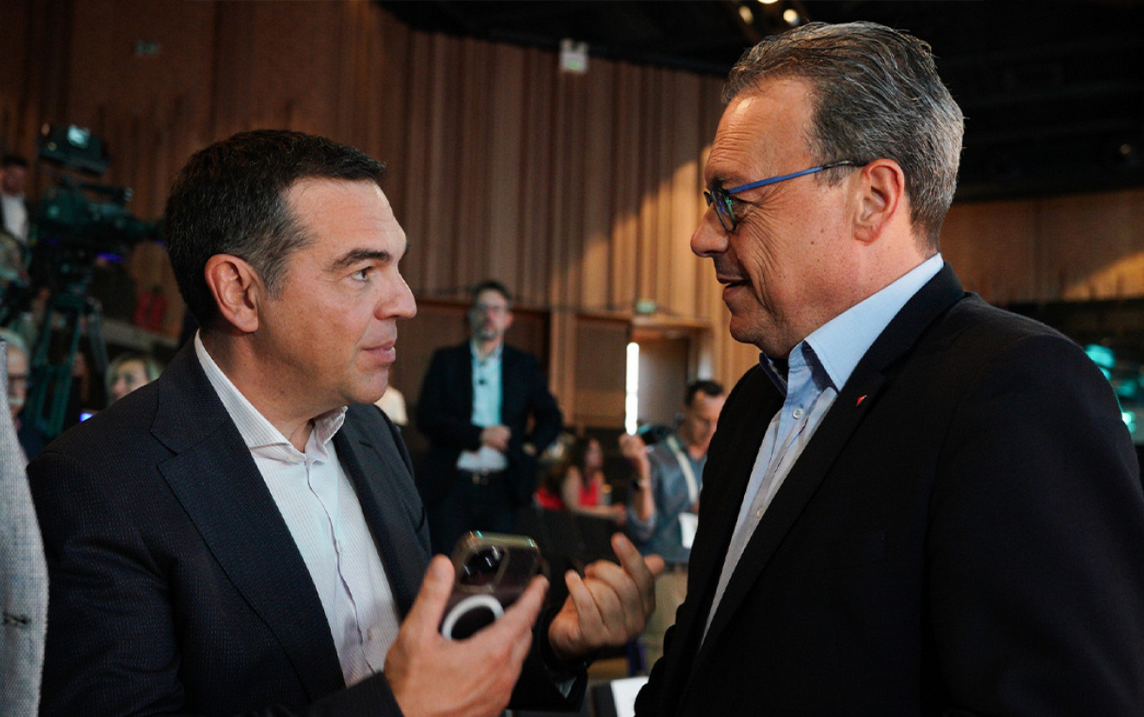
We invoke Zhang Yimou because Alexis Tsipras has expressed admiration for Chairman Mao. But more so because the former Prime Minister’s attempted return to the political spotlight could very well mirror Professor Lu’s journey.
In SYRIZA, New Left, and the parties of Kasselakis, Zoe (Konstantopoulou), and Varoufakis, they haven’t exactly forgotten Alexis — but many, for various reasons, would very much like to. And they want him to stay, as Konstantopoulou once put it, in his “burrow.”
Still, the former PM seems undeterred and determined to return. To make his former comrades remember — and “bow” to him as leader of a new party. Not just his old comrades, but others too, including voters from PASOK — although, according to polls, most don’t want to see him return. But just because they don’t want him today doesn’t mean they won’t tomorrow.
Public opinion is like the tide: ebb and flow. So is political fortune. One day you’re Onassis, the next you’re Thanasis. And going from Thanasis back to Onassis is exceedingly rare. The only one who managed such a comeback in modern Greek history was Andreas Papandreou — for reasons beyond the scope of this article, but certainly tied to Konstantinos Mitsotakis and the “dirty ‘89.”
Kyriakos and Alexis
Today, politics may have many flaws and abuses, but we don’t have a “dirty ‘89.” We do have a Mitsotakis — but his name is Kyriakos, not Konstantinos. Ironically, the son has become Alexis Tsipras’s political nightmare. Kyriakos has beaten Alexis in two national and two European elections. According to reports, he even prays at night for Alexis to return — because, as Kyriakistas say, his comeback would reignite the anti-SYRIZA sentiment, giving Kyriakos yet another win.
“A Tsipras comeback would be the best gift to Kyriakos, making him the first post-junta Prime Minister to win three consecutive terms,” says a senior government official. The reference to “terms” is significant, as Kyriakos’s late father also won three straight elections during the “dirty ‘89” era — but only managed to form a government once, with borrowed votes, and served just three years.
Tsipras certainly understands all these “prime ministerial” and political dynamics. Still, as one of his close associates puts it, “Knowing what’s right and not doing it is the greatest cowardice.”
Whether he’ll make his move before or after the elections is unclear — possibly even to Tsipras himself. His rebranding is going well, but it still needs work and time. Still, he’s preparing “for all scenarios,” says a reliable insider — as any politician aspiring to a leading role must do.
The Institute
In ten days, Tsipras will “strike again” through his Institute. On June 10, the day after Pentecost and two days before SYRIZA’s conference at the Athens Concert Hall, he’ll try to capture the center-left with… heavy artillery: American leftist senator Bernie Sanders (via video call), Ines Schwerdtner (co-chair of Germany’s Die Linke), former Italian PM Enrico Letta, François Ruffin (co-founder of France’s New Popular Front), Democratic Party of Italy secretary Elly Schlein, and Spain’s Yolanda Díaz (Deputy PM and Minister of Labor).
This lineup suggests Tsipras doesn’t intend, as rumored, to shift to the Center, but to stay within the Left — with a dash of left-wing social democracy. “He wants,” his aides say, “to capture the Center by charging from the Left.” Whether the plan works remains to be seen.
It will be tough, as both in Greece and across Europe, the political pendulum is swinging sharply to the right in these turbulent, Trumpian times. Moreover, especially within SYRIZA, many don’t feel comfortable with Tsipras’s return — including Pavlos Polakis, Nikos Pappas (both reportedly not on good terms with him), and the party’s current leadership.
For example, Sokratis Famellos won’t attend the Institute’s event — not because he’s necessarily opposed (though he likely is), but because he’ll be in Brussels. Alexis Haritsis, leader of New Left, is also uncertain to attend. George Papandreou, who did attend and speak at the Institute’s previous event, will not be there this time.
Naturally, if Bernie Sanders were attending in person (instead of via video), many center-left MPs and officials would have shown up — just to meet the iconic U.S. senator of the Democratic Party’s left wing.
SYRIZA and New Left
Speaking of Famellos and Haritsis — SYRIZA and New Left failed to agree on a unified stance for the Tempi train crash pre-investigation committee. Their split was driven by Kyriakos Mitsotakis. The core disagreement was whether or not the Prime Minister should be referred to trial alongside Kostas Karamanlis (of Achilleas).
New Left, per its political bureau, didn’t want to turn Mitsotakis “from perpetrator to victim,” while SYRIZA’s majority didn’t want to exclude him from responsibility. Some say SYRIZA’s stance was partly shaped by pressure from Konstantopoulou, Koutsoumbas (KKE), and Kasselakis (KIDIS), who all support referring the PM.
The prospect of SYRIZA’s 26 MPs signing a joint request with Kasselakis’s 6 MPs to form a pre-investigation committee on Mitsotakis sends chills down many in SYRIZA HQ. Some even called Kasselakis’s proposal to co-sign with KIDIS an “invitation to sin,” especially after Stefanos was ousted undemocratically from SYRIZA. That “sin” would become even heavier — maybe even damnable — if Zoe Konstantopoulou’s party joined in, given her continued attacks on Tsipras.
Yet some — including Tsipras and Alekos Flambouraris — reportedly agree with what Konstantinos Karamanlis once said when Mitsotakis referred Andreas Papandreou to court: “A prime minister is sent home by the people, not the courts.” In SYRIZA’s political bureau, Flambouraris, Stefanos Tzoumakas, Dionysis Temponeras, Giorgos Vasiliadis, and Christos Spirtzis (who is involved in the Tempi case) opposed referring Mitsotakis. Olga Gerovasili also objected to co-signing anything with Kasselakis or Konstantopoulou’s MPs.
Convergence and Louka
The disagreement between Famellos and Charitsis over whether or not to refer Mitsotakis to justice is not expected to derail the relationship between SYRIZA and the New Left. Certainly, new obstacles are emerging in the effort to achieve a strategic—and electorally beneficial—convergence between the two parties, but both Charitsis and Famellos want to keep the lines of communication open.
It’s no coincidence that the two men spoke late Thursday night, with Alexis (Charitsis) informing Socrates (Famellos) of the New Left’s final decision regarding Mitsotakis, and Socrates briefing Alexis on what was to be discussed in SYRIZA’s Political Secretariat and Parliamentary Group the following day.
It’s worth noting that beyond the headaches caused by the (alleged) return of Tsipras and the division over Mitsotakis, both parties also look unfavorably on Louka Katseli’s initiative for a joint ballot of the progressive opposition parties in the fall.
According to sources, the “joint center-left ballot” plan will essentially begin to unfold on Monday, June 2, when an event about the future of the center-left will take place in Patras, coordinated by Marinos Skandamis, secretary of PASOK’s Citizen Protection Department. Speakers will include Effie Achtsioglou (New Left), Haris Kastanidis (PASOK), Kostas Arvanitis (SYRIZA), Petros Kokkalis (leader of the Kosmos party), and Louka Katseli.
In the coming period, a Declaration will be made public, reportedly signed by notable figures of the broader center-left, such as Fotis Kouvelis, Antonis Roupakiotis, and others. Over the summer and beyond, the aim is to form Initiative Groups throughout the country via local events, to promote the demand for a “joint ballot.” Already, beyond Patras, a text in support of “a new progressive political subject” has been signed by around 150 members in Thessaloniki.
Such an effort is unlikely to bear fruit as long as it is led by individual actors rather than mass organizations, major social groups, political parties, and collectives. And certainly, the main reason is that you can’t ignite a world that has already been destroyed. Unfortunately, the world of the governing Left has been destroyed—due in no small part to some of those now claiming they want to reorganize it.
Not to mention that worse than seeing reality as bleak is failing to see it at all. And—unfortunately again—some simply don’t see it. They just describe it as “bleak” because for years now, they’ve been wearing black glasses. And while they claim to have swallowed an ocean of knowledge and new ideas for the emerging world, their political and programmatic output barely amounts to a teacup’s worth.
In any case, the proverb says that in June, they put down the sickle and sow the radish. We have no choice but to wait and see what “radishes” Tsipras, Famellos, Charitsis, and Androulakis will sow. In any event, the latest polls, by MRB and Pulse, showed that Mitsotakis won’t be “cut down” with sickles. They’ll need to come up with something else.
Ask me anything
Explore related questions




