





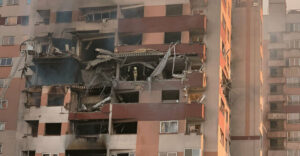
Israel’s sweeping strikes on Iran — the first with such intensity and success in the long history of hostility and unrelenting hatred between the two countries — bring yet another war front into focus in the Middle East. It is the third in succession, after Gaza and Lebanon. Tel Aviv and Benjamin Netanyahu never hid, from the events of October 7, 2023 and the “Black Saturday,” that Iran was the target and that the cost would be paid regardless of time, preparation, or the sacrifices the plan would require.
In a symbolic move — Friday, a day of prayer for Muslims — Israel launched hundreds of fighter jets from its bases with such precision that it suggests not conventional military planning, but an operation even more organized than the bombings against Hezbollah in Lebanon.
The Crucial Role of Mossad and a Sleeping Iran
Israel made it crystal clear and left nothing to the imagination when, just hours after the first strikes on Iranian soil, it released specific footage. In the video, members of the country’s intelligence services and elite military units are seen on Iranian territory with full equipment, supervising the initial strikes. Tel Aviv informed the media that the operation required months of preparation, as it had multiple targets and unfolded in several distinct phases.
Mossad agents appear to have spent many months organizing this complex operation, allegedly aided by inside cooperation. It’s worth noting this is not the first time Israel has severely exposed Tehran and its tight security measures: in July 2024, a long-wanted Hamas leader, Ismail Haniyeh, was killed in a bomb-rigged apartment in the Iranian capital.
Despite Iran’s theocratic regime tightening security significantly, Israel not only repeated a successful strike but this time hit consecutive military targets, Tehran’s nuclear program centers, neutralized the country’s most powerful military figure, and eliminated several key nuclear scientists. In under 11 hours, Tel Aviv, without any officially recorded losses, stormed through the heart of Iran’s vaunted “impregnable” security and control system, achieving something no one had ever attempted or completed before.
Where Did Israeli Jets Strike?
Tehran and surrounding military installations.
Natanz, where explosions occurred at the main uranium enrichment facility.
Tabriz, where blasts were reported near a nuclear research center and two military bases.
Isfahan, south of Tehran.
Arak, southwest of Tehran.
Kermanshah, west of Tehran, where a ballistic missile storage facility near the Iraq border was hit.
The Nuclear Program: An Overview
Natanz
About 225 km south of Tehran, Natanz is Iran’s main uranium enrichment facility and was one of Israel’s key targets. Damage appears severe. The site is partly underground and was recently reinforced.
It houses a wide range of advanced centrifuges, including modern models for producing highly enriched uranium. According to the International Atomic Energy Agency (IAEA), nearly 14,000 centrifuges are operational, with thousands more installed but inactive.
Low-enriched uranium is used for peaceful purposes, like energy production. Highly enriched uranium can be used in nuclear weapons.
Natanz has been attacked before — notably with the Stuxnet virus about 15 years ago and sabotage in 2021. Each time, Iran repaired the damages and upgraded its centrifuge technology.
IAEA chief Rafael Grossi confirmed last Friday that Natanz was hit but stated no radioactive leakage had been detected so far. He condemned attacks on nuclear facilities, calling them extremely dangerous, as he did in Ukraine: “Any military action that jeopardizes the safety of nuclear sites has serious consequences for the people of Iran, the region, and beyond,” he said to the agency’s board in Vienna.
Fordow
Iran’s most protected nuclear site, Fordow, lies near the holy city of Qom, deep within a mountain — around 800 meters underground — to shield it from airstrikes. There is no indication Israel attempted to hit it. Such an attack would require repeated use of specialized bunker-busting bombs, something analysts say is unlikely without direct U.S. support.
Fordow was a secret site until its discovery in 2009. It houses Iran’s most advanced centrifuges, critical for enriching uranium up to 60% — near the weapons-grade threshold. It is believed to contain around 3,000 centrifuges, mostly cutting-edge, with capacity for at least 1,000 more.
Parchin
Parchin is a military complex southeast of Tehran, where Iran has reportedly conducted high-explosive tests possibly used as triggers for nuclear warheads. Experts suspect past weaponization activity there.
Iran denies any such activity and has consistently refused IAEA requests for access.
Bushehr
Bushehr is Iran’s only operational nuclear power plant. Located on the Persian Gulf coast, it runs on Russian fuel.
Tehran’s Greatest Loss
Hossein Salami, head of the notorious Revolutionary Guards, was killed in a highly targeted strike. Israel had rare and precise intelligence about his location and timing, down to one of the many apartments he used. Salami, perhaps the most powerful man in Iran after the Supreme Leader, took extreme security measures, with his guards constantly changing his whereabouts — often known only to himself.
He played a key role in Iran’s nuclear program and was a major obstacle to the U.S. proposal for a nuclear deal recently offered by the White House and Donald Trump.
Salami was known for his hardline stance against Israel and the U.S. Since the 2000s, he had been subject to U.N. and U.S. sanctions.
The U.N. Security Council first sanctioned him in December 2006 for involvement in Iran’s ballistic missile program. The U.S. followed in October 2007, freezing assets under a presidential order targeting WMD traffickers and their supporters.
In April 2021, the EU imposed sanctions on him and seven other Iranian officials for their role in suppressing the November 2019 protests.
In September 2023, French prosecutors charged Salami, Quds Force commander Esmail Qaani, and Intelligence Minister Esmail Khatib for threatening lives and inciting terrorism against supporters of the Mahsa Amini protests — the so-called “Hijab Revolution.”
In April and October 2024, when Iran launched attacks on Israel with over 300 drones and missiles, Salami was the architect of every operational detail. In January 2024, Iranian media linked to the Revolutionary Guards showed him inspecting a missile facility linked to anti-Israel operations.
Ask me anything
Explore related questions




