





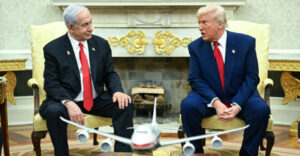
Until the early hours of the morning, journalists and television networks waited in vain for the US President to speak in the White House courtyard, where the press office had set up a microphone. This was regarding both the hour-long security meeting in Washington and the US President’s phone call with Benjamin Netanyahu.
At the same time, in a similar unusually long process in Israel, the Prime Minister of the country and the top ministers of his government, as well as the heads of the military, were planning under the same “silence” the next steps regarding the crisis in the Middle East and specifically Iran.
Through leaks, Washington noted that the President is now more than ever before in favor of continued bombing of Tehran and the Iranian border, and that the scenario of US involvement in the crisis is clearly on the table.
Upon leaving the White House, top officials of the Trump administration did not articulate anything at first, signaling that the President himself would “cover” all questions and answer all questions. Trump’s final choice to announce that he would not speak at throughout the rest of the day on the issue clearly generated more questions than he answered…
Trump today faces an extremely difficult decision, not only because he has to decide to become another President who will put the US into a war in the Middle East, but also because he has openly for several years now expressed himself outright against any of his predecessors who have done so. Since 2022 has even publicly criticized Republican Presidents who in the past have decided to engage in military operations in the Middle East, calling such moves “disastrous”.
The American President has before him a crucial choice for the future of the world – as we know it – and he seems willing to sacrifice even his campaign rhetoric regarding war conflicts, the one he has faithfully followed since the day he was elected and the one on which he has built almost all of his foreign policy actions. Trump should do a 180-degree turn at home and move from “if I were President, no war would have started” to “I’m starting one of the biggest wars of the 21st century too…
Whatever the decision, Donald Trump, who, among other things, called for the evacuation of Tehran himself and had no problem disputing his agencies’ report that Iran is not close to acquiring a nuclear weapon, has aligned himself perfectly with Israel’s narrative by giving a small sample of his intentions.
The task ahead for Trump is quite complex, but there is both fresh precedent and a detailed “guide” to both what followed the previous US engagement in the region and the political consequences for those who made the decision. In historical times, after all, 2003 and 1990 are but a few “minutes” away from today.
The crucial “Franco-British” factor
The US task will be considerably easier and the burden considerably lighter if, in the “bloc” being built in recent days, the French and British say “oui” and “yes” to the US invitation. Britain, which has already reinforced its forces in the Eastern Mediterranean and the Middle East, seems easier to be convinced that it must again be on the side of the US and Israel to defeat the Tehran regime.
Paris, on the contrary, seems and is now extremely difficult to acquiesce as in the early 2000s to a similar request from the US and Britain President Chirac had completely split his position before the invasion of Iraq. Emanuel Macron has no in the slightest inclination to get involved in such a war, and there is a strong possibility that he will openly do the opposite of what Trump currently wants as a prop.
Ask me anything
Explore related questions




