





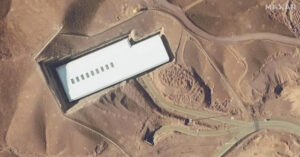
When Israel launched its attack on Iran on June 13, it invoked a critical argument: that Iran’s nuclear program had reached a “point of no return.” This claim, based on classified intelligence also shared with Western allies, appears to have mobilized not only Israel’s government but also its national security elite.
Although the full contents of Israel’s files remain classified, The Economist has obtained access to sources familiar with the dossier, offering a picture of its findings and their political weight.
Contents of the Dossier
Israel’s case rests on two core pieces of evidence, which it says demonstrate Iran’s accelerated march toward a nuclear weapon:
- A group of Iranian scientists allegedly concealed nuclear material of unknown enrichment level, not recorded by the International Atomic Energy Agency (IAEA). On June 9, the IAEA reported that Iran’s declared stockpile included over 400 kg of highly enriched uranium.
- These scientists were reportedly scheduled to meet with commanders from the Islamic Revolutionary Guard Corps’ missile division, suggesting the beginning of the “weaponization” phase—i.e., the coupling of a nuclear warhead with a missile.
This activity is seen as a continuation of the AMAD program, which Iran supposedly suspended in 2003 due to fears of a U.S. invasion. The updated structure now includes the SPND organization, officially operating under civilian covers such as COVID-19 vaccines and laser technologies. Israel points to the key role of Mohsen Fakhrizadeh, the former AMAD chief, who was assassinated in 2020.
The “Special Progress Group” and the 2024 Acceleration
The files refer to the formation of a “Special Progress Group”, tasked with rapidly advancing toward weaponization if ordered by Supreme Leader Ali Khamenei.
This activity reportedly ramped up in late 2024 due to:
- The limited success of Iran’s missile attacks,
- The weakening of Iran’s air defenses following Israeli strikes,
- The collapse of Iran’s allies in Gaza and Lebanon.
Why the Missile Meeting Matters
The planned meeting with the missile command is viewed as crucial. If verified, it suggests Iran has moved from theory to practice, entering the operational planning phase. Similar efforts were noted in 2011 by the IAEA, which mentioned modeling of nuclear warheads.
U.S. and IAEA Reservations
U.S. Director of National Intelligence Tulsi Gabbard told Congress in March that Iran has not approved a new nuclear weapons program. The IAEA’s Director General Rafael Grossi similarly stated recently that there is no evidence of a systematic effort to build a bomb. However, his agency did confirm the presence of undeclared materials at three Iranian sites.
Trump’s Stance and Internal Discord
Despite dissenting views, President Trump stated on June 17:
“I don’t care what [Gabbard] said — I think they were very close to getting one [a bomb].”
Figures in his administration, including former envoy Brett McGurk, acknowledge that only the U.S. has the capability to strike key installations, such as Fordow, a heavily fortified underground facility that remains untouched.
The Iraq Precedent and Today’s Risks
The 2003 Iraq War was justified by faulty intelligence about weapons of mass destruction. Today, similar concerns arise:
- Are the Israeli claims accurate, or are they shaped by political pressures?
Even if the intel is reliable, the fundamental question remains:
Has Iran truly crossed the threshold, or is it just closer than ever before?
Ask me anything
Explore related questions




