





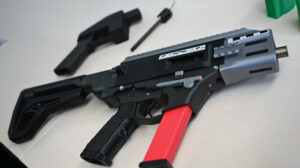
Three-dimensional printed weapons, also known as “ghost guns,” are no longer a science fiction scenario, but a reality.
With the help of a 3D printer (3D printer), digital blueprints, and simple, inexpensive materials, anyone around the world can assemble a functional firearm with no serial number, no license, and no tracking capability.
From internet platforms to the home
According to the BBC, popular social media, such as Facebook, Instagram, and Telegram, have been turned into trafficking sites for 3D-printed weapons and parts.
Despite company regulations, advertisements for guns appear on online platforms and drive users to private channels, where guns are advertised for sale and shipped around the world. Many of these gun ads directed potential customers to Telegram or WhatsApp channels.
One such example is “Jessy“, a Telegram seller who suggested the BBC send 3D-printed guns smuggled into the UK for £160 in bitcoin.
His communication was so direct, it raises questions about the boundaries between actual criminal intent and online fraud. The ability to advertise on Meta and operate on Telegram highlights obvious loopholes that real arms dealers could exploit.
Trivial weapons and ethical dilemmas
People seeking 3D-printed guns don’t have to buy ready-made ones through social media, as it is possible to assemble their own.
Designs for 3D-printed guns, such as the FGC-9, are distributed for free through websites and internet platforms.
These weapons are designed deliberately without commercially available components, making their detection nearly impossible. According to Dr. Rajan Basra of King’s College, this trend is turning ordinary citizens into weapon makers in their own homes, without requiring any special knowledge or expensive equipment.
As gun rights lawyer Matthew Larosiere points out, some are defending the dissemination of this information in the name of freedom. “It’s just information,” he states.
But the distinction between theoretical knowledge and practical application is becoming increasingly ambiguous, especially when there can be deadly consequences.
Myanmar: The example of the use of 3D weapons
Myanmar is the first and so far only country where the massive use of 3D printed weapons has been observed in active military conflict, with resistance groups manufacturing and using hundreds of FGC-9 (semi-automatic weapons), which cost dramatically less than black market machine guns.
However, their use was limited due to a lack of materials and the emergence of more powerful weapons, such as RPG (anti-tank rocket launcher or bazooka) and machine guns.
The example of Myanmar highlights the limitations of today’s 3D-printed weapons for military use, but globally, their proliferation continues at a rapid pace.
Several countries are considering laws to criminalize the possession of 3D printed designs for weapons manufacturing.
Manufacturers of 3D printers are being urged to prevent the printing of gun parts in the same way that regular printers restrict the printing of coins. However, the effectiveness of these measures is not completely guaranteed.
Ask me anything
Explore related questions




