





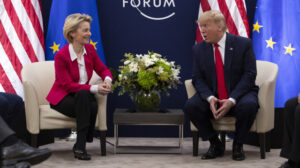
Under pressure to reach a trade deal with the US, European leaders at yesterday’s European Council tried to come up with a formula aimed at appeasing US President Donald Trump after agreeing to a historic increase in defence spending under NATO.
“Today, we received the latest US document aimed at continuing negotiations. We are examining it,” announced European Commission President Ursula von der Leyen.
German Chancellor Friedrich Murch encouraged the EU to quickly reach an agreement. The head of Europe’s largest economy wants negotiations to move quickly, even if it means accepting an asymmetrical deal under which the Europeans would accept some extra tariffs in return for nothing.
No one in Brussels believes that the goal of “zero tariffs” can be achieved. According to many European diplomats, the goal is probably to allow Trump to score a victory without sacrificing the essentials.
One of them raised the prospect of a “Swiss cheese” deal… with lots of loopholes. The EU could accept a general tax on European imports, but with a series of exemptions for key sectors such as steel, cars, pharmaceuticals, and aerospace.
A lesser evil for companies currently heavily affected by the customs tariffs already imposed by the US government: 25% on steel and cars, and 10% on most other products.
“France is in favour of a quick agreement, we don’t want this to last forever,” French President Emanuel Macron said after the 27-nation summit in Brussels. But, “if the Americans finally choose to keep 10% tariffs on our economy, there will inevitably be an impact on goods and products sold by Americans on the European market,” Macron added, arguing that Europeans are “neither naive nor weak.”
Time is running out as the July 9 deadline set by Trump approaches. If no agreement is reached by that date, the US president could double tariffs on imported European goods to 20% or even raise them to 50%, as he warned in May. However, yesterday the US administration indicated that an extension could be granted.
“We will not allow ourselves to be provoked, we remain calm, assured Belgian Prime Minister Bart de Bever, calling for a trade war with the US to be avoided.
Macron raised the stakes on Wednesday after a NATO meeting during which the Europeans agreed to increase their defense spending to 5 percent of their GDP, as Trump has called for.
“We cannot be allies, say we have to spend more on defense, and then wage a trade war within NATO, it’s absurd,” the French president said.
“The problem is that on the US side, we have an incomparable negotiator, while the EU has few competent leaders, Hungarian Prime Minister Viktor Orban.
The 27 EU leaders are divided: Orban says he has close ties to the U.S. president, as does Italian Prime Minister Georgia Meloni. Northern European countries are more inclined to avoid escalation at all costs.
The EU had threatened in early May to impose €95 billion in tariffs on US imports, including cars and planes, if trade negotiations with Washington fail. It has since backed down.
The US is also taking advantage of the negotiations to try to extract concessions on European regulations, particularly those relating to the digital sector, as Washington sees them as particularly hurting US giants such as Apple, Google, and Meta.
The US government is seeking a relaxation of European regulatory frameworks aimed at limiting the abuse of power by big tech in terms of competition, online content, and artificial intelligence.
Ask me anything
Explore related questions




