





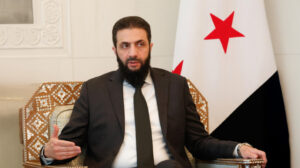
On December 9, 2024, the Bashar Assad regime was toppled, and Syria turned a new page when the Sunni jihadist group Tahrir al-Sham seized power, led by Ahmad al-Golani.
While the international community watched in bewilderment as the long-suffering country headed into uncharted waters, a few twenty-four hours later, the new strongman of Damascus decided to reassert himself.
In the first official announcements of the new regime, the new leader’s guerrilla present name “Al-Jolani” – referring to the place of his homeland, the Golan Heights – was “wiped out” and replaced with his real last name “Al-Saraa”. Over the months, the decision to change the surname of the new interim Syrian president was anything but random.
Reaching out to Turkey – Moving away from Iran
The first sign of Damascus’ new foreign policy came from Turkey, the first country to recognize the new Syrian regime and reopen its embassy. A typical example of the renewed, close Syrian-Turkish relationship was clearly demonstrated by the choice of the new head of Syrian diplomacy. The inexperienced 37-year-old Asaad Al-Saibani, who had just completed his postgraduate studies at an English-speaking private university in Istanbul, was appointed foreign minister. The frequent contacts that followed between members of the two countries’ governments increasingly confirmed political observers’ initial assessment that Syria was gradually turning into a “Turkish protectorate” – a conclusion that explained the new Damascus government’s tolerance of growing Turkish military influence in the country’s northern provinces.
At the same time, however, Iran decided to withdraw from Syrian territory, removing all traces of the Revolutionary Guards’ presence. The once “strategic”, as they were called, Damascus-Tehran relations have abruptly passed into the past, with the Iranian government media commenting critically on the fact that Syria is now controlled by Sunni jihadists. Thus, the first major shift in Syrian regional policy was a fact.
Syria and Israel are on track to normalize relations
Meanwhile, while the situation in Syria remained uncertain, the Israeli army took the opportunity to advance into areas of southern Syria, which it still controls today. What was striking, however, was the relatively mild tone of the new Syrian President with regard to this new fait accompli. On the one hand, Ahmad al-Saraa gave the impression that he wanted to appease Israel, expressing the view that “Israel should not be worried anymore, since Iran has now withdrawn from Syria.” On the other hand, even more striking was the fact that Al-Saraa, while calling for Israel’s withdrawal from the southern Syrian provinces, was at the same time refraining from calling for Israeli withdrawal from his homeland, the Golan Heights, which have been under Israeli control since the 1967 Six-Day War.
The “new Syria” proved to be equally tolerant of Russia, with the strong support of the previous regime, with the result that Russian military bases are still maintained to this day in Latakia and Tartus. At the same time, nothing has changed in terms of the US presence in the country, which continues to maintain its bases in the eastern Syrian provinces.
President Al-Saraa‘s private meeting with Donald Trump in Riyadh on the sidelines of his tour of the Gulf countries last May proved to be of crucial importance. Both the Saudi host, Crown Prince Mohammad bin Salman, and Turkish President Erdogan were present at the meeting via video conference. As the White House confirmed last week, that meeting launched the normalization of relations between the new Syria and Israel.
Damascus’ options under the microscope
A clear portent of the impending major new shift in Syria’s stance toward Israel were very specific choices made by Damascus during the recent“12 Day War” between Israel and Iran. Syria did not condemn Israel’s attack on Iran on June 13. Although it was impossible to react anyway, Syria chose not to even protest when Israeli air defenses were operating undisturbed in Syrian airspace to repel Iranian ballistic attacks. And, finally, Syria condemned the Iranian missile attack on a US base in Qatar.
Shortly before the Israel-Iran ceasefire, the White House, Israel, and the Syrian state news agency SANA confirmed that, during the “12-Day War,” Israeli and Syrian officials held daily contacts to determine the border line and the conditions for Israeli forces to remain in southern Syria. The ultimate goal of the contacts is the signing of an “Abraham Agreement” between Israel and Syria with a timeframe for the end of Trump’s term. And while all this is going on, what remains striking is the dumb acquiescence of Ankara, which seems to have secured the influence it sought by concluding its contacts with senior Israeli officials in Azerbaijan – a country that willingly assumed the role of Turkey-Israel “liaison”, apparently with the knowledge and probably with the encouragement of the State Department.
Servant to many “bosses”
Today, just six months after Syria’s regime change, it is observed that within its territory, all the major regional players are operating undisturbed: Turkey, Israel, Russia, and the United States.
Interim President Ahmed al-Saraa has decided that he must please everyone. However, the question that remains unanswered is, until when will he be able to please everyone? And more importantly, at what price?
Ask me anything
Explore related questions




