





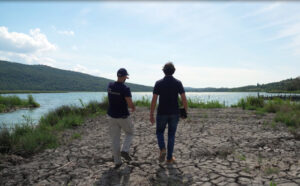
At the bottom of the Amvrakikos Gulf, the sea whispers stories of green zostera meadows. Stories that only those who listen attentively can feel and understand. They speak of a delicate and precious ecosystem that once stretched across the seabed. About zostera grasslands – the living lungs of the sea, absorbing pollutants and enhancing coastal resilience to climate change, and providing shelter and food for many marine species. These seagrasses are now coming back to life.
Nestlé Hellas and Enalaia, with the scientific support of the Department of Zoology of the University of Ioannina, have launched an environmental action programme, a marine mission that combines science, collaboration, and vision. The first pilot project for the restoration of zostera seagrass meadows in Greece is becoming a reality in the water, where it all began.
Initially, areas that could support zostera growth were identified, and others with healthy populations that could be used as donor sites. Thus began the process of transplanting. Through planting young zostera plants and monitoring their growth, the project aims not only to protect but also to restore the marine ecosystem. Most interestingly, at the forefront of this effort are young graduate students and researchers from the University of Ioannina, who are applying their knowledge in the field. With innovative techniques, continuous measurements, scientific methodology, but also enthusiasm and hope, they aim to reduce the pressures on the marine environment and provide valuable data for the protection and restoration of Zostera meadows.
It is no coincidence that this idea was born out of a partnership of different forces. Dionysis Karvelis, Project Manager for Enaliga, stresses: “This collaboration between a social enterprise, an academic institution and a large company highlights the need for collective action and scientific innovation, which is not only limited to environmental restoration but also to the empowerment of local communities, especially fishermen, who are a critical part of sustainable development.”
A commitment rooted in the sea
For Nestlé Hellas, this action is part of a broader sustainability strategy that includes the development and support of initiatives to tackle marine plastic pollution. Since 2019, the company has been working closely with Enalie in the Mediterranean Cleanup programme. The program focuses on the removal of marine litter in partnership with commercial fishermen, sorting, and recycling. In these six years, Nestlé has supported actions in the Argosaronikos, Thermaikos, Evian, and Amvrakikos Gulf regions. This year, it is reinforcing its fruitful collaboration with Enalie with the implementation of this new pilot project for the protection and restoration of the marine environment.
Nestlé Hellas CEO, Nikos Emmanouilidis, stressed: “This initiative reflects our commitment to sustainability and the protection of natural resources, while enabling the new generation of researchers to innovate and actively contribute to solutions for the future. Collaboration and knowledge sharing are essential to address the challenges of climate change.”
The participation of the University of Ioannina and its research team is crucial in the implementation of the project and its monitoring. The Professor of the Department of Biological Applications & Technologies, Mr. Ioannis Leonardos, said: “The University of Ioannina has scientific teams that are active in innovative techniques, aiming to apply them for the benefit of both the environment and the local society. Initiatives like this enhance the education of young scientists and contribute to the utilization of knowledge for the common good.”
The restoration of the zostera meadows is a first but essential step in the regeneration of the Amvrakikos Gulf. With this new initiative, Nestlé Hellas and Enaliea are sending a message of action for the protection of the sea and the future, through the preservation of a valuable natural ecosystem.
In Amvrakikos, where science meets hope, every zostera that takes root again on the seabed symbolizes the rebirth of nature that can become reality if we give it space, time, and care.
Ask me anything
Explore related questions




