






Dimitris Mavromatis was quite young when he read Andre Malraux’s quote that “art is a resistance to destiny”. To a scion growing up in the bosom of a very wealthy family, these words of the French writer might not have meant anything, but not when it comes to this particular Greek.
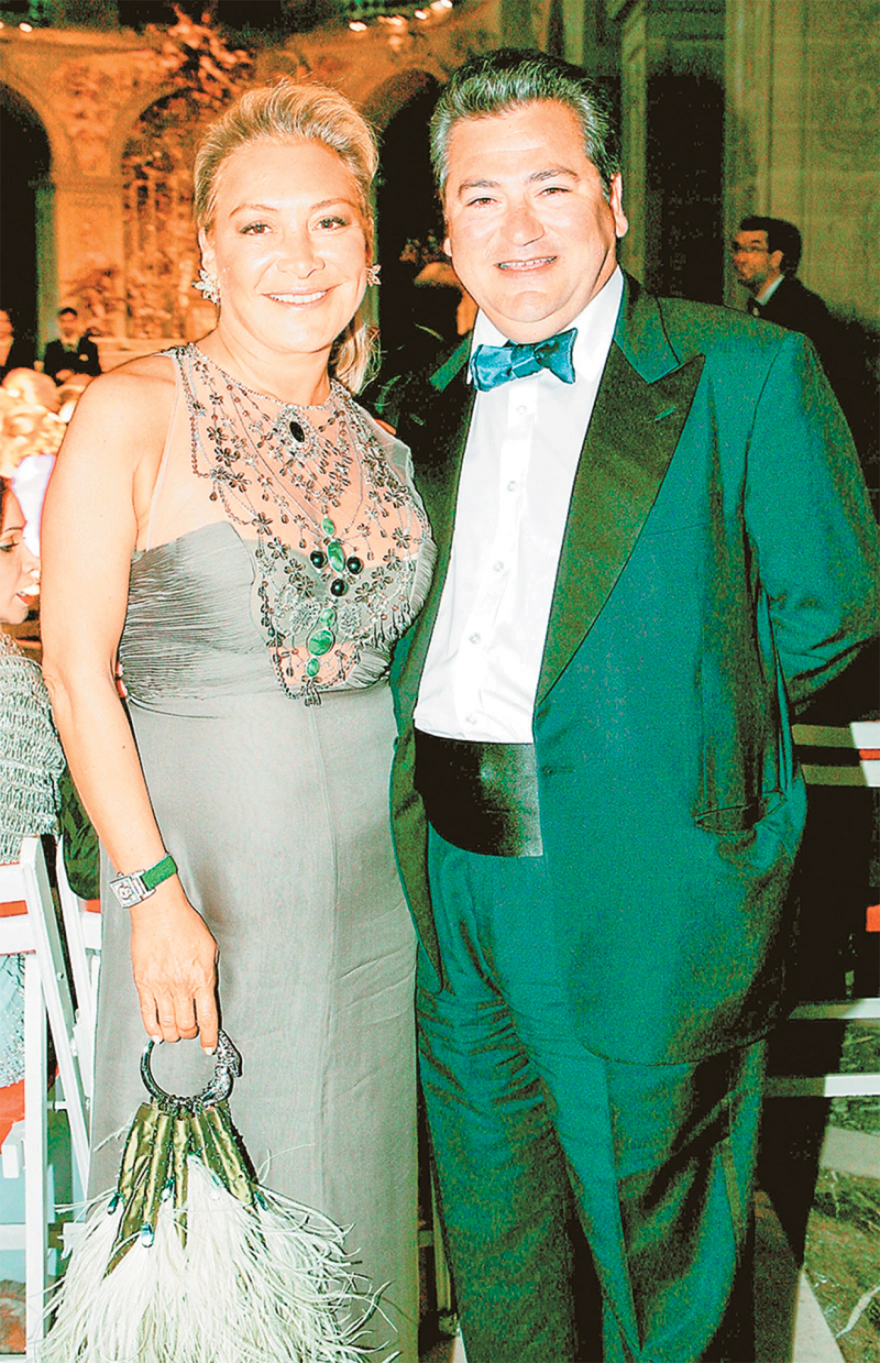
As his acquaintances say, Mavromatis can boast that as a teenager, he decided to go against his destiny. The one that wanted him to be the heir apparent to the vast trading empire built by his Constantinopolitan father, but which his son sold, earning hundreds of millions.
The last word, after all, was never of much importance to the Greek royal except in what had to do with his love of art or with specific investments. Proof? Even some of his iconic residences around the world are occasionally put up for sale by this selectively lonely billionaire. So it seems it’s now the turn again for his stunning villa in Mykonos, which is for sale via private sale, and according to reliable reports, the asking price for Mavromatis is €25 million.
In fact, according to leaks, interested parties are being informed that the owner of the villa is not entering the so-called “bargaining” process, something that at least two prospective buyers have realized so far. The amount is huge, say some people from the real estate sector. On the other hand, those who have been hosted or invited to the house in question describe it as completely justified. Dimitris Mavromatis is selling it at this price along with all the furniture, objects, and artwork that decorate the interiors of his villa in Choulakia.
This is the old villa of the late publisher Antonis Lyberis, but not the one that ended up with shipowner George Prokopiou. It remained unfinished when it was bought nine years ago by his late sister Liana Mavromatis after consultation with Dimitris.
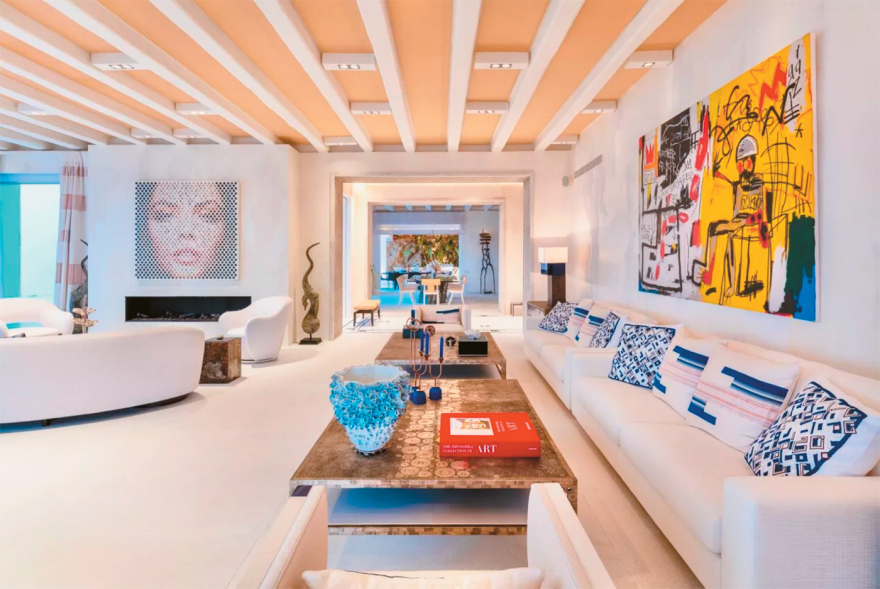
In addition to the cost of the purchase, the two brothers spent more than 3 million euros in order to finish, decorate, and furnish it with the best that was available on the market. The Francois-Xavier Lalane-designed bar alone, which friends and guests of the expensive collector face, costs over 6,200,000 euros.
It was bought by interior designer Liana Mavromati at a Sotheby’s auction in Paris and is a work of art made up of two porcelain ostriches.
The 1,500 sq.m. residence ideally combines design and art, as well as modern and traditional Mykonos style.
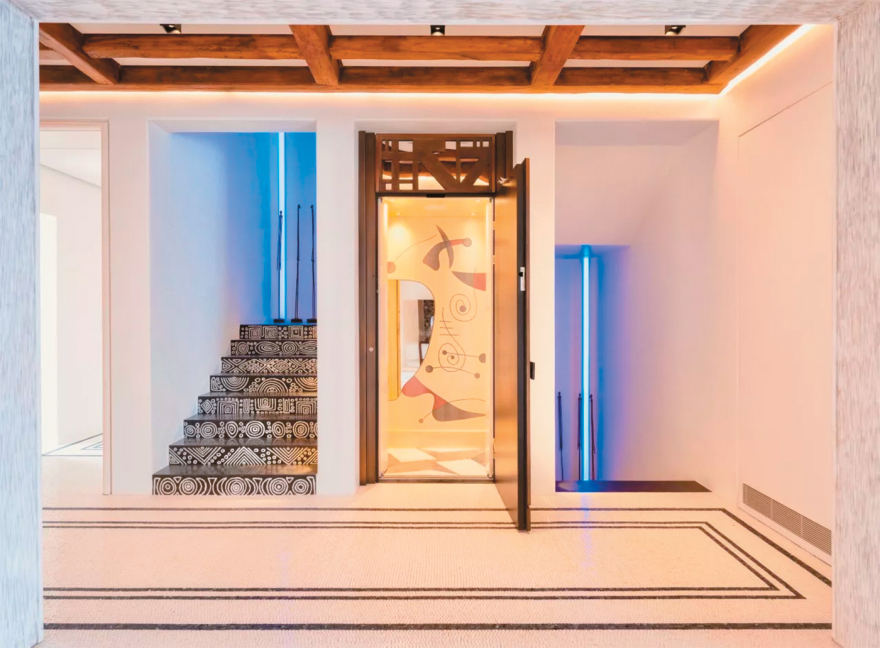
It has six bedroom suites and, of course, the master bedroom, seven bathrooms, the floors are made of marble tiles, while the golden entrance door was made by a French artist.
The loss and the decision
Destiny, which is what Mavromatis almost always wanted to face, struck him with a painful loss in July 2019. A sudden complication in his sister Liana’s health led her to the hospital, where she ended up after a short hospitalization, filling her brother’s heart with sadness. After the loss of Liana, Mykonos would never be the same for him again, and those who saw him five summers ago at the “Solymar” found that he had little appetite for company or conversation.
He has not yet been seen on the island this year, and his decision to sell his stunningly aesthetic villa, asking, reportedly, €25 million,n was much discussed in celebrity circles. The only thing visitors will not see in this residence is some of the dozens of famous works of art owned by Dimitris Mavromatis. He has chosen to keep away from the island the Picasso paintings he owns, works by Basquiat and sculptures by Giacometti worth millions of euros.
The restless collector
It was the last week of June 17 years ago, and the sun was shining in Monaco on the day of the opening of an exhibition of sculptures created by the late Sofia Vari-Botero. Among the guests from the international jet set and influential Greek patrons was Dimitris Mavromatis, then the world’s largest collector of 18th-century objects.
The news that pieces from his famous collection of porcelain were being auctioned off at that time had already become known in collectors’ circles, while the massive volume detailing the 86 objects had already generated cravings for all the pieces.
The sale of the six-storey residence that dominated Belgravia – it was in Chester Square – then reportedly fetched him a sum in the region of £40 million, according to leaks. This particular square in London is located in what is perhaps the most exclusive district of the city and is considered one of the most expensive in terms of real estate in the British capital.
That didn’t stop the son of the wealthy Istanbul businessman from selling it when he felt it had nothing else to offer him. Mavromatis had already earned the nickname “The Eye” thanks to his exceptional sense of smell, especially when he was looking for the rare Sevres porcelains, which he had adored since he was a young man still strolling through the antique shops of the Marché aux Puces in Paris.
Friends of the 67-year-old Greek businessman have to say about his sensitive character and the diversity that made him stand out in the art world. His father was a businessman and, as his career has shown, a very insightful one, as his Paris-based father saw far, more specifically to Africa. He traded coffee and cocoa from Cameroon, and business was so good that the business opened offices in London, Geneva, and Amsterdam.
Dying in 1977, he leaves behind an empire, the weight of which the then 19-year-old Dimitris, who had already begun to “fall in love” with antiques, is unable to bear. Fully aware that a wrong move could lead to billions of dollars in losses, he decides to sell the family business.
It took him just over a year and a half to close the deal, and he agreed to the sale when he was sure he would get the highest price. By the time the final signatures fell, he was now a young billionaire looking forward to opening his first brokerage firm in Geneva in 1981, at the age of 23. More would follow, but unlike his father, his passion was not business, but rare 18th-century porcelain and objects.
So these led him to seek out rare pieces, such as the famous black vase that dominated the cover of the auction catalogue of 1,986 of his items.
It is unique in the world, as are some other pieces from Mr. Mavromatis’ very large collection, which at one point lost count as it grew at a dizzying rate. The incident is typical when he approached the expert John Whitehead in 2004, having just purchased a magnificent 1770s Sèvres porcelain vase painted by Dodin, the greatest artist of the famous factory.
The vase was missing its cover, and Mr. Mavromatis asked Whitehead if there was another vase in this form from which a copy could be made. The latter did not have to look very hard to tell him: “Of course there is, you have that too!”. He had other, quite different and very expensive items, such as his diamond collection, of which he chose to auction 16 pieces.
Top of the list was the Graff Ruby, an 8.62-carat ring with a Burmese stone of exceptional clarity that sold for 9 million euros.
He owns more than five Picasso paintings, one by Francis Bacon, and has a work by the “heretic” Jean-Michel Basquiat in his collection. He remains unmarried and, as he has stated, if he does not have children, he will donate his famous collection to a museum, but not a Greek one, as he does not want his own to have the same fate as that of Alexandros Iolas.
Dimitris Mavromatis has never understood the financial crisis, having secured for decades the financial soundness that allows him to be bold, especially when he sets his eyes on a work of art. Being one of the richest Greeks abroad, he did not hesitate to lighten his bank account by 20,260,290 euros to own a Picasso at Christie’s auction in June 2011.
The Greek collector acquired the famous Spanish artist’s creation titled “Femme Assise, Robe Bleu,” showing Picasso’s mistress Dora Maar sitting in a chair and wearing a pink hat.
For the portrait of Dora Maar, Mr Mavromatis clashed with another collector whose name was not disclosed, and although the initial sale estimate was between €4.5 million and €9 million, the dispute sent the price soaring.
Eventually, through Thomas Seydoux, then head of the house’s Impressionist and Modern Art department, the Greek collector acquired the Picasso painting for just over €20 million. This work is the latest acquisition in his collection that includes stunning works by famous painters.
Picasso finished it in 1939, and by the time of the Christie’s auction,n it had only been exhibited once, in 1967, at the Beyeler Gallery.
Methodical player
Four years later, the brilliant and insightful collector remained calm on an evening when tensions had skyrocketed in Christie’s auction room. Being a well-known player and one of the most famous collectors in the world, he had to hit Alberto Giacometti’s rare sculpture “Tête de Diego sur socle” more than 18 times, which was appearing at auction for the first time.
His main rival was the British gallerist Simon Theobald, who tried to acquire for himself or a client the sculpture by the famous Swiss artist, whose works are prominent on the art market. The work, with a starting price of 2 million euros, quickly soared and gradually came up against only two contenders, the Greek collector and the British gallerist, who was eventually defeated by Mavromatis, who finally acquired it, eventually giving 4 million euros and proving for the umpteenth time that when he wants something he will get it.
Ask me anything
Explore related questions




