





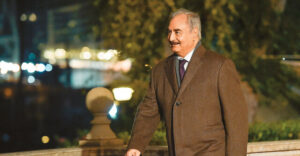
Gentiles from eastern Libya. Authoritarian, authoritarian, self-interested. He’s a marshal when he’s addressed as marshal. Flattered when he is called a strong man of Cyrenaica. At 82, the controversial Khalifa Haftar is a remnant of an outdated world of warlords, warlords, coup leaders, guerrilla militias, and Bedouin nomads. He is building his kleptocratic family dynasty in the richest oil-producing region of the country. He insists on projecting his brutal image as a bastion of stability in an abysmally divided, violently divided, and conflict-ridden Libya.

It continues to conceal beneath the military uniforms of disciplined centralisation and the conservative suits of diplomatic chameleonism the figure of a ruthless, ostensibly nationalist, chieftain. He declares unwelcome any European officials who do him a favour, as he is not internationally recognised, and they visit him. He is looking favourably on the possible adoption of the illegal and unsubstantiated Turkish-Colombian memorandum signed by the government in Tripoli, which he hates and which is dependent on Ankara. Almost in tandem with the efforts of Tayyip Erdogan, with whose Turkish troops he confronted with bloody ferocity in Libya, to gnaw away at Greece’s sovereign rights. After all, one would not expect any moral neutrality from an eminently untrustworthy personality.
“A Converging Threat”
Moreover, he has recently engaged in an “asymmetric threat” against Greece by instrumentalizing migrant boats from Tobruk arriving daily in Gavdos and Crete. From the 400-kilometre-long coastline of eastern Libya, which it controls, the migrant flows start with floating caravans where each passenger pays a minimum of €3,500 for their transport. However, he is not counting on sharing this money with the smugglers, whom he encourages. He is aiming for greater benefits. To extract a pile of euros from Europe to stem the mass migration flows, he is becoming an increasingly ruthless exploiter.
To receive, mainly from the West, the key to the international legitimacy of the de facto government of eastern Libya, which it controls, it is using the most illegitimate terminology. He is not a geopolitically realistic player in the troubled region. Although it is playing the role of a pillar of stability, it is acting as an adventurous pissant.
The Greek diplomatic authorities correctly diagnosed his ravenous houjas and warmly welcomed him as an “ally” in January 2020. It was on the moons that the “official”, recognized by the international community (UN, Brussels, USA), government of Tripoli had denounced as illegal the Turkish-Libyan memorandum concluded with Ankara. A government indefinitely anchored in power without elections, which cannot breathe without the air of Turkey, and above all, without the troops sent by Erdogan.
Haftar has been fighting hard against it since 2019. He advanced westward to take the Libyan capital, declaring that he would rid the city of “jihadist terrorists and criminal gangs”. He withdrew after fourteen months of fierce civil fighting in which all the rules and principles of international humanitarian law governing a war were violated.
Who’s in charge
Benghazi, late May 2025. North African landscape. The temperature is 35 degrees Celsius in the shade. In the halls of Benina airport, the dense haze of smoke is cut by the hajjari. A smoker’s paradise. The “no smoking” signs look more like a request than an order. Painted black and white taxis like teddy bears always, with dents in the doors, often without bumpers and permanently without working turn signals – in Tripoli, they are, by decree, painted yellow, but you can’t spot the difference there – serve the few visitors.
They take them to the half-destroyed city center, the old port and the inner harbor, which, after some 15 years of prolonged fighting and merciless conflict,t are in dire need of urban reconstruction and revitalization. Signs of prosperity in the area around the country’s largest oil reserves are non-existent.
The route is dominated by huge signs with giant posters that leave no doubt as to who is in charge there. On the poster is a face carved as if on an embossed embroidered kilim of a desert scene set in the sands of ancient Cyrenaica. With a stony, grim look like that of a stern military judge, he seems to have general supervision before issuing a sentence of condemnation.
However, his ubiquitous image of a hawkish nose and willful dimpled chin is extremely popular with the harried local population. Either out of fear of reprisals, or out of hope for stability and order in a lawless environment. He enjoys, moreover, the support of the great tribes of Awakir, Magarba, Barasa, Hasa, Obaidat, and Zidan. Local imams remember him in their prayers in the minarets.
Armed groups in the shadows of the urban landscape weave a despotic narrative of political power obeys them blindly. Khalifa Haftar is the undisputed leader in the landscape of eastern Libya. Although a proven greedy, abrasive, and brutal embezzler of the lion’s share of the domestic energy wealth, he is acceptable. For better or worse, he is considered charismatic.
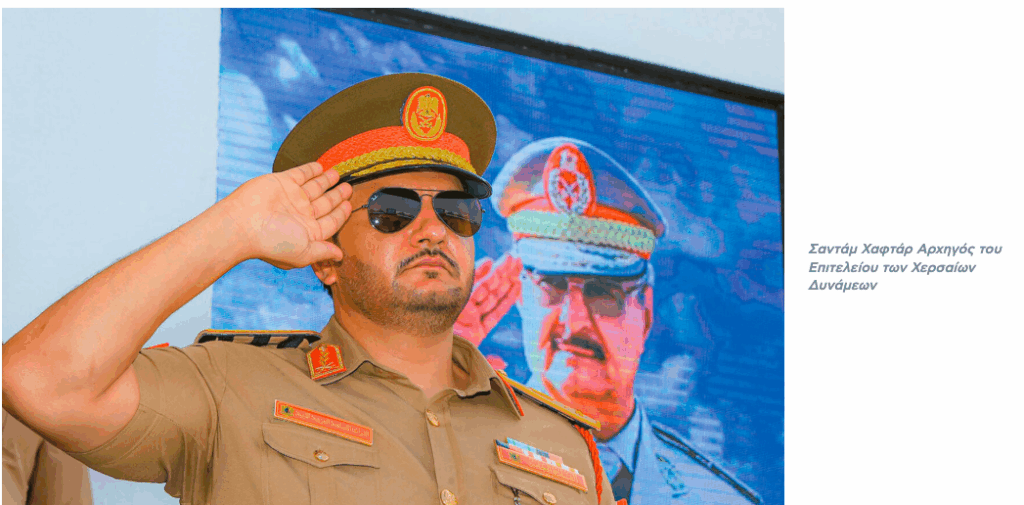
Meanwhile, with overt nepotism in favour of his clan, he has in the position of Chief of Staff of the Ground Forces – and his most likely successor – his youngest son, 33-year-old Saddam. Contemptuously ignoring allegations by Amnesty International that he had committed summary executions, created mass graves, practiced torture and sexual violence “without any fear of repercussions.”
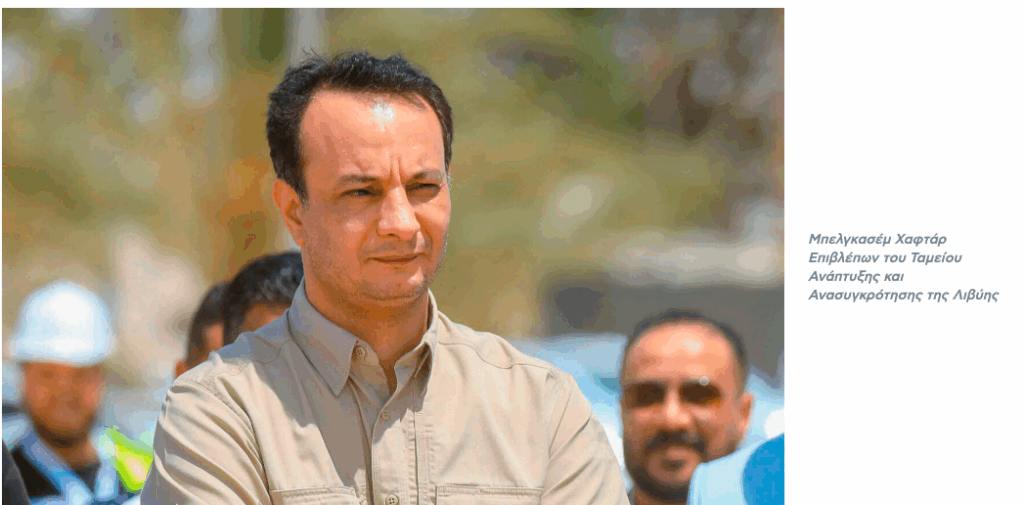
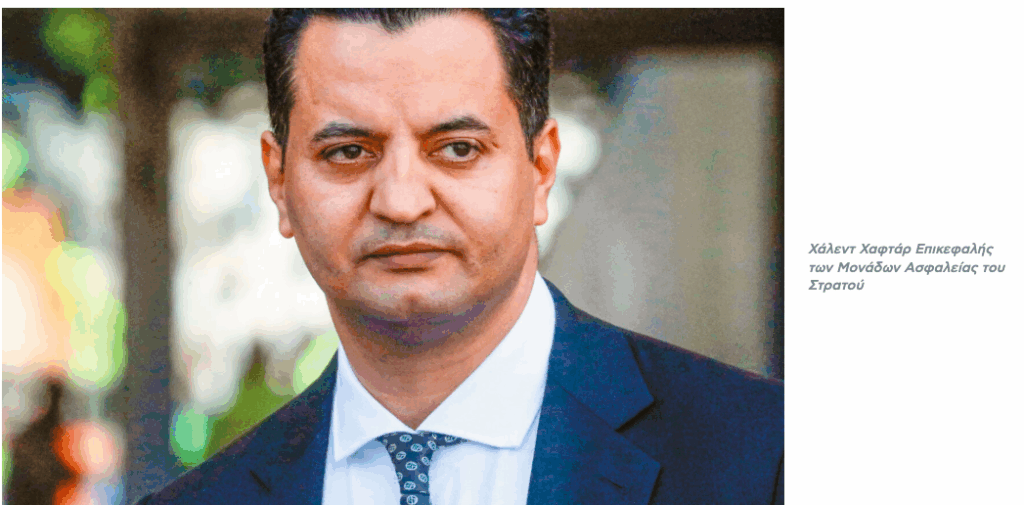
Another son, Halent, has been appointed head of Dad’s Army Security Units. A third, Belgassem, is appointed as his father’s top political adviser, overseeing Libya’s lucrative Development and Reconstruction Fund. All of his six sons and one daughter are comfortable under the third-world influence of the father’s family. He consolidates his power by appointing members of his family to critical and decisive positions of responsibility. After all, he believes he has his donkey tied up thanks to the implicit, but meaningful, public demonstration of diplomatic and material support from a portion of the international community.
The bullying of the Russians
At the military parade he organized this year on that warm May Day to mark the anniversary of Operation Dignity launched in 2014 to commemorate the capture of Benghazi, a group of his allies were discreetly present. In attendance were officials from Belarus, the head of Egypt’s intelligence services, Major General Hassan Rashad, government representatives from Niger and Chad, and most notably the Russian Deputy Defense Minister Yunus-Bek Yevkurov.
Responsible for training North Korean troops fighting in support of Vladimir Putin‘s claims on the Ukrainian fronts. With the Russians, after all, Haftar has a long history of privilege and bullying. Obtaining generous supplies of arms, military equipment, and Moscow-printed fake Libyan dinars to finance his war operations.
In return, after the Russians withdrew from Syria and the fall of the regime of Bashar al-Assad, he covertly granted them the land base of Maaten al-Sara, on the border with Chad and Sudan, to oversee and infiltrate the Sahel region. At the same time, it is strengthening its Russian activities by offering them the Al-Hadim Mediterranean air base east of Benghazi and Al-Kardabiya in Sirte. Not coincidentally, this June, two Russian warships visited Tobruk to “build” ties between the Libyan and Russian navies.
In effect, to put mortgages to “exploit” the vast coastal front in the east of the country? Moreover, they are seeking the immediate construction of a Russian naval base in Tobruk. No wonder about their grandiose ambitions. Haftar has a positive outlook from the outset. After all, he was recalled, so was the Marshal. He’s an independent, partisan, and untrustworthy man. He tears down and rebuilds bridges according to his ulterior motive.
He was weighed in detail, in depth, and very carefully by the Greek Foreign Ministry’s services during his “surprise” visit to Athens on that winter day in January 2020. They discerned the gluttonous arrogance of his character that wrapped itself around his neck like the scarf he wore around his neck during his stay at the Great Britain Hotel. And they treated him with similar diplomatic tact. Instead of giving him dinner in some elegant restaurant with strict protocol, they hospitably organized a dinner party with cutlets at the “Vlachika” in Varis.
As a slick servant to many masters and an eager recipient of financial sponsorship from several sponsoring states, the marshal has specialized, among other things, in the bulimic carving of roast sheep. Literally, but also symbolically. A skill rather incompatible with the parchment of a man trained at the rigorous Soviet Military Academy of the War College in Moscow. A mastery entirely incongruous for the same person who resided in exile for over 20 years in Langley, Virginia – coincidentally the CIA headquarters – as a dictator-in-waiting.
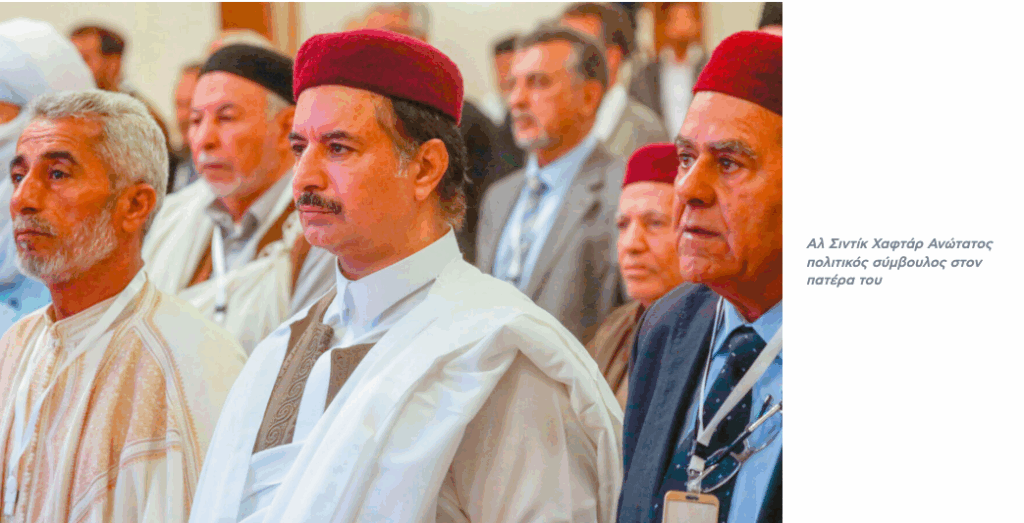
Then sentenced in absentia to death for high treason by a court-martial in his hometown, he was granted US citizenship and introduced himself as Hal Hafter. He was guided and zealously dedicated to the overthrow of Muammar Gaddafi, of whom he was a trusted friend and ‘right-hand man’. His only “break” in the leisurely American dream was his involvement in a failed guerrilla uprising in the mountains of eastern Libya in 1996, when he was nearly captured. He returned from his patient obscurity actively in the country in 2011 during the “Arab Spring” to play a leading role in the bloodier conflicts that followed the uprising, the fall, and the assassination of Gaddafi. In February 2014, he appeared on television and described in dramatic tones his plan to save the nation. He promised transparent electoral processes that the people are still waiting for.
Military purges
He was portrayed as the “secular” leader with strong anti-Islamist rhetoric, which somewhat softened his crude brutality in the eyes of international observers. The truth is that at the time, the country’s major cities were effectively taken over by the extremist local Isar al-Sharia group, an offshoot of al-Qaeda, the Islamic Caliphate, and instigated by the Muslim Brotherhood. It exterminated them with relentless brutality. It unleashed military purges with assassinations, bombings, sabotage, mass executions of prisoners, and massacres of civilians.
It indirectly won diplomatic favor from the democratic West and support from the soft Arab regimes. But a heroic boss of the whole country, he never became. Since then, plenty of water has flowed into the Gulf of Sirte, and endless dust storms have swept across the vast Libyan desert. Along with it came tons of blood. But for the cynical former career office,r it was the expected consequences of a brutal civil war. One that continues unabated in a country mired in an institutional vacuum and bogged down in a semi-anarchic state.
Gaddafi’s chief of staff
So here he is today, the self-appointed marshal of the self-declared Libyan National Army, based in Tobruk and with its stronghold in Benghazi, giving sharp orders like a dervish to his over-equipped troops, with Russian fighter planes, helicopters, and French missiles. A coalition, if not a patchwork, of armed nationalist units, local militant factions, tribal militia,s and the Tariq Ben Zayad brigades of the Sunni Salafi sect. Foreign mercenaries are close by. The Russians who replaced the late Yevgeny Prigozhin’s private paramilitary group “Wagner”, the professional “dogs of war” from Sudan and Chad, and the over-trained war business “contractors” from the United Arab Emirates.
All of them are standing in a sushi restaurant in front of an elderly mustachioed war veteran with health problems – he was hospitalized with a stroke a few years ago in an intensive care unit in Paris – who refuses to adapt to the modern world. Stubborn, arteriosclerotic and unrepentant, with his absolutism, widespread corruption and brutality, he departs arm-in-arm with the past. He melancholically recalls his poor childhood years in his hometown, the eastern city of Ajdabiya, coming from the Firjan tribal bosom.
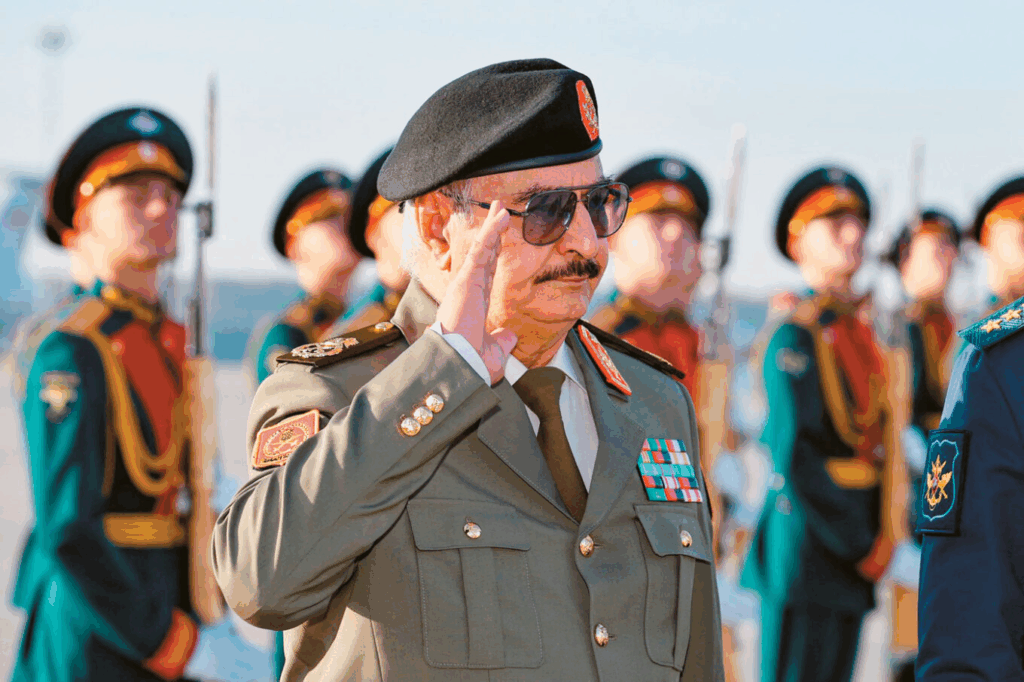
He longs for his initial subversive inspiration from the example of the leading figure in the Arab world Gamal Abdel Nasser who overthrew the Egyptian monarchy in 1952. He recalls glorious memories of his participation as a 25-year-old officer in the bloodless movement under his near-identical 27-year-old ambitious Lieutenant Colonel Gaddafi, who toppled the British-controlled puppet King Idris from power in 1969.
Just as the first and only – then 79-year-old Libyan monarch was taking spa baths in Kamena Vourla, renting 24 rooms at the local Galini Hotel for him and his entourage, he was dethroned in an instant. Haftar looks back with pride to those years when he was a member of his country’s “Revolutionary Council” and fought as head of the Libyan detachment alongside the Egyptians in Sinai during Yom Kippur’s 1973 war against Israel. And he does not forget his painful adventure in the mid-1980s. When as Gaddafi’s powerful chief of staff he took over as commander-in-chief of Libya’s “dirty war” in Chad. Where he bombed villages from the air with banned chemical gases and incendiary phosphorus bombs with a sense of impunity that he maintains unshaken to this day.
Unfortunately for him, in 1987, he was ambushed and taken prisoner with his 500 or so men, irreparably exposing Gaddafi, who had already signed an agreement to ostensibly end the war. The relationship between the two former comrades-in-arms was definitively broken. He settled after US intelligence actions first in Zaire and then in Kenya, where he founded the “National Front for the Salvation of Libya”, a purely US-driven vehicle for the violent overthrow of Gaddafi.
American passport
When Kenya drove him out in 1990 under diplomatic and trade pressure from Tripoli, and the Soviet collapse, the US “chariot” carried him family-style to the “land of the brave” and the home of the starlet. There, under the presidency of former CIA director George H.W. Bush Sr. he was oriented towards becoming the next Gaddafi.
To replace him at the head of the pompously named Islamic Jamahiriya, without his green book of ideas, his amazons and robes, with the fierceness of his military cloak and decorations. An aspiration that has not been withdrawn from the mind of the Marshal so far. But, just as well, despite his zeal, because of his philanthropy, he has not to this day renounced his American passport.
Who knows, it might come in handy for a self-obsessed individualist in stripes who, overwhelmed by his addiction to deals and transactions, wants to change the balance in the Eastern Mediterranean by strengthening Turkish influence. The one he fought tooth and nail against in his own country. It is possible that in his clientele, he is adopting the fantasy that he will never have true friends if he does not risk indulging his enemies.
Ask me anything
Explore related questions




