






We didn’t meet in “Yalom’s divan” – to borrow that expression – nor even in the psychiatrist’s chair of Stathis Bartzokas. We met in a café near his practice in Kolonaki.
It was noon. While we spoke, Bartzokas kept glancing at his watch. As unbelievable as it may seem, the man works between 12 to 14 hours a day, every day – listening, observing, and advising patients for nearly his entire waking life.
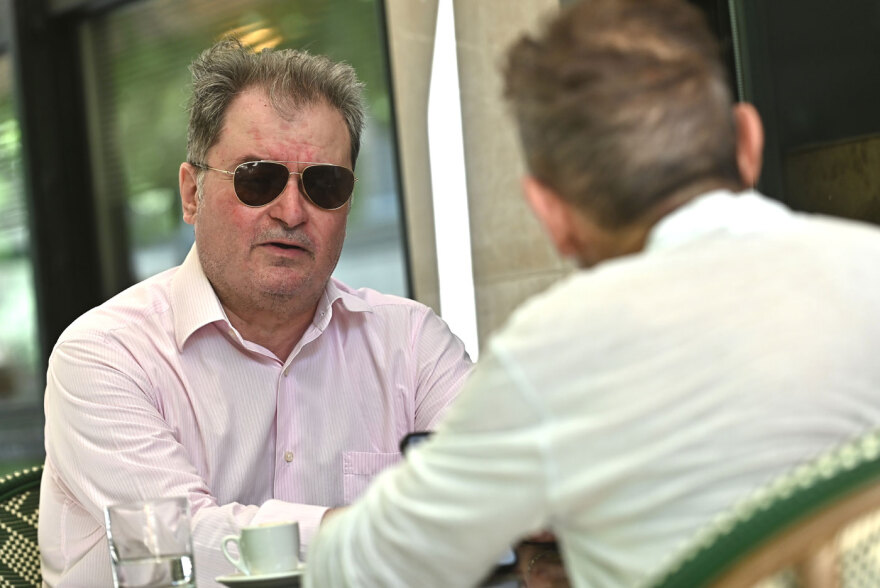
He exudes calm. What struck me was his intellectual clarity, his disarming directness, and his views, some of which may disturb the sleep of many public figures. His perspective is backed by hard global data:
- 30% of the global population suffers from some form of mental illness.
- 1% (or roughly 100,000 people in Greece) are schizophrenic.
- Donald Trump, he claims, has malignant narcissism.
- All politicians, including Greece’s 300 MPs, should undergo a psychiatric evaluation.
- The 2015 “No” referendum vote? A case of collective paranoia, with 62% voting to “destroy everything.”
And that’s only the beginning.
Scene 1: “Trump and the Narcissism Pandemic”
Dimitris Danikas (D.D.): You’ve spoken before about a “pandemic of paranoia.” What do you mean by that?
Stathis Bartzokas (S.B.): Paranoia, not to be confused with schizophrenia, is widespread, affecting roughly 30% of the global population. These are people who reject common sense. You see it among conspiracy theorists, anti-vaxxers… It’s not a Greek phenomenon; it’s global.
D.D.: What about Donald Trump? Is he paranoid?
S.B.: Trump suffers from narcissistic personality disorder. It’s evident. He manipulates, dominates, and commands. He has caused global upheaval. I’ve called this the “Trump Syndrome.”
D.D.Where does that narcissism stem from?
S.B.: Most likely his childhood. His upbringing shaped him into someone who imposes his will on others. Family dynamics and privilege played a huge role.
Scene 2: “I Can Destroy the Country”
D.D.: Is there such a thing as benign and malignant narcissism?
S.B.: Yes. Benign narcissists seek recognition without harming others. Malignant narcissists are like cancer. They walk over corpses to get what they want.
D.D.: Would you put Erdogan in the malignant category?
S.B.: Absolutely. He imprisons all his political opponents.
D.D.: Do such personalities come to your practice?
S.B.: All the time. You can spot them immediately. They come in with a dismissive attitude, “What can this doctor possibly tell me?” And they usually quit early.
D.D.: What about someone like Yanis Varoufakis?
S.B.: He’s certainly a narcissist. Whether benign or malignant is debatable. But his stubbornness over the “No” vote could’ve led us into civil war. He once proudly said, “Honey, I closed the banks.” What does that tell you?
Scene 3: “The Disease of Power”
D.D.: Are most politicians narcissists?
S.B.: Yes, either benign or malignant. Wanting to be seen, to be admired – that’s narcissism. Power only amplifies it: the bodyguards, the luxury, the ego-stroking.
D.D.: Have you treated politicians?
S.B.: Many, from different parties. Some had serious personality issues. Not necessarily psychiatric disorders, but strong narcissistic imprints.
D.D.: What’s the danger?
S.B.: A personality that places ego above all else can cause widespread damage.
Scene 4: “We All Need a Psychiatrist”
D.D.: What about Zoe Konstantopoulou?
S.B.: She still clings to the “No” ideology. She bullies nearly everyone she speaks to. When someone pointed out she didn’t have children, she turned it into a gender issue. But she engages in constant personal attacks.

D.D.: If she came to see you?
S.B.: She wouldn’t. But everyone, including her, should see a psychiatrist.
D.D.: What advice would you give her?
S.B.: Be less combative. Stop bullying. Understand what the “No” vote really meant. It was collective madness. If we had left the euro, we could’ve ended up in civil war.
Scene 5: “The Greek Votes Emotionally”
D.D.: Are these contradictions rooted in Greek psychology?
S.B.: Greeks vote with memory and emotion, not logic. We were promised the memoranda would be “torn up” – and people believed it. That’s not rational.
D.D.: Do politicians exploit this?
S.B.: Of course. Some even sell baldness cures and letters from Jesus. Velopoulos gets 9% of the vote. That’s his audience, not guided by reason.
D.D.: So, society is mentally unwell?
S.B.: Deeply. Look at the recent baby murders by mothers. This is not new, but it’s more visible now. Around the world, 30% of people suffer from mental disorders – depression, anxiety, addiction. And that number remains steady.
Scene 6: “Paranoid Personalities & Domestic Violence”
D.D.: What’s a paranoid personality?
S.B.: Someone who doubts everything. Always suspicious. They say things like, “Yes, but…” – questioning even the obvious.
D.D.: Does this affect relationships?
S.B.: Hugely – especially in marriages. Domestic violence isn’t new; it just wasn’t reported in the past. Now, women speak out.
D.D.: What about mothers killing their children?
S.B.: In cases like Pispirigou, there’s likely a genetic, antisocial personality disorder. One in 100 people is born antisocial. These people often become criminals, drug dealers, or gang members.
D.D.: So it’s in the genes?
S.B.: Yes. Just as myopia is inherited, so are violent or psychotic tendencies. You must study family history.
Scene 7: “The Rise of the Haters”
D.D.: Why do anonymous people insult and threaten writers online?
S.B.: Narcissism is everywhere now. Social media has made everyone think they’re stars. Haters feel important when they tear others down.
D.D.: Does it give them pleasure?
S.B.: Yes, it feeds their ego. It makes them feel powerful – “I told him off.” Rudeness is now normalized online.
D.D.: Have you met Tsipras?
S.B.: Briefly, before he entered politics. He achieved great things in his way. He may be a narcissist, but I don’t believe he set out to destroy the country.
D.D.: What do the 30% who suffer from psychiatric conditions vote for?
S.B.: The irrational, the extreme. Golden Dawn, Velopoulos – fringe parties on the far right and far left. They represent an escape from reason.
Epilogue: “AI Can’t Replace the Third Eye”
D.D.: Could AI replace psychiatrists?
S.B.: No. AI lacks empathy. A psychiatrist is a third eye. We see things machines can’t – body language, tone, behavior, deception, agitation.
D.D.: What triggers extreme jealousy?
S.B.: It can be a symptom of schizophrenia, when it becomes delusional. Like thinking your partner cheated in the 10 minutes you were gone.
D.D.: What about hallucinations?
S.B.: Hearing voices, seeing visions – classic signs of paranoid schizophrenia. Many in religious settings suffer from this and mistake it for divine messages.
Final Words
D.D.: Are the mentally ill outside, not locked away?
S.B.: Exactly. Mental hospitals no longer institutionalize for long. Of the 100,000 schizophrenics in Greece, maybe 500 are admitted. The rest live among us.
D.D.: Where is psychiatry today?
S.B.: It’s the new “trend” in medicine – and that’s dangerous. Too many “mental health consultants” are unqualified. Psychologists aren’t doctors. Life coaches play therapist. It dilutes the profession.
Conclusion:
In a time of emotional voting, rising narcissism, and untreated mental illness, society – Greek and global – teeters dangerously on the edge of reason. Stathis Bartzokas doesn’t sugar-coat it: We are living in a world where the lunatics are not locked away. They’re leading us.

Ask me anything
Explore related questions




