





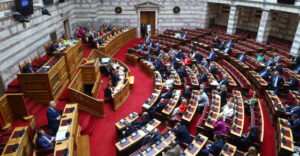
With dramatic developments, unprecedented scenes, and a parliamentary session that ended well past midnight, the heated two-day debate in Parliament over the OPEKEPE (Greek Payment Authority for EU Aid Schemes) case concluded with the ruling New Democracy (ND) party choosing a “hybrid” approach. Not all its MPs voted, yet it did not fully abstain either, aiming to avoid procedural invalidation. As tensions rose – especially after PASOK requested a postponement – the Speaker proceeded with the vote, the entire opposition walked out, and ND MPs were left alone to reject the formation of a Preliminary Investigation Committee.
PASOK’s Motion to Postpone the Vote
According to protothema.gr, while the official ND line was to abstain, the party was informed that the opposition intended to challenge the vote’s validity due to absences and would call for a postponement. The strategy was then revised: a few ND MPs remained in the chamber, and others had submitted absentee ballots to ensure the necessary quorum and procedural legality.
Tensions After Midnight
Tensions peaked after 12:30 a.m. when PASOK’s parliamentary representative, Dimitris Mantzos, officially requested a postponement of the vote due to procedural irregularities. At that moment, only a few ND MPs were present in the chamber, standing by as opposition representatives argued with Deputy Speaker Giorgos Georgantas. Georgantas declared that the required quorum of 75 MPs was present, allowing the process to proceed.
This led to the implementation of the government’s main strategy: ND neither fully participated nor fully abstained, ensuring that the required 151 votes to form a Preliminary Committee were not reached. In the end, ND was alone in rejecting the committee’s formation. Parliamentary sources from ND criticized opposition parties for walking out instead of staying to vote for their own proposals.
Empty Seats
The government’s choice to propose a Parliamentary Inquiry Committee instead of a Preliminary Investigation Committee was evident in the low attendance during the debate. Only a few dozen MPs were present to hear from Makis Voridis and Lefteris Avgenakis. Following Avgenakis’s lengthy speech, most MPs left, and only a handful remained through the early morning hours. The few ND representatives present included parliamentary spokesperson Notis Mitarakis, parliamentary group secretary Apostolos Vesyropoulos, MP Giorgos Amyras, and Justice Deputy Minister Yiannis Bougas – all nearly alone in the government benches.
ND MPs who spoke during the debate firmly argued that the Parliamentary Inquiry is the most appropriate method for a comprehensive investigation of OPEKEPE’s operations from its founding to today, rather than limiting the scope to the party’s actions over the past six years.
Voridis and Avgenakis Defend Themselves
The main figures of the day were Makis Voridis and Lefteris Avgenakis, who had not previously addressed the part of the case involving them. Voridis argued that since no specific act (crime) was described, and no direct perpetrators are being prosecuted, it is unjustified to call for charges against him for complicity or instigation. He rejected the accusations, and regarding former OPEKEPE president Grigoris Varas, he noted that Varas is under scrutiny merely for requesting a subordinate’s resignation.
Lefteris Avgenakis went on the offensive, calling PASOK’s proposal legally groundless. He criticized former OPEKEPE administrator Simandrakos for problematic payments made during 2022–2023. Avgenakis also targeted PASOK leader Nikos Androulakis, with whom he shares roots in Heraklion, and accused PASOK members of involvement in irregularities with agricultural subsidies. He even brought up the son of former Prime Minister George Papandreou, claiming that PASOK cannot pretend to be unaware of what has been happening in the field of farm aid.
The Parliamentary Inquiry Committee is now expected to be formed in September, but opposition parties have raised concerns that delaying the process could allow potential crimes to fall under statute of limitations rules, potentially shielding those involved.
Ask me anything
Explore related questions




