





In the summer of 1984, in a Greece where PASOK dominated and “handed out” money, the climate of euphoria and prosperity that prevailed in the homes of urban centers, neighborhoods, villages, and islands did not exist at all in a residence in Varkiza.
On a warm day that summer, 38-year-old Dimitris Konstantaras visited his father, Lambros, who, after suffering a severe stroke—the second in just a few years—was no longer the charming star of cinema and theater.
He was “the recluse of Varkiza,” according to magazines and newspapers of the time, facing speech and mobility problems, and not wanting anyone to visit him except his son Dimitris.
The latter was already a successful journalist and co-host with Elena Akrita of the ERT program “Kiriakatika,” a flawless master of language and grounded despite being widely recognizable.
Growing up as the child of divorced parents, Dimitris Konstantaras did not enjoy his father as much as he would have wanted as a boy—something he admitted years later in an interview.
In the twilight of the actor’s life, he would go as often as he could to Varkiza to see the father he missed, who, after a brilliant career, was experiencing in harsh terms the last years of his life.
He spoke to him, sat with him, and longed to take him on a walk—one of those walks he had dreamed of as a little boy living with his mother, Youli Georgopoulou.
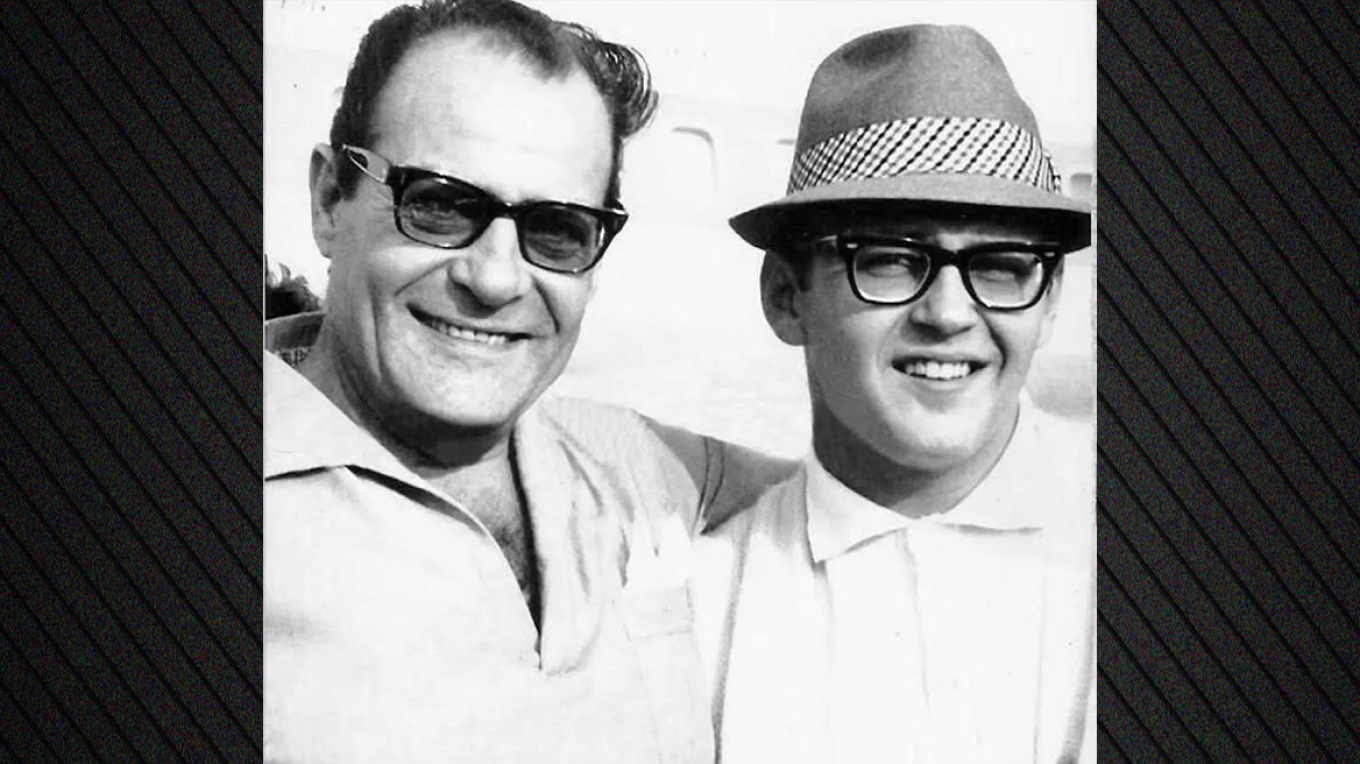
Lambros Konstantaras had divorced his wife after only four years of marriage, and his son searched for him daily, as all young children do at that age.
Perhaps that is why—helped also by a photograph capturing the moment—he always remembered the walk to Faliro when he was three years old as one of the rare few, while later he left Greece for some years.
He finished high school in the United States and returned in 1968 to study at the Faculty of Philosophy at the University of Athens.
At that time, his father was a famous star of theater and cinema, while he himself was just beginning his own path.
Writing and television
For a time, he linked his career with that of his father, when he began working with him by writing texts and occasionally music for his films and theatrical plays.
Father and son grew closer, although the former disliked the latter’s beard and relatively long hair. Still, he accepted his father’s advice not to become an actor.
He chose journalism and proved to be an excellent master of words, with texts that stood out, while on television he became an outstanding presenter and anchorman.
Apart from news broadcasts, he excelled as head of ERT’s sports department, later worked at MEGA and other channels, and also loved radio.
He helped young people a great deal—something evident in the moving farewells from Christos Sotirakopoulos, Eleonora Meleti, Giorgos Liagas, and many others, only hours after the announcement of his passing.

His love with Vicky Vourlaki turned out to be very strong—they would have celebrated 60 years together soon—and their marriage gave him two children, Lambros and Pavlina, whom he deeply cherished.
He became involved in public life, first in the 2002 prefectural elections where he was elected councilor, and two years later as a Member of Parliament with New Democracy.
He enjoyed engaging with public affairs, wanted to remain active, but never chased interviews just to appear on television. In the last two years, he faced health issues but smiled whenever the whole family gathered together.
At the Botsis Journalism Awards ceremony in May last year, Dimitris Konstantaras entered the hall with his breathing device hanging on his shoulder and oxygen tubes in his nose.
He was to receive an honorary award for his contribution and wanted to accept it himself despite his health problems. When his name was called, he did something no one expected: he removed the tubes, left the machine waiting for him—according to the testimony of Maria Panagopoulou, widow of Kostas Hardavellas, who was present—stood up, and walked proudly to receive the award, smiling for the photographs.
That is how he will be remembered by those who knew him, lived alongside him, and loved him.
Ask me anything
Explore related questions




