





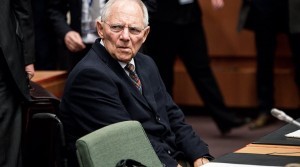
German Finance Minister Wolfgang Schauble quoted Goethe to declare that “one should take care and mind their own business” when Finance Minister Yanis Varoufakis referred to the issue of German multinationals involved in kickbacks vis-a-vis Greek state contracts in past years.
The reference aimed squarely at Siemens, amongst others, a German corporate giant that was allegedly involved in bribery and money laundering activities related to the then state-owned telecoms utility in Greece, OTE. On the most basic level, Siemens has been proven to have donated one million deutschmarks to then ruling socialist PASOK party, giving the cash to a former top aide of then PM Costas Simitis, one Theodoros Tsoukatos. The latter said he gave the D-marks to PASOK; PASOK’s bookkeepers claim they never received the “donation”. On another occasion, Siemens donated money, in the six-figure range, to the campaign fund for a PASOK politician serving as transport minister, one Tassos Mantelis. As of 2015, neither man has been convicted of any wrongdoing.
At the meeting with Varoufakis, Schauble said h disagreed that a joint international enforcement of anti-corruption laws was necessary to tackle the problem.
He is no stranger, however, to corruption as it was his party’s political financing furor that may have been a force in the rise of German Chancellor Angela Merkel. The CDU issue concerns illegal forms of party financing to during the 1990s that included accepting under-the-table donations and the non-disclosure of cash donations as well as the maintenance of secret bank accounts and illegal wire transfers to and from foreign banks. The scandal, uncovered in late 1999, led to the loss of political influence by Helmut Kohl and Wolfgang Schauble. As a result, today’s “iron lady”, Merkel, and Roland Koch emerged as the most powerful German conservative politicians.
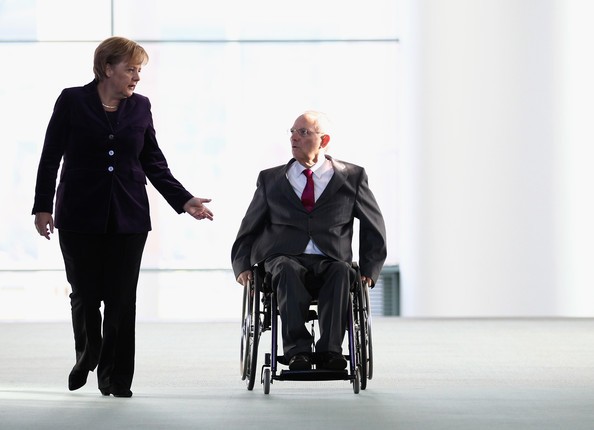
The phrase Stasi 2.0 is a catchphrase of a civil rights campaign in Germany that focused on the proposals of Schauble, Secretary of the Interior of Germany at the time, who had proposed a preemptive security strategy that bore similarities to the practices of the communist East German Stasi intelligence agency. Some of his ideas had to do with telecommunications data retention and a proposal to legalize military action of the German military inside German borders.
Further controversy was sparked when he recommended a book by Otto Depenheur in an interview. The recommendation of literature defending the Guantanamo Bay detention camp as a “legally permissible response in the fight of constitutional civilization against the barbarity of terrorism” caused outrage.
Hacker group Chaos Computer Club published one of his fingerprints in March 2008 in the magazine Datenschleuder as protest against his support for increasing the use of biometric data.
Wheelchair-bound Schauble has often being accused as being tough, cantankerous and obstinate, however, there are those who state that he has not always been that way. An assassination attempt by a mentally disturbed woman in 1990 left him a semi-paralyzed man, who has likened himself to Sisyphos carrying a boulder up the hill. A lonely man without many friends, he is seen as dogmatic and a bit of a know-it-all.

Born in 1942 in south-west Germany he came from a Protestant family and was a conservative by conviction. Nationalistic, but also pro-European in his outlook, he grew up in the 1950s, and viewed the cultural clashes of the 1960s with disdain. Sources within the Bundestag state that he believes that he would be a better chancellor than Merkel and is rather cynical, knowing that he will never get the chance.
Described as devious and suspicious by nature, Schauble is a formidable opponent for any would-be tactician.
Ask me anything
Explore related questions




