





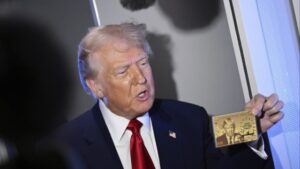
Donald Trump signed an executive order on Friday creating a “Golden Residency Card,” available for a payment of one million dollars, modeled after the Green Card, which allows holders to live and work in the United States.
“It will be a tremendous success,” the Republican president told reporters about the new system, which will allow foreigners with “exceptional qualities” to obtain the “Golden Card.”
Supporters of the program claim it could bring significant capital into the U.S., while critics argue that priority should instead be given to attracting skilled talent. The “Golden Card” is part of a broader effort to replace the existing EB-5 immigrant investor visa with a new scheme that grants U.S. citizenship to foreign investors in American businesses.
The Golden Residency Card marks the latest in a series of moves by the Trump administration to raise Treasury revenues through new and often unprecedented measures. Since taking office, Trump has raised billions through new tariffs, acquired a stake in Intel, demanded 15% of Nvidia’s revenue from certain chip sales to China, and hinted that he should receive a share of revenues from university patents.
Commerce Secretary Howard Lutnick said the Golden Card is similar to the Green Card model, with holders paying global tax obligations just as U.S. citizens or permanent residents would. The cost: $1 million per card for individuals and $2 million for companies sponsoring an employee, plus a $15,000 vetting fee.
Another type of visa—the “Trump Platinum Card”—is not expected to be launched soon.
$100,000 Fee for Tech Work Visa
Later today, President Donald Trump will also announce the introduction of a $100,000 application fee for work visas widely used in the technology sector, which he has long targeted.
A senior White House official confirmed the information, first reported by Bloomberg.
The H-1B visa allows foreign workers with specialized skills—scientists, engineers, and computer programmers, among others—to work in the United States. Most of these visas are granted to Indian nationals. They are temporary work permits, initially valid for three years, extendable up to six, for foreigners sponsored by employers.
The imposition of a $100,000 fee for H-1B applications could deal a major blow to the tech industry, which heavily depends on skilled workers from India and China.
Since his first term, Trump has expressed his intention to limit work visas to prioritize American workers.
Applications for H-1B visas have surged in recent years, peaking in approvals in 2022 under Democratic president Joe Biden. By contrast, rejection rates peaked in 2018, during Trump’s first term in the White House.
In 2024, the United States approved around 400,000 work visas, two-thirds of which were renewals. Three-quarters of successful H-1B applicants came from India.
This latest announcement adds to the set of anti-immigration measures taken by Trump and his administration, which is also moving forward with mass deportations of undocumented migrants.
Ask me anything
Explore related questions




