





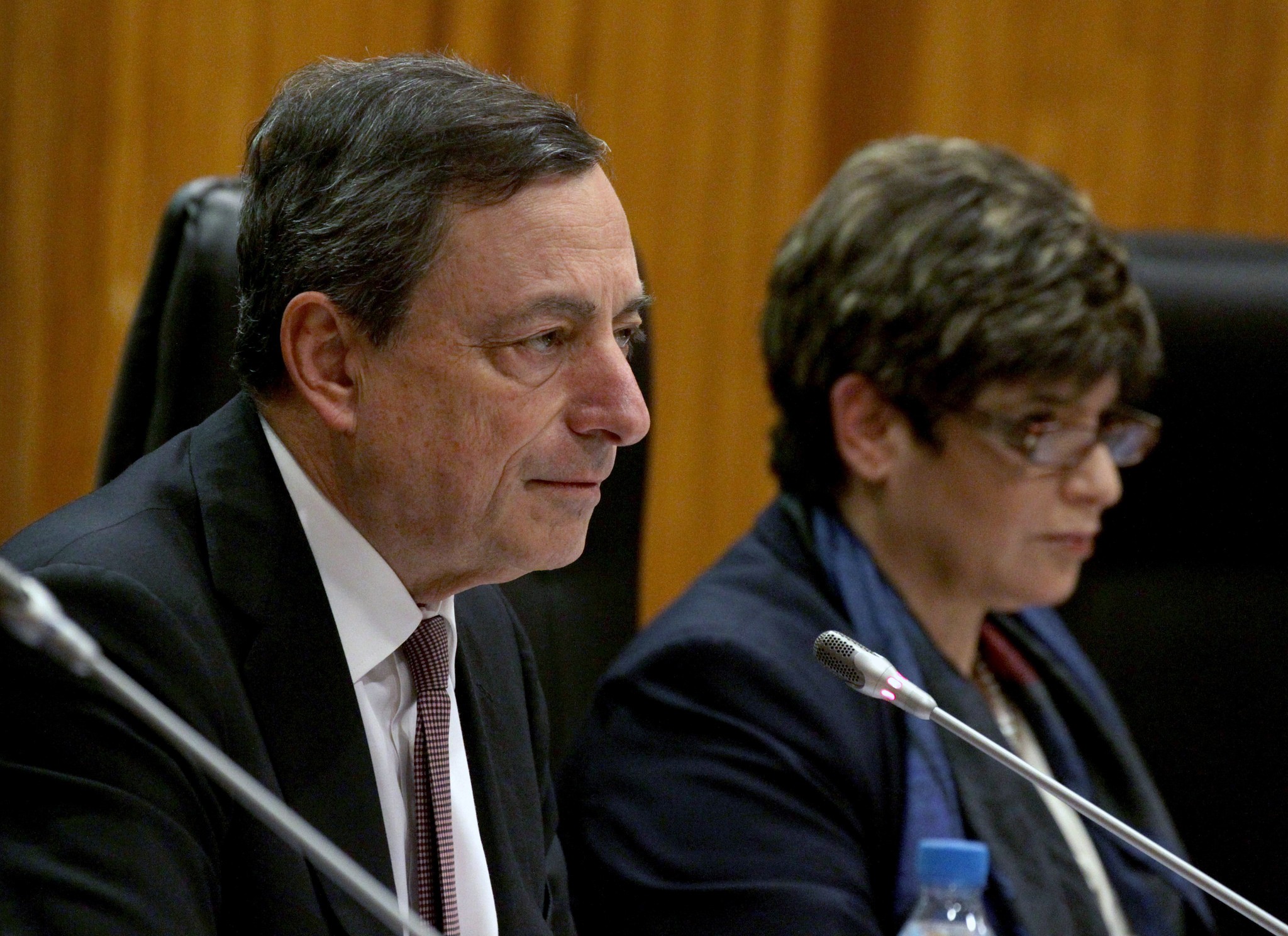
European Central Bank (ECB) President Mario Draghi met with central bankers at Nicosia, Cyprus, on Thursday. During the Governing Council, the ECB decided to keep interest rates unchanged and keep the focus on implementation on moentary policy measures.
“Following up on our decisions of January 22, 2015, we will, on March 9, 2015, start purchasing euro-denominated public sector securities in the secondary market,” said Draghi. “We will also continue purchasing asset-backed securities and covered bonds, which we started last year. As previously stated, the combined monthly purchases of public and private sector securities will amount to €60 billion. They are intended to be carried out until the end of September 2016 and will, in any case, be conducted until we see a sustained adjustment in the path of inflation which is consistent with our aim of achieving inflation rates below, but close to, 2% over the medium term.”
Draghi pointed out that a significant number of positive effects have been noted from these monetary policy decisions. He said that financial market conditions and the cost of external finance for the private economy have eased further, borrowing conditions for firms and households have improved considerably and money and credit dynamics have been firming.The substantial additional easing of the monetary policy stance supports and reinforces the emergence of more favourable developments for the euro area economy. In an environment of improving business and consumer sentiment, the transmission of our measures to the real economy will strengthen, contributing to a further improvement in the outlook for economic growth and a reduction in economic slack. Thereby, our measures will contribute to a sustained return of inflation towards a level below, but close to, 2% over the medium term and underpin the firm anchoring of medium to long-term inflation expectations.
According to Eurostat’s flash estimate, real GDP in the euro area rose by 0.3%, quarter on quarter, in the last quarter of 2014, which was somewhat higher than previously expected. The latest economic data and, particularly, survey evidence available up to February point to some further improvements in economic activity at the beginning of this year. Looking ahead, we expect the economic recovery to broaden and strengthen gradually. The low level of the price of oil should continue to support households’ real disposable income and corporate profitability. Domestic demand should also be further supported by our monetary policy measures leading to ongoing improvements in financial conditions, as well as by the progress made in fiscal consolidation and structural reforms. Moreover, demand for euro area exports should benefit from improvements in price competitiveness and from the global recovery. However, the euro area recovery is likely to continue to be dampened by the necessary balance sheet adjustments in various sectors and the rather slow pace of implementation of structural reforms.
Turning to the monetary analysis, Draghi said that recent data confirm the gradual increase in underlying growth in broad money (M3). The annual growth rate of M3 increased to 4.1% in January 2015, up from 3.8% in December 2014. Annual growth in M3 continues to be supported by its most liquid components, with the narrow monetary aggregate M1 growing at an annual rate of 9.0% in January.
The annual rate of change of loans to non-financial corporations (adjusted for loan sales and securitisation) was -0.9% in January 2015, after -1.1% in December 2014, continuing its gradual recovery from a trough of -3.2% in February 2014. The three-month cumulated net lending flows were positive in January for the second consecutive month, compared with sizeable net redemptions still recorded a year ago. Despite these improvements, the dynamics of loans to non-financial corporations remain subdued and continue to reflect the lagged relationship with the business cycle, credit risk, credit supply factors and the ongoing adjustment of financial and non-financial sector balance sheets. The annual growth rate of loans to households (adjusted for loan sales and securitisation) increased further to 0.9% in January 2015, after 0.8% in December 2014. Our recent monetary policy measures should support a further improvement in credit flows.
To sum up, a cross-check of the outcome of the economic analysis with the signals coming from the monetary analysis confirms the appropriateness of the Governing Council’s recent decisions, says Draghi. The determined implementation of all our monetary policy measures will provide support to the euro area recovery and bring inflation rates towards levels below, but close to, 2% in the medium term.
Monetary policy is focused on maintaining price stability over the medium term and its accommodative stance contributes to supporting economic activity. However, in order to reap the full benefits from our monetary policy measures, other policy areas need to contribute decisively. Given high structural unemployment and low potential output growth in the euro area, a cyclical recovery along the lines of the March ECB staff projections is no grounds for complacency. In particular, in order to increase investment, boost job creation and raise productivity, both the decisive implementation of product and labour market reforms and actions to improve the business environment for firms need to gain momentum in several countries. It is crucial that structural reforms be implemented swiftly, credibly and effectively, as this will not only increase the future sustainable growth of the euro area but also raise expectations of higher incomes and encourage firms to increase investment today, bringing forward the economic recovery. Fiscal policies should support the economic recovery while remaining in compliance with the Stability and Growth Pact. Full and consistent implementation of the Stability and Growth Pact is key for confidence in our fiscal framework. In view of the necessity to step up structural reform efforts in a number of countries, it is also important that the macroeconomic imbalance procedure is implemented effectively in order to address the excessive imbalances as identified in individual Member States.
Draghi then went on to answer questions, with Greece dominating a large part of discussions.
CLICK HERE to read transcript of Question and answer time.
Ask me anything
Explore related questions




