





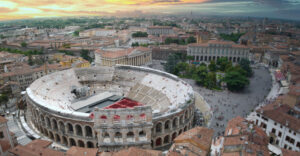
With 100 days remaining until the start of the Milan–Cortina Winter Paralympic Games, organisers are moving ahead with major interventions so that the 2,000-year-old Verona Arena will become fully accessible for people with disabilities. The monument will host the opening ceremony of the Games.
According to The Guardian, the transformation includes the installation of an elevator and toilets in a structure that predates even the Colosseum. The CEO of the organising committee, Andrea Varnier, described the arena as “the symbol of our Paralympic Games”, acknowledging that some traditionalists consider the intervention “blasphemy”.
“The decision to hold the opening ceremony at the Verona Arena was not only aesthetic, although of course we want to showcase such beauty,” he said. “It was also an idea: to make the arena accessible, not only the venue itself but also the entire route from the railway station to the site.”
He added: “Now an elevator will be built; for lovers of classical monuments this is blasphemy. But it will now exist. And we believe this is part of the changes taking place. It is also a very powerful message.”
Varnier stressed that the €20 million renovation project is a key element of the Games’ legacy, along with the expansion of accessible public transport and funding for training and the development of winter Paralympic sports. He expressed hope that these measures will contribute to the growth of winter Paralympic sports in what he described as a “demanding” environment.
In another initiative, applicable to both the Winter Olympics and the Winter Paralympics, Varnier pledged that the “critical” process of artificial snow production would take place without the use of chemicals. “We know that with climate change, snow production is critical,” he said. “But a new system we are implementing allows the use of water without harming the local ecosystem, and the new snow-making equipment uses only water. No chemicals are added in any of our technologies. It is real snow, even if it is artificially produced.”
Closing
The Winter Paralympic Games will host athletes from 50 countries across six sports: alpine skiing, biathlon, cross-country skiing, ice hockey, snowboarding and wheelchair curling. Varnier did not disclose the number of tickets already sold, though he admitted that there is still ground to cover.
“Spectators at the moment have turned their attention to the Winter Olympic Games and that is a bit unfortunate, because we would like ticket sales to move in parallel,” he said. “Unfortunately, this always happens and we have not managed to reverse this pattern. We still need to boost ticket sales, but we are very optimistic because we are in exactly the same position our colleagues in Paris were, so this is normal.”
As he noted, the success of the Games will also be judged by the legacy they leave behind: “In a way, there has already been success thanks to the legacy we will leave — I will not stop underlining that.” He stressed that the Games will represent yet another “small brick” in the development of the Paralympic movement.
Ask me anything
Explore related questions




