






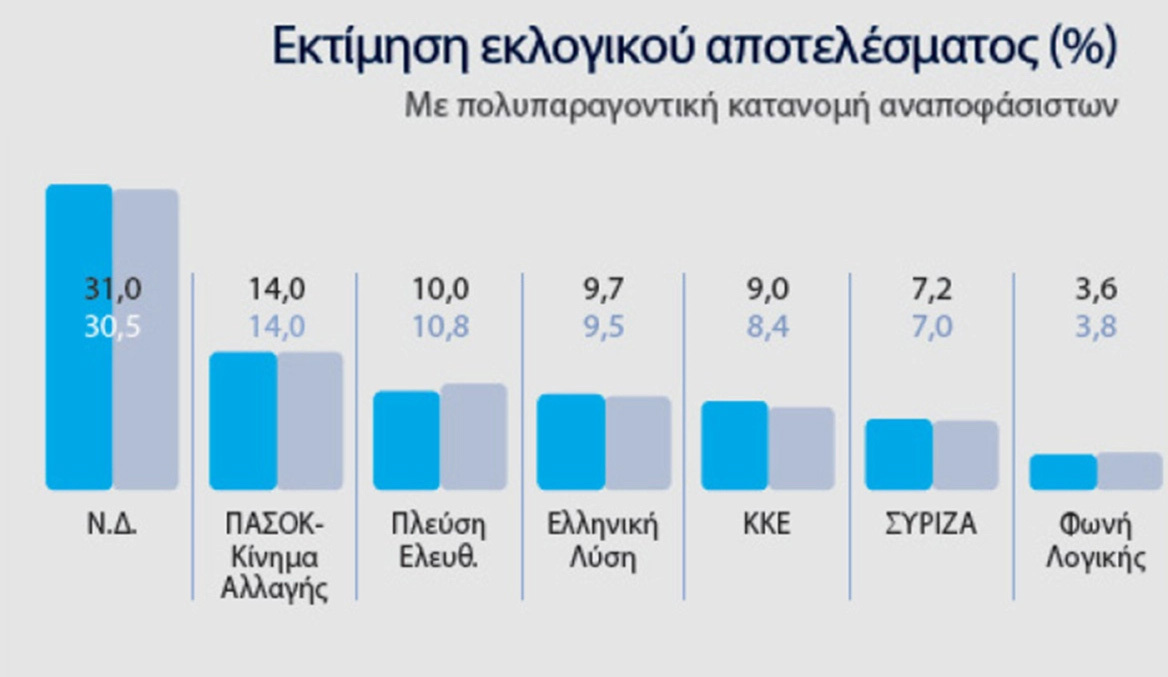
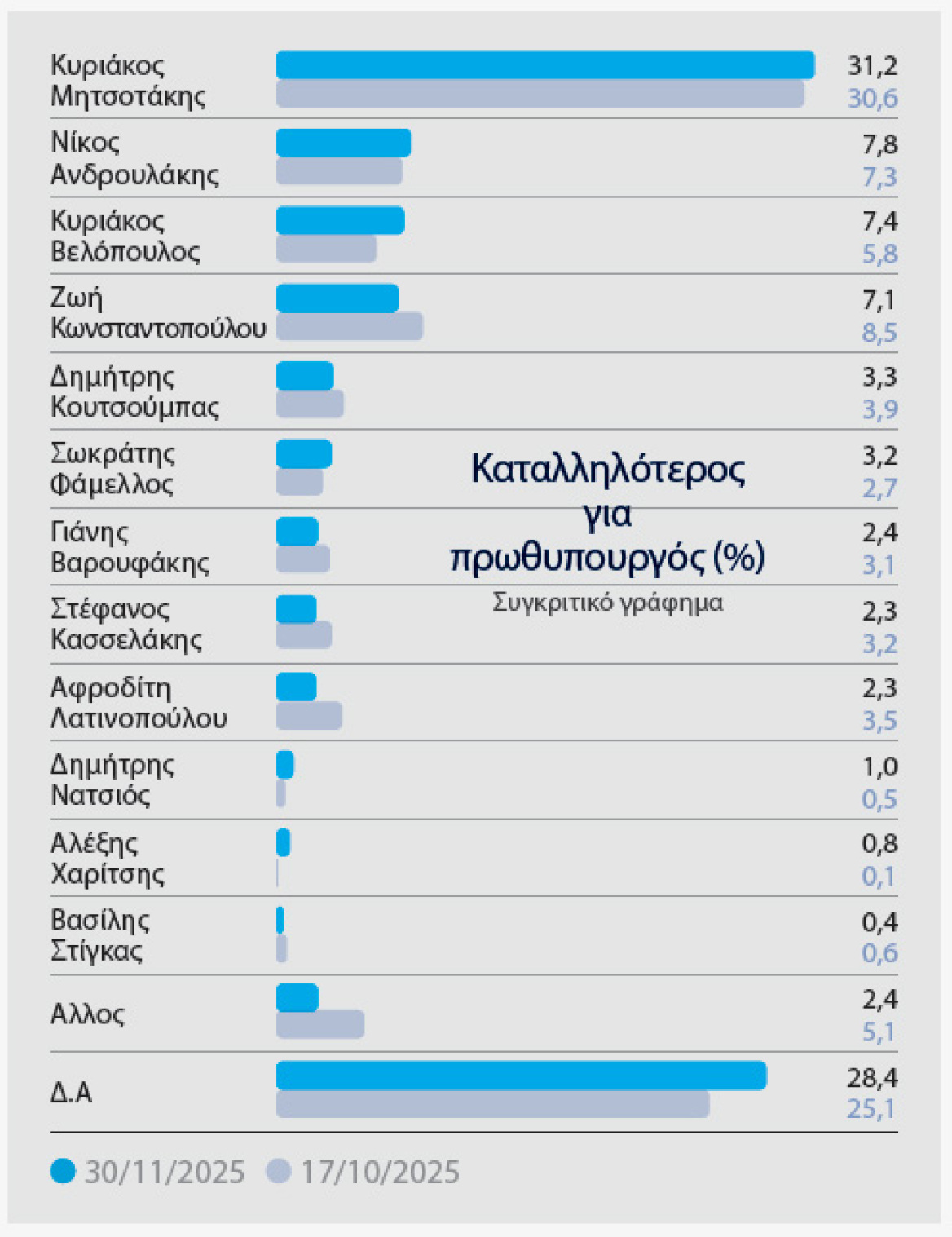
The change in agenda brought by the Zappeion energy agreements at the beginning of the month is pushing New Democracy to polling levels considerably higher than its performance in the European elections: in the vote estimate, the governing party now stands at 31%, according to the Marc poll published by “Proto Thema”, with Kyriakos Mitsotakis leading Nikos Androulakis by 23.4 points in suitability for the premiership, chosen by 31.2% of respondents.
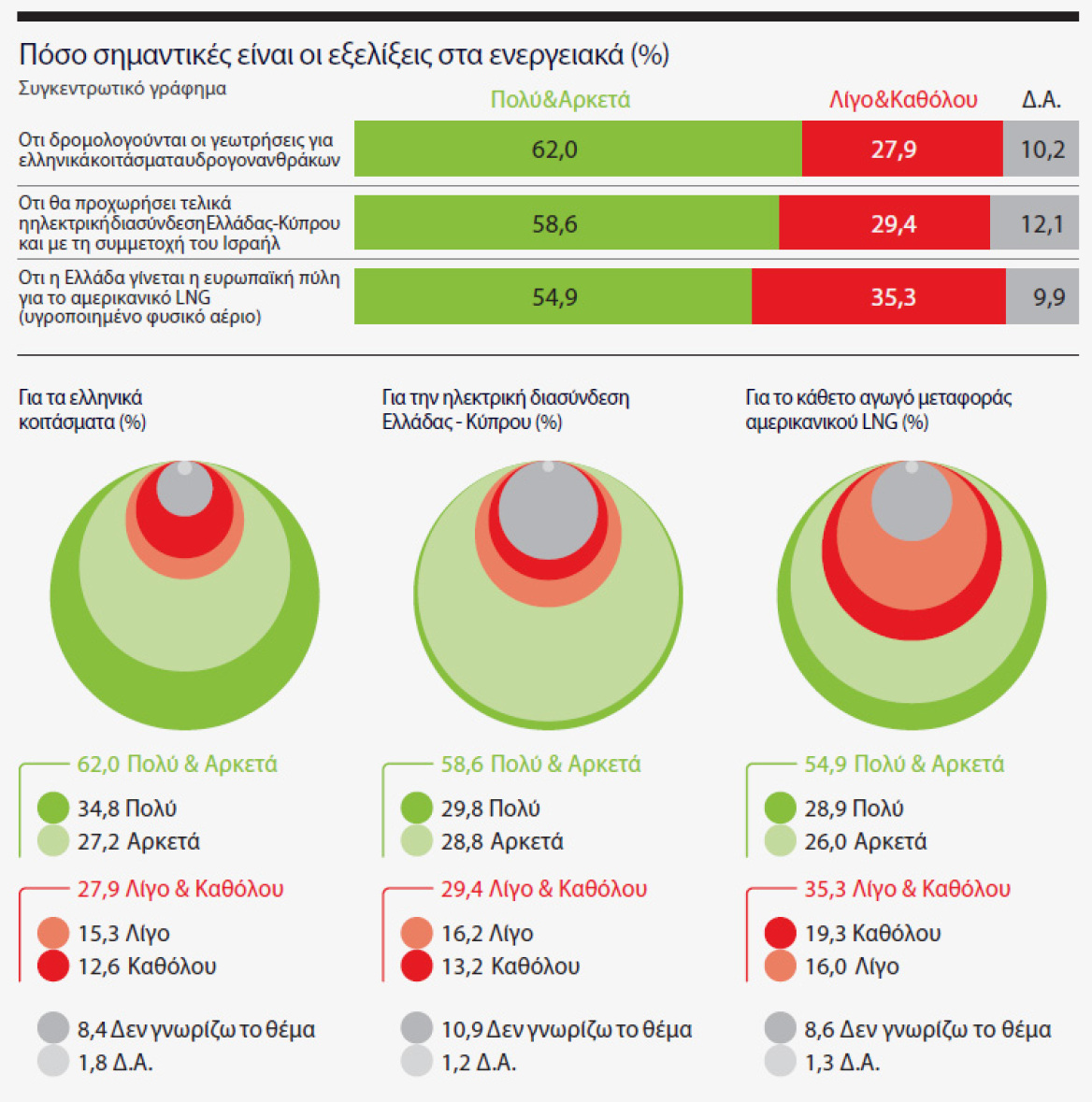
The shift in climate and agenda is clear in the poll: both the announcement of the start of drilling for Greek deposits and the renewed prospect of constructing the Greece–Cyprus–Israel electricity interconnection, as well as the creation of the Vertical Corridor for transporting American LNG from Greece to Ukraine, receive very positive reactions surpassing 50% across almost all sample categories — age groups, party affiliations, and ideological segments.
Click here to see the full poll
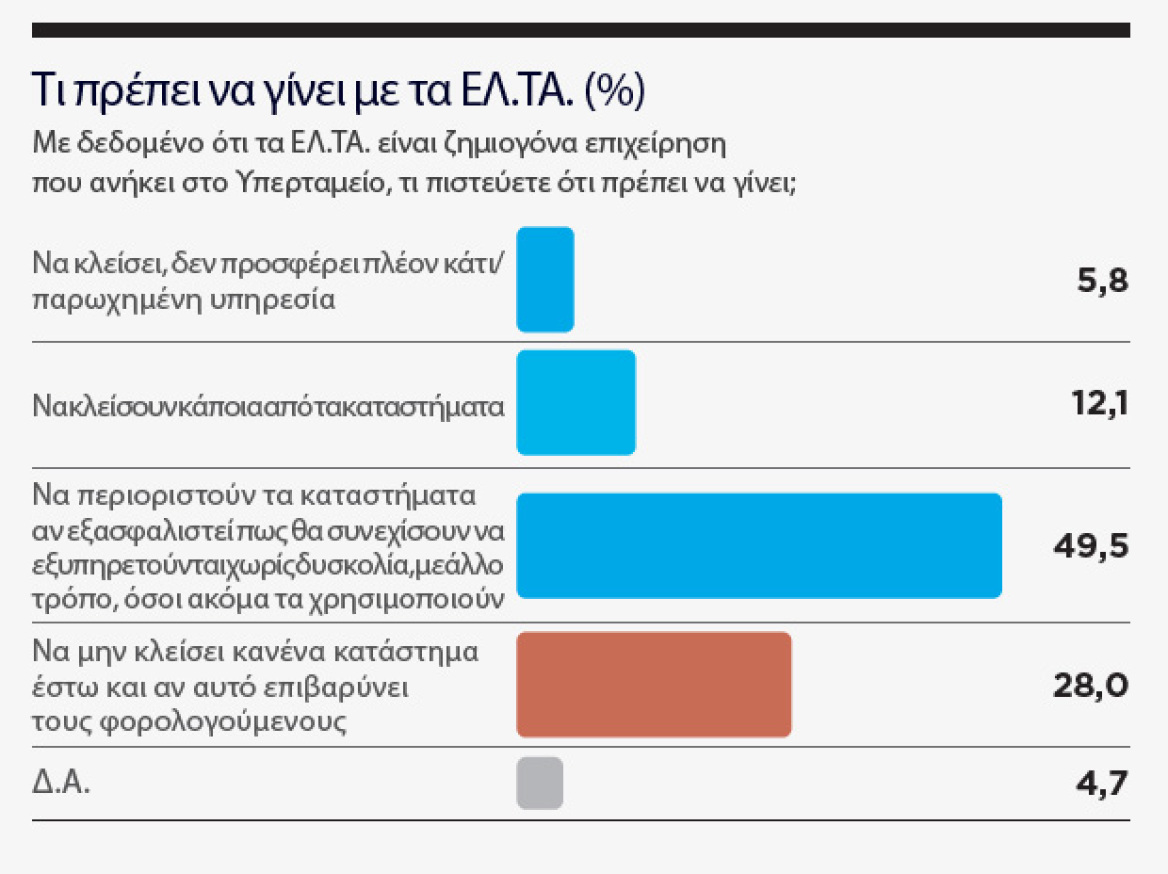
At the same time, Greek society appears — by majority — to be returning to common sense: notably, when asked about ELTA, one in two respondents agrees that the number of branches should be reduced, but they also demand alternative means of service for those who still use them. A similar sentiment appears regarding the OPEKEPE scandal, with significant cross-party shares of voters attributing responsibility both to the ministers in office at the time and to those who received subsidies without producing anything, either plant-based or livestock.
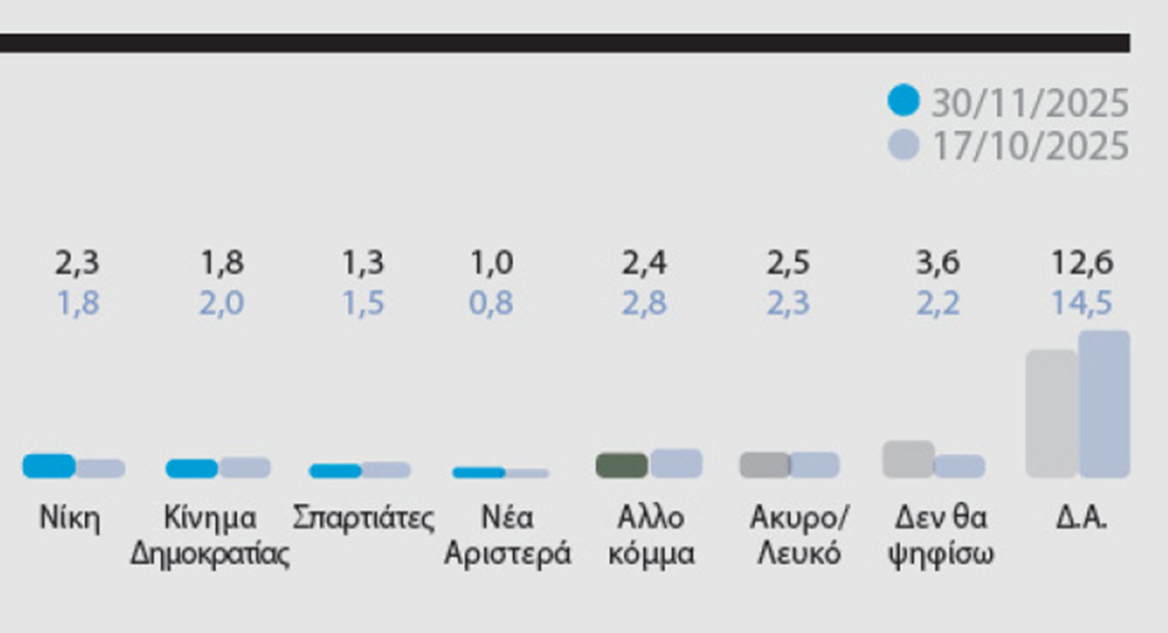
New Democracy 2.7 points above the European elections
ND is measured at 31% in the vote estimate, 2.7 points above the 2024 European elections, with PASOK steady at 14%. Despite the fact that the main opposition party shows a small rise in voting intention and qualitative indicators, it does not appear to pose a threat to the governing party, as noted by Marc’s CEO, Thomas Gerakis.
The Marc measurement indicates an eight-party Parliament, with Course of Freedom (Plefsi Eleftherias) at 10% in third place but continuing a downward trend (a drop of 0.8 points compared to October), followed closely by Greek Solution with a slight increase and only 0.3 points behind, nearly reaching double digits.
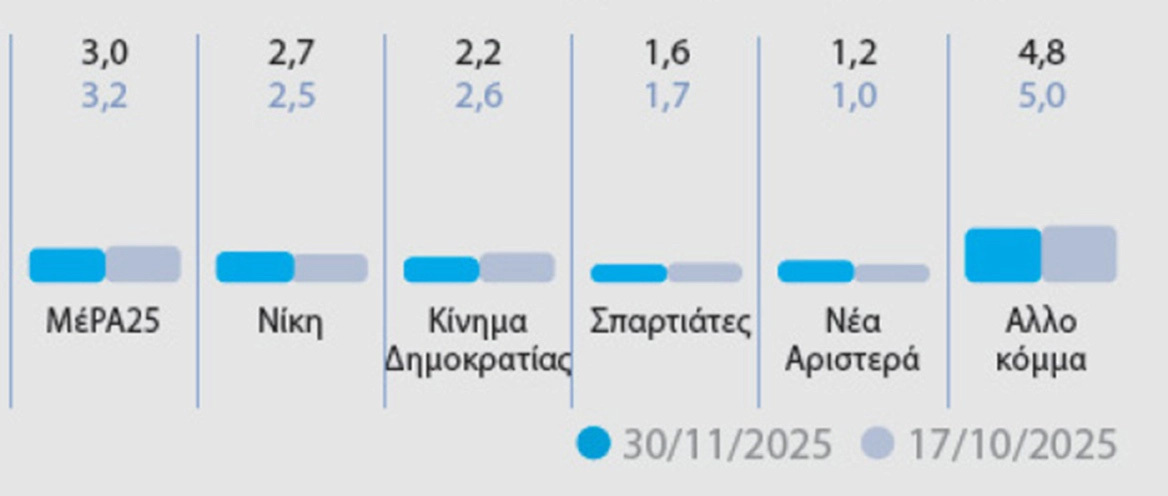
Marc shows the KKE rising to 9%, and SYRIZA slightly up at 7.2% from 7% in October. A small 0.2-point drop but still comfortably in Parliament for Afroditi Latinopoulou’s party, as well as a borderline presence for MeRA25. By contrast, despite a small rise, Niki remains at 2.7%, and numbers for Kasselakis’s party and the New Left are notably lower.
44.5% in favor of stability
Trust in the government reaches 32.1%, while on the dilemma “stability or political change,” although one in two citizens wants change, a significant 44.5% prefers stability — which objectively benefits ND, especially in a scenario of second elections. The distribution among those who choose improved government performance and political stability is nearly uniform between men and women (44.8% and 44.3%) and across age groups: 43% aged 17–44, rising slightly to 43.7% for ages 45–64, and reaching 47.6% in older ages.
Regarding voting preferences among those who choose stability, the group includes 79.4% of ND’s 2023 voters, 30% of PASOK voters, 12.3% of SYRIZA voters, and even 10.9% of KKE voters.
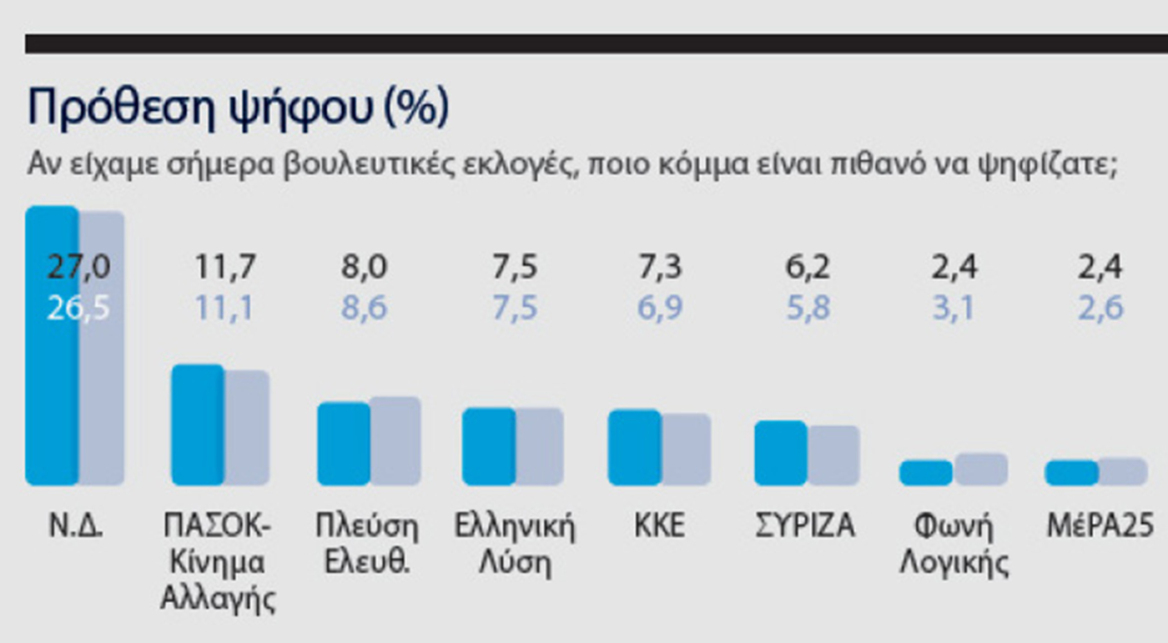
At the same time, among undecided voters — down by two points since October — the dominant share continues to be those who self-identify as centre-right, with everything that implies. The Marc poll does not indicate an “electoral psychology” in society, but it is noteworthy that within less than 40 days there is a 1.2-point rise in people stating they will not vote in the next elections.
The battle for the Centre and Centre-Left
Interesting insights arise from how parties perform by ideological self-placement: ND maintains dominant percentages among those who consider themselves “right-wing” or “centre-right”, exceeding 54%, while all other parties remain in single digits.
ND also fights a strong battle and holds a slight lead over PASOK in the Centre — but the main opposition party (PASOK) clearly leads among centre-left voters, followed by Course of Freedom, and then SYRIZA, which however has lost the left-wing space, now dominated by KKE with 32.3% versus SYRIZA’s 15.9%.
Among voters who identify as “no affiliation”, ND leads with 19%, followed by Greek Solution with 11.9% and Course of Freedom with 9.1%, while PASOK sits at only 6.4%.
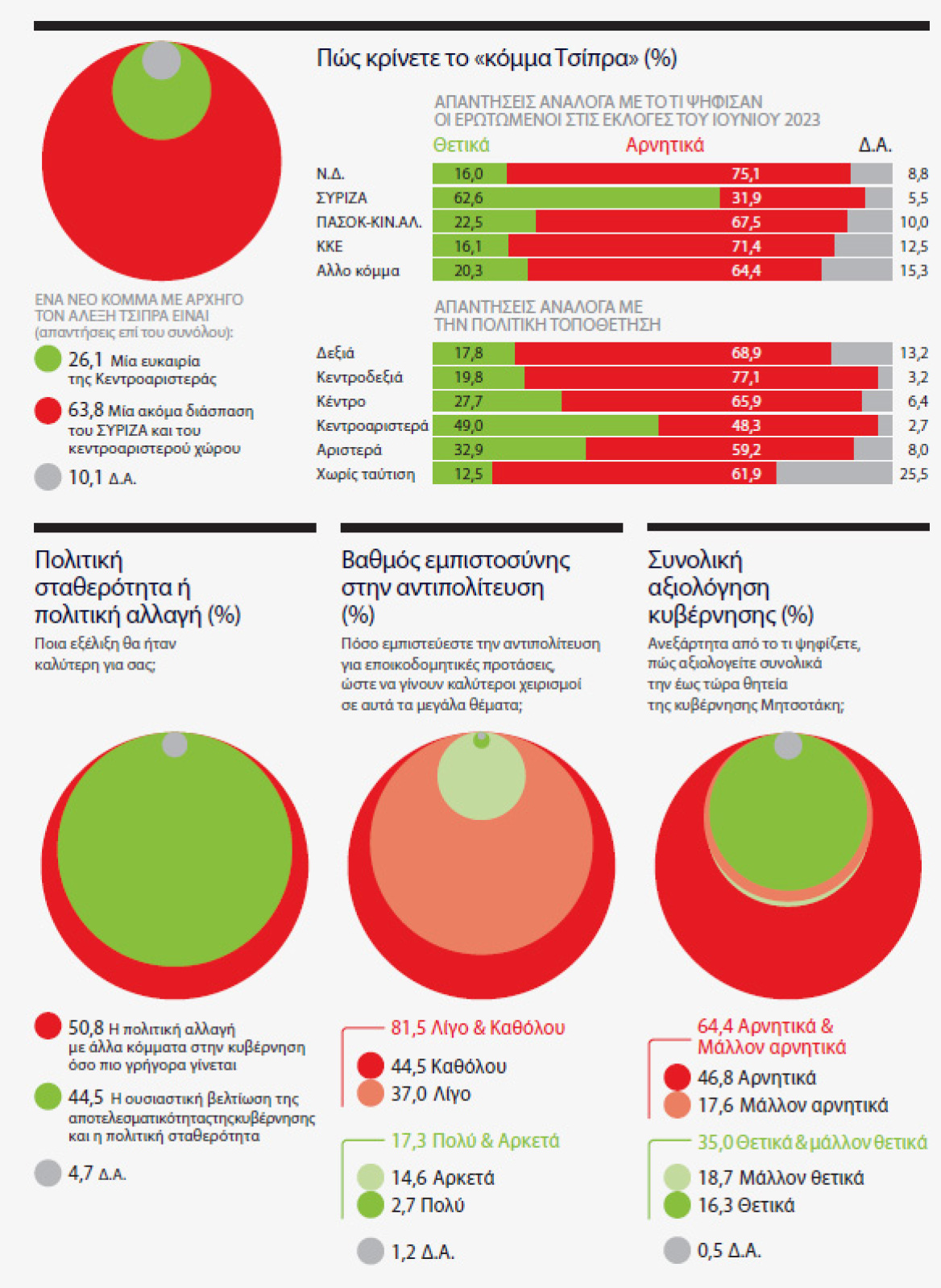
The “Tsipras party”
As noted by Thomas Gerakis, there are “pending issues” in the political landscape related to the possible formation of new political entities. In this context, it is striking that 26.1% of Marc’s sample believes that creating a “Tsipras party” would be an opportunity for the reorganisation of the Centre-Left.
This percentage includes 62.6% of SYRIZA’s 2023 voters — slightly over 11 points of that election’s voter base — which would immediately place the former prime minister in third or even second place if this answer is read as a potential vote. Furthermore, 22.5% of PASOK voters — around 2.5 points — express the same view, suggesting the potential breadth of a Tsipras party, even if it is clear that under current polling data it would not threaten ND’s dominance.
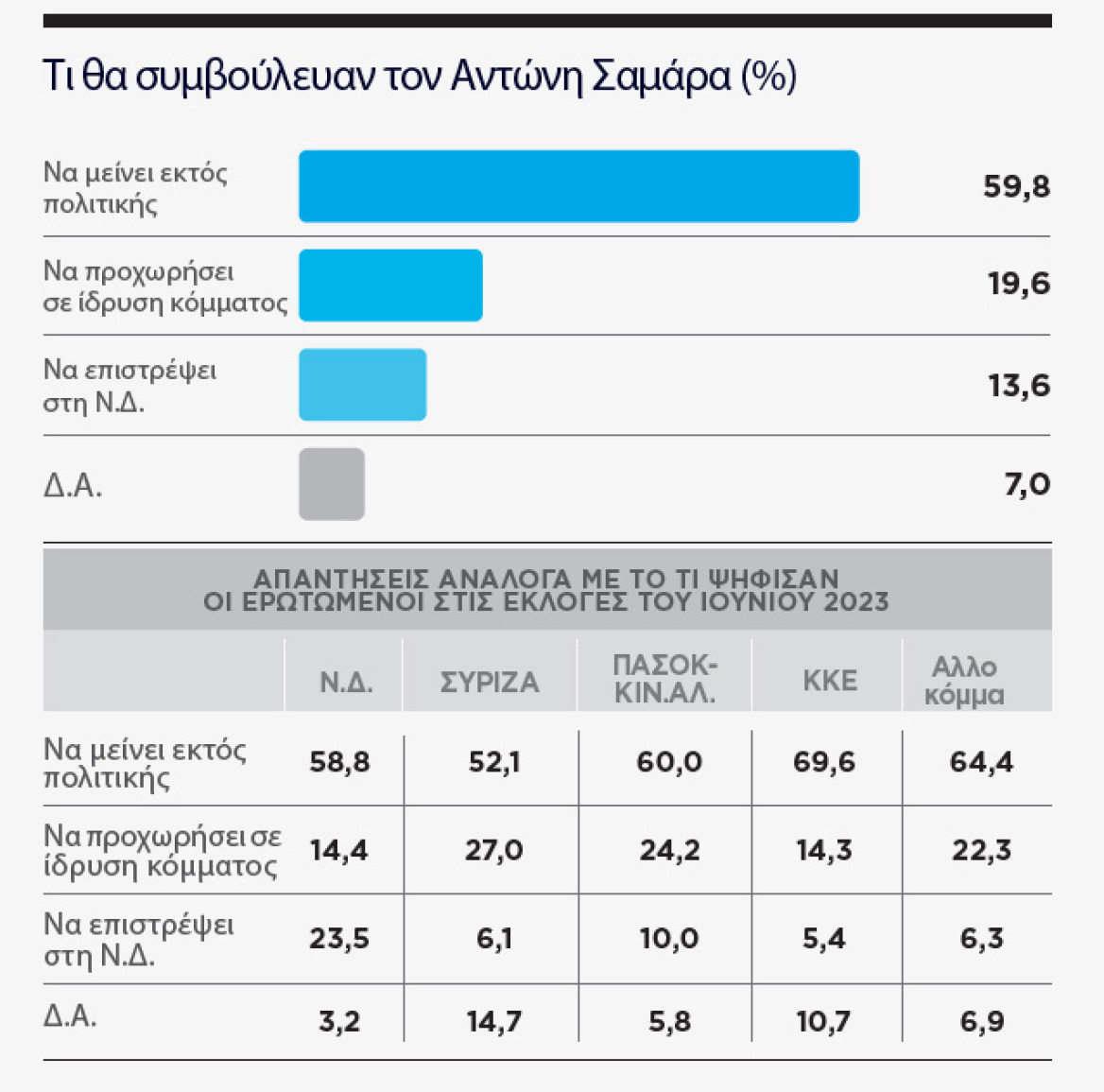
Across the full sample, 19.6% urge Antonis Samaras to found a new party, while 59.8% tell him to stay out of politics and 13.6% to return to New Democracy, although his latest public appearance made it clear he has cut all ties.
It is interesting that among those who encourage him to create a party are 27% of SYRIZA voters and 24.2% of PASOK voters — possibly hoping such a move might reduce ND’s electoral strength. Meanwhile, 14.4% of ND’s 2023 voters (about 5.5 points of that electorate) support the idea of a Samaras party, but that support drops to just 4.4% among today’s ND voting intention respondents, and one in three Kyriakos Velopoulos voters also holds this view.
Ask me anything
Explore related questions




