





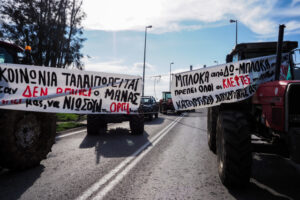
Strong concerns expressed by the market and the productive bodies about the impact that the agricultural mobilizations may have on the economy, at a particularly critical time, the Piraeus Chamber of Commerce and Industry points out in a statement.
With the festive season just around the corner, it is stressed, trade and supply chain professionals stress that there is a serious risk of disruption in the movement of products and the smooth operation of the market.
The possibility of prolonging the mobilisations, the EBEP continues, could have a chain effect, affecting the festive consumption more in the Greek periphery and less in the capital and urban centres.
It is also stated that, with the State reacting belatedly to the just problems of the farmers, but also with the Prime Minister opening the “door of dialogue” to the farmers and with the market now “in the final stretch”, just a few days before the holidays, we hope for a consensual solution, which should have been given much earlier. The problems that have already arisen are the result of underestimating the size and seriousness of the problem, as they could have been avoided if the call for dialogue had been addressed to the farmers from the very first 24 hours of the mobilisations. Instead, the delay in taking initiatives has burdened both the farming community and the market, adding to the uncertainty at a particularly critical time.
According to the first assessments of the rural mobilizations, the blockades and transport delays do not threaten the sufficiency of goods so much as the increase in costs and the restriction of consumer movement. Particularly vulnerable appear to be the food and retail sectors, which rely on uninterrupted supplies in the run-up to the holidays. Operating costs for businesses are rising, which may be passed on to final prices for consumers. Significant problems are also being recorded in the agri-food sector, where the transport of perishable products is becoming more difficult, increasing the risk of spoilage and economic losses, especially from exports to the Balkans, Italy, and Central Europe.
Damage becomes irrecoverable in fresh, while time/shelf life is lost and price pressure is exerted. The impact of the farmers’ blockades is being felt across a wide range of the economy, with some sectors disproportionately affected. The first victim appears to be the trade and retail sector, as delays in supply lead to turnover losses of 5-15% in affected areas at a time of increased consumer traffic. Particularly vulnerable are small and medium-sized enterprises in trade, transport and tourism, which do not recover their lost turnover, estimated at €31-45 million per day, with a disproportionate burden in the periphery, where the festive market is a key factor of viability.
At the same time, the transport and logistics sector is under intense pressure, with route delays, late delivery clauses and a +10-30% increase in operating costs, effects that are being transmitted in chains throughout the market. A negative footprint is also being recorded in domestic tourism, as hospitality businesses in the Greek periphery, which among other things face the risk of holiday cancellations, are struggling to ensure timely supply in a period of increased demand due to the holidays. Industry is facing delays in the supply of raw materials and distribution of products, while export firms risk facing order cancellations and loss of credibility in international markets.
Overall, the effects of the mobilisations are not limited to a single sector, but threaten to cause widespread economic damage in the midst of the festive season. From now on, each additional week of mobilisation adds around €200 million of damage and, as the days go by, the impact on production, consumption and exports will be greater. The “worst” scenario of continuing the blockades for a third week estimates that, according to last year’s economic data on turnover and exports, the total damage to the Greek economy could even exceed 800 million euros.
The president of the Piraeus Chamber of Commerce and Industry, Vassilis Korkidis, underlines that he recognizes the just demands of the agricultural world and makes the following appeal: “We invite you to enter into a good faith dialogue with the Prime Minister, who is now called upon to manage the delicate balance of your support measures within the framework of the economy’s capabilities. The need to resolve your problems is felt to be imperative, even at the risk of wider economic damage in the midst of the festive season. We note that the next period is very marginal before the effects become irreversible. Certainly, the many and existing agricultural problems cannot be solved in a day or in a meeting, but at least they can be prioritised and with society on your side, they can commit the government to meeting them. We have seen your dynamic presence in the mobilizations, and we want to see the same in a dialogue with the Prime Minister.”
Ask me anything
Explore related questions




