





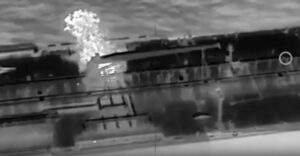
A strike against a Russian oil tanker belonging to the so-called “shadow fleet” in international waters of the Mediterranean and within proximity to one of the world’s busiest maritime corridors serves as a stark warning for international shipping.
The targeted drone attack does not merely alter the geographical parameters of the war; it directly challenges the notion of “safe seas” and introduces a new reality of heightened uncertainty for commercial maritime activity.
The risk of misidentification, a major environmental accident, and a sharp rise in insurance costs make this incident far more than an isolated event. It signals the beginning of a period in which freedom of navigation is once again being tested.
Giorgos Tsiakalos, Head of Intelligence at the maritime security and risk management company Diaplous, a retired senior officer of the Hellenic Army and former Assistant Professor at the Hellenic Military Academy, explains to the Athens–Macedonian News Agency (ANA-MPA) why this strike represents a qualitative escalation and outlines the real risks now facing international shipping.
The Shadow Fleet Under Fire: The Strike on a Russian Tanker in the Mediterranean and the New Risks to Maritime Navigation
Giorgos Tsiakalos, Head of Intelligence, Diaplous Maritime Security & Risk Management
What follows is the full interview:
– How do you assess the strike on a Russian “Shadow Fleet” tanker in international waters of the Mediterranean?
The strike on the Russian oil tanker QENDIL constitutes a qualitative escalation, not because it immediately alters the overall security environment in the Mediterranean, but because it demonstrates that the targeting of “commercial-type” vessels can extend beyond active theaters of military operations.
The incident, which occurred on December 19, 2025, approximately 85 nautical miles south of Crete, highlighted the use of low-cost, low-signature systems with long operational reach, effectively challenging the concept of “safe waters.” For the shipping industry, the consequences are primarily indirect: an increased need for dynamic, voyage-by-voyage risk assessments, greater caution in areas near unstable coastal zones, and stricter scrutiny of exposure to sanctions regimes.
– Does this incident create a new operational precedent for targeting commercial vessels far from active war zones?
This attack establishes a significant operational precedent by shifting the reference point from strikes near active conflict zones to selected targets of high political and economic value in more distant maritime areas.
Targeting a vessel linked to the so-called “shadow fleet” fits within a broader strategy aimed at disrupting revenue flows and sanction-evasion mechanisms. In that sense, it is a more deliberate and selective action than traditional opportunistic attacks.
However, even if the target profile remains one of “special interest,” the widespread availability of technology—drones and unmanned systems—significantly increases the risk of misidentification, collateral exposure, or retaliatory actions affecting broader shipping activity. This reinforces the need for timely intelligence sharing, continuous maritime situational awareness, and voyage-specific adaptation of security procedures.
The attacks recorded in the Mediterranean during 2025, including those involving limpet mines, share several common characteristics:
-
They are targeted and purpose-driven
-
They occur at unexpected times
-
They take place in non-traditional or unforeseen locations
-
They are carefully planned and precisely executed
-
They minimize or eliminate human casualties
-
They seek to avoid major environmental damage
-
They support the narrative of actions taken by a defending state against targets associated with an aggressor
– If such attacks escalate, what are the main risks for international shipping?
In the event of escalation, the risks to international shipping would intensify and take on a systemic character. War risk would no longer be geographically confined and could spread unpredictably into areas of heavy commercial traffic, increasing uncertainty for shipowners and charterers alike.
At the same time, the risk of a serious environmental incident—particularly involving laden tankers—would rise significantly. Of particular concern is the possibility that such attacks could move beyond the realm of state actors and be carried out by groups or organizations for hire, motivated by ideological, religious, or financial interests. Such a development would push global shipping into a prolonged state of uncertainty and elevated risk.
In parallel, insurance and regulatory costs would be expected to increase, with higher war-risk premiums, stricter coverage terms, and added operational burdens such as navigation restrictions, NAVTEX warnings, and voyage delays. All of this would unfold in an environment where disinformation and cyber threats further complicate decision-making.
Ask me anything
Explore related questions




