





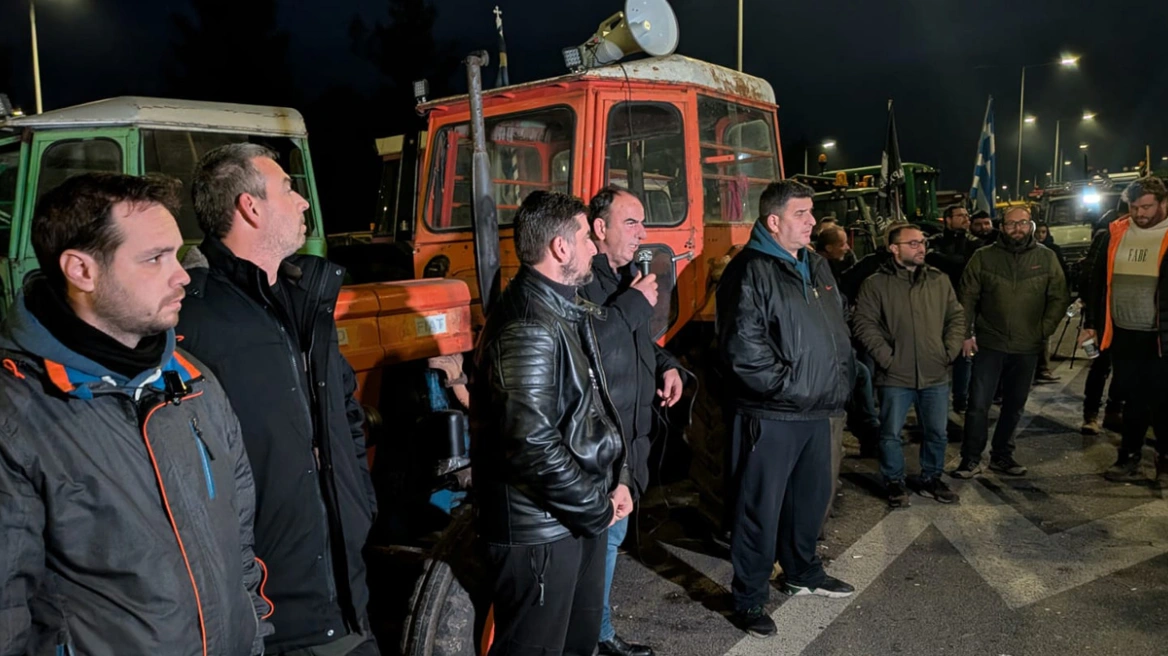
Farm union leaders are preparing to come down to Athens—not with tractors, as the “hardliners” of the roadblocks had planned, but for dialogue with the government. At the same time, they are sending signals that they will not rush in before the scheduled announcements on Wednesday morning, as the government would prefer, but will decide whether to enter talks after those announcements.
The battle of impressions is twofold: on the one hand, farm union leaders have announced a 48-hour blackout on the roads; on the other, the government is emphasizing that if such tactics persist, the laws against obstructing transportation will be applied.
We won’t send in the riot police, but…
“Our doors are open to dialogue, but if no one comes, the government cannot sit idly by, nor can it play traffic cop in a blocked country,” Deputy Prime Minister Kostis Hatzidakis told SKAI. “I’m not saying we’ll send in the riot police. There are laws and fines concerning obstruction of transportation. I’m not here to threaten anyone. We were tolerant, but it goes beyond me when the prime minister calls for dialogue and no one shows up. This is a first for me.”
Indicative of the climate in recent hours are the statements of Sokratis Aleiftiras, a farm unionist at the Nikaia roadblock, who set the “line” that there will be a response after the detailed government announcements on Wednesday. It is noted that Mr. Aleiftiras is responsible for agricultural policy for the Freedom Sail party, while control of this particular roadblock lies with the Communist Party of Greece (KKE), despite the large participation of farmers who are New Democracy voters.
According to information, several “blue” (ND-aligned) farm unionists now appear ready to participate in dialogue with the government even without the others—something the unionists of the Left parties do not want under any circumstances.
Arbitrarily or through dialogue?
In statements after the conclusion of the nationwide meeting, representatives of the Nikaia and Karditsa roadblocks, Rizos Maroudas and Kostas Tzellas (both from the KKE), reiterated the argument that the government has not provided a clear framework for satisfying their demands. On the other hand, officials from the Ministry of Rural Development have countered in recent days that specialization is not possible without prior dialogue. For example, they noted that inspections have secured €160 million. “How should it be allocated? Arbitrarily or after dialogue?” they asked pointedly.
An informal meeting has already taken place at the Prime Minister’s office following the decisions at Malgara, while a detailed presentation of measures for agriculture is scheduled for Wednesday morning. It is recalled that on Thursday, Minister of Rural Development Kostas Tsiaras will travel to Brussels, where the free trade agreement with Latin American countries, Mercosur, will again be discussed. The consequences of the agreement are significant for Greek farmers and livestock breeders, and the stance our country will take will be discussed at the agricultural meeting.
According to information, Greece tends to align with France and Italy, which are setting a series of conditions for signing the agreement—a stance that led to the postponement of the signing in mid-last month, despite strong support from countries such as Germany and Spain. Protection from the consequences of Mercosur is included among the farmers’ demands, and the framework to be set may function as a pressure-release valve for the situation.
Farmers, however, insist that key demands must be answered clearly by the government before they sit at the table for dialogue. In their prioritization, they continue to place the reduction of electricity prices to 7 cents at the top, although everything suggests they would be satisfied if it dropped to 8 cents from the current 9.
They insist that the announcement regarding tax-free diesel is vague and continue to raise the issue of guaranteed prices for products, citing a related request submitted to the EU by Italy (which has not yet been answered). They also call for the abolition of “agricultural courts.” At the same time, they maintain that, alongside a proposal for dialogue, they also heard talk of thugs and of roadblocks against society.
The more experienced participants in roadblocks and mobilizations, however, are keeping lines open and appear to be planning the next day and an exit strategy. In this context, the Minister of Rural Development reiterated in recent days that dialogue is not a concession but a democratic duty. Some have taken this message on board, along with the sense of fatigue among many who have been on the road since the first day.
Ask me anything
Explore related questions




