





The supercomputer DAEDALUS, set to boost research and innovation in Greece, is in its final assembly and technical testing phase in the Czech Republic. The system integrates over 2,000 NVIDIA Grace Hopper (GH200) superchips and will be installed at the Lavrio Technological Cultural Park of the National Technical University of Athens (NTUA).
Phase A of the project is funded with €29.2 million from the Recovery Fund and the Public Investment Program, while Phase B is supported with up to €12.68 million from EuroHPC. DAEDALUS is expected to reach computing power exceeding 89·10¹⁵ FLOPS, positioning Greece as a regional hub for high-performance computing in Southeastern Europe. The full installation and operation of the supercomputer and the AI Factory Pharos are scheduled for summer and fall 2026, respectively.
The new national supercomputer DAEDALUS, poised to transform Greece’s research and innovation landscape, has now entered its final implementation phase: the entire system has been assembled at the HPE factory in the Czech Republic and is undergoing full technical testing before being transported to its final home at NTUA’s Lavrio Technological Cultural Park.
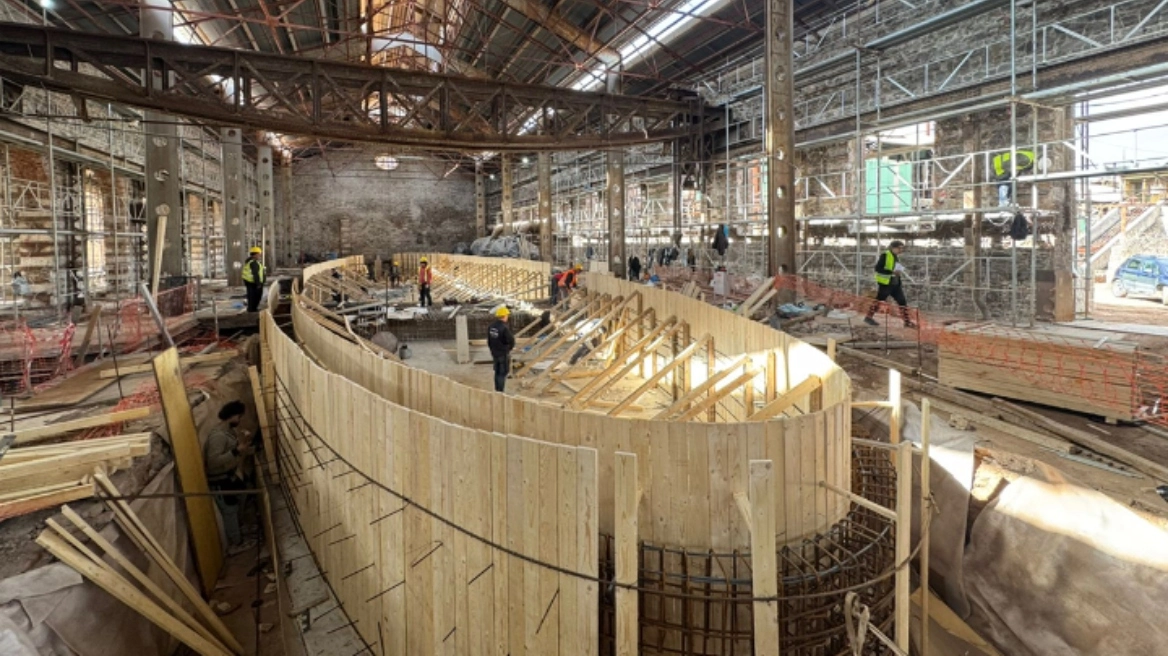
Early photos of DAEDALUS have already generated excitement among those anticipating its operation in Lavrio. The facilities are being adapted to accommodate the system by summer.
The supercomputer comprises complex, specially designed cabinets with direct liquid cooling and high power specifications. It houses more than 2,000 NVIDIA Grace Hopper (GH200) superchips, specifically engineered for large-scale AI applications.
Extensive operational testing of individual units and their integration as a single system is underway at HPE labs to ensure stability and performance under real workloads before installation in Lavrio.
The project is funded in stages: Phase A is supported by the Recovery and Resilience Fund and the Public Investment Program, totaling €29.2 million including VAT. Phase B will upgrade DAEDALUS with EuroHPC Joint Undertaking funds, up to €12.68 million excluding VAT. The overall investment, including equipment, installation, cooling and power infrastructure, and creation of the AI Factory, is complemented by additional costs for support, operation, and human resources to ensure long-term sustainable operation.
“The new national supercomputer DAEDALUS is fully assembled and in its final testing stage before installation at the Lavrio Technological Park. This is not just another technical project. It is a strategic national investment that positions Greece at the core of European computational and technological power. In an era where AI and data shape economic and geopolitical influence, Greece cannot be a mere consumer of technology. DAEDALUS allows us to generate knowledge, innovation, and high-value applications locally,” said Dimitris Papastergiou, Minister of Digital Governance.
He added: “As the computational core of the AI Factory Pharos, it will provide startups, universities, and public institutions access to advanced infrastructure previously available only to a few countries. From healthcare and sustainable development to Greek language and culture, we are creating the conditions for Greece to shape—not just follow—developments. With DAEDALUS, we are building a new pillar of digital sovereignty, realizing our vision of a knowledge-based, technology-driven, outward-looking economy with an active role in Europe’s AI ecosystem.”
Based on current measurements, DAEDALUS is expected to reach computing power of over 89 quadrillion floating-point operations per second (89·10¹⁵ FLOPS, double precision). Compared to home or standard professional computers, this corresponds to millions of times higher speed, enabling tasks that would take conventional systems weeks or months to be completed in hours or days. Its installation marks the first time such a powerful system is hosted in Greece, placing NTUA and Lavrio among Europe’s top high-performance computing hubs in Southeastern Europe.
The infrastructure goes beyond just the machine. DAEDALUS will form the core of Pharos, an AI Factory providing service layers including access rules, support, tools, data management, and human expertise. Pharos aims to make high-performance computing accessible to research centers, universities, startups, and public bodies, offering technical assistance to safely and efficiently harness the system. Sensitive data handling, anonymization, preparation of AI-ready datasets, and proper access policies will all be managed within the Pharos ecosystem, lowering barriers for users.
The practical impact is immediate and multi-layered. For Greek startups and SMEs, DAEDALUS and Pharos offer computing power and technical support previously accessible only through expensive commercial cloud services or with significant delays at international centers. This can reduce development costs and accelerate AI model training cycles, enabling faster transitions from proof-of-concept to functional prototypes in sectors such as healthcare, public services, energy, and environment. Universities and research institutes will gain access to infrastructure for complex simulations and large-scale experiments, reducing reliance on foreign platforms and enhancing industry collaboration.
In healthcare, for instance, a Greek startup could rapidly train large AI models to triage medical images—X-rays or CT scans—while integrating anonymization and secure data management, testing and validating clinical applications far faster than previously possible. Public sector access to national-scale computing power opens opportunities for improved data analysis, rapid crisis response, energy network optimization, and environmental protection and resource management applications.
DAEDALUS will not operate in isolation: it will be part of a European ecosystem of AI factories and computing hubs, strengthening connections with neighboring countries through Pharos “antennas,” enhancing Greece’s technological and geopolitical position. As a regional hub, it is expected to attract collaborations, expand the user community, and increase the scale of projects developed by Greek universities, research institutes, and companies.
Installation and full operation follow a clear timeline: DAEDALUS will be installed in Lavrio in summer 2026, with full services via Pharos expected by fall 2026. The project is implemented under the aegis of the Greek Research and Technology Network (GRNET), with scientific and administrative oversight from leading academics and European program representatives, including EuroHPC and NTUA. Close cooperation between academic, technical, and administrative stakeholders, along with EU and Greek public funding, aims to ensure maximum return on investment for the economy and research.
Despite obvious benefits, the project faces challenges: managing high energy consumption and ensuring reliable, scalable cooling for a liquid-cooled cabinet center requires rigorous infrastructure planning and maintenance. Effective utilization also depends on investment in human capital, clear data governance frameworks, and fair access mechanisms so smaller teams and SMEs can compete on equal terms. Long-term sustainability will rely on delivering high-value services, attracting collaborative projects, and integrating financial models that support operations beyond the initial investment.
In conclusion, DAEDALUS and Pharos represent a strategic national investment designed to close longstanding technological and computational gaps in Greece. The initiative aims to create a national hub for high-performance computing and innovation, supporting top-tier research programs, strengthening Greek entrepreneurship, and elevating the country’s position in Europe’s technological landscape.
Ask me anything
Explore related questions




