





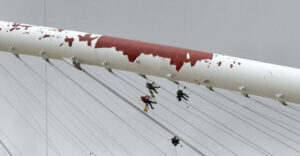
Stunning footage has emerged of the work being carried out recently on the Kalatrava stadium at the OAKA football stadium.
The Coordinator and General Manager of OAKA, Konstantinos Khalioris, made a post on his personal Facebook account, in which he published images of workers hanging from a height of 62 meters, where the highest point (upper arch) is located from the base of the stadium’s construction.
Khalioris notes that “the complexity of the project is exacerbated by the fact that all of the work is performed at great heights, which requires specialized access systems, systematic security protocols and highly trained personnel. The conditions of working at such a height, combined with the use of ultra-high pressure equipment and the need for precision of application, make the project particularly complex and technologically demanding.”
“At the same time, the construction site operates on a 24-hour basis, with constant rotation of specialized crews, in order to strictly adhere to the established schedules and technical milestones of the project.Continuous operation, combined with the high degree of technical difficulty, requires excellent coordination, detailed planning and implementation of advanced project management procedures, ensuring the uninterrupted progress of the work,” stresses the Coordinator and General Manager of OAKA.
He concludes his post by underlining that “With the completion of the works, OAKA enters a new era, with enhanced structural safety, increased resilience and a significantly improved level of reliability. This emblematic infrastructure project is turning a new page, looking to the future with greater security, optimism and technological upgrades, meeting the modern requirements of operating and hosting major international events“.
A project worth €80 million in 14 months
It is recalled that in January 2025, the project “Structural and operational rehabilitation of the two structures of the Central Stadium and the Cycling Track of the Olympic Sports Centre of Athens – Olympic Athletic Centre – OAKA” was announced with an estimated value of 63.09 million euros excluding VAT or 78.23 million euros including VAT and with a duration of 14 months from the signing of the contract.
The objective of the project is the repair of the problematic points and the implementation of the necessary procedures for the restoration of the required level of structural adequacy of the metal structures of the two emblematic roofs of the OAKA, as well as the maintenance – repair – replacement of elements of the metal structures and polycarbonate panels of the roofs of this sports facility.
The two steel arches of the shelter are 80 metres high, 304 metres long each and have a total weight of 9 000 tonnes. The entire roof has an area of 25,000 square metres.
The project in numbers:
– 500 tons of total weight of screws of various sizes
– 1,800 km length of welds
– 80 meters the height that the aerial technicians will climb
– More than 27 meters the depth of the foundations
– 10 km of metal cables
– 116 beams ranging from 33 to 54.8 metres in length that are welded to the two arches
– 304 metres long and 80 metres high metal domes to be repainted
– EUR 78.23 million including VAT for the cost of maintenance
– 25,000 square metres of area covered by the polycarbonate panels, each measuring 1 x 5 metres
The post of the Coordinator and General Director of OAKA, Konstantinos Chaliori, is detailed:
“The Calatrava canopy works of OAKA are in full swing.
The preparation of the metal surfaces of the shelter is carried out through ultra-high pressure water blasting, in accordance with the requirements of ISO 8501-4 standard and cleaning grade Wa2, throughout the entire construction. This is a highly demanding and specialised process, which is carried out with water blasting equipment with a pressure of up to 2500 bar, using appropriate high performance nozzles and a controlled application distance of 10-30 cm from the surface. The process is performed with high precision cross movements in order to achieve uniform cleaning and complete removal of corrosion products, deposits and residues of old coatings, without causing stress or deterioration of the metal substrate.
In areas of increased pathology of the structure, as well as in critical areas such as bolted joints, welds and geometric discontinuities, an additional de-scaling process up to PSa2 grade is applied, with the aim of fully restoring the metal surface and creating a suitable substrate for the new corrosion protection. This differentiated technical approach requiresa high level of expertise, as each surface is evaluated and treated based on its structural condition, loads and durability requirements of the structure.
After the cleaning process is complete, anew, advanced corrosion protection system is applied, selected according to the degree of cleaning and the condition of the existing paintwork. This system includes high-tech coatings with special admixtures and improved mechanical and chemical properties, exceeding the durability requirements set for the specific construction. The application is carried out under strict control of environmental conditions, dry film thickness (DFT) and adhesion, ensuring long-term corrosion protection of the metal structure.
A special technical approach is applied to the arch hangers, where the new external anti-corrosion paint system includes specialised resins and high-strength reinforcing fibres. Materials are selected to ensure compatibility with the existing internal protection system, ensuring the functional continuity of the corrosion protection system and avoiding incompatibility between old and new coatings, which requires special experience and expertise in large-scale complex metal structures.
After completion of the water blasting and before the application of the new coatings, an extensive technical inspection of the structure is carried out. In particular, non-destructive testing of the welds is carried out using ultrasonic testing (UT), with the aim of detecting possible failures, microcracks or internal discontinuities. At the same time, a full tightening check of all bolted connections is carried out, with replacement of worn or non-compliant bolts, ensuring the structural integrity and operational safety of the structure.
The complexity of the project is compounded by the fact that all work is carried out at a great height, up to 62 metres from the base of the structure (maximum upper arch height), which requires specialised access systems, strict safety protocols and highly trained personnel. Working conditions at such a height, combined with the use of ultra-high pressure equipment and the need for precision of application, make the project particularly complex and technologically demanding.
At the same time, the construction site operates on a 24-hour basis, with a constant rotation of specialized crews, in order to strictly adhere to the established schedules and technical milestones of the project. The continuous operation, combined with the high degree of technical difficulty, requires excellent coordination, detailed planning and implementation of advanced project management procedures, ensuring the uninterrupted progress of the work.
The project is financed through the Development Fund, with the support of the Super Fund, underlining the strategic importance of the intervention for the upgrading of the national sports infrastructure. It is an investment of high technical value, incorporating modern technologies for the maintenance and rehabilitation of large metal structures.
With the completion of the works, OAKA is entering a new era, with enhanced structural safety, increased durability and a significantly improved level of reliability. This emblematic infrastructure project is turning a new page, looking to the future with greater safety, optimism and technological upgrading, meeting the modern requirements of operating and hosting major international events.”
Ask me anything
Explore related questions




