





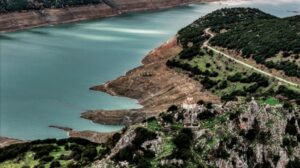
A striking, as well as comforting, reversal of fortunes has been recorded in recent months in the Morno River basin, as the alarm raised in the fall of 2025 over water adequacy in the capital appears to be coming to an end.
Within about six months, water supplies in the reservoir showed a spectacular over-tripling, radically changing the image of the man-made lake and “swallowing” back the submerged village of Kallio, which had emerged offering an image both otherworldly and alarming at the possibility of an unrelenting drought.
From absolute dryness to an over-tripling of cubic feet
The data processed by the Orange Press Agency is revealing of the speed of the recovery. On Oct. 23, 2025, the lake was at its lowest level in 15 years, with reserves, according to data from EYDAP, having plummeted to 156,996,000 cubic metres. At the last available measurement, that of 8 April 2026, the level has risen dramatically, with the volume of water now approaching 491,629,000 cubic metres.
The expansion of the lake surface is similar. While on 9 October 2025 its area had shrunk to 8.3 square kilometres (down 44% from the average of the last decade), measurements taken on 7 April 2026 show that the lake covers more than 14.7 square kilometres.
This increase has resulted – as shown in the Orange Press Agency’s drone footage – in the old settlement of Kallio being covered by water again, with only a few minimal buildings and wall tops now rising above the surface, reminiscent of the dramatic situation of the previous months.
Laguvardos: Impressive rains and snow cover have significantly improved the situation
Meteorologist and Director of Research at the National Observatory of Athens, Kostas Lagovardos, speaking to the Orange Press Agency, analyzed the latest data from the Athens Observatory’s Artificial Lake Mornos Observatory (meteo.gr), as well as the data of the EADAP, and acknowledged the rapid change.
“The last high-resolution satellite photo we had a fortnight ago shows the area of the artificial lake of Mornos, at about fourteen square kilometers, which is about minus 20% below the normal value for this period. So we’re in much better shape than we were in the autumn obviously, but we’re still a little bit below normal” notes Lagovardos.
As for rainfall, he explains that “the first quarter of the year has been impressive in the region. Both rain gauge stations of the National Observatory of Athens in the Mornos catchment area are at the highest rainfall point for the first three months of the year in the last decade.
Regarding the snow cover of the region, although we had lower than normal snow cover in March due to the limited phenomena, in the last few days, due to the phenomena we had from the last bad weather, we are currently almost at normal levels.”
“We should not be complacent”
Regarding the reserves announced by EYDAP, Costas Lagovardos says that “obviously we are in a situation that takes us out of the alarm we had in the autumn, when we saw the water level in the artificial lake too low. But in no way should we be complacent, because we’re going into the period now where we’re not going to have rain in the area, because we’re going into spring, into summer. We will have more evaporation because of the rise in temperature and of course the consumption that will follow in the coming months. And we all hope to have a good hydrologic year next year as well, so we can say that for at least a long period of time we will not have a problem with the availability of water from the Morno River.”
The “black” October of 2025
Today’s relief comes after a period of intense concern, during which all relevant authorities were mobilised.
It will be recalled that in October 2025, the shrinking lake had revealed an eerie landscape, evoking memories of the great drought of the early 1990s. Observatory data at the time showed that 2025 was shaping up to be the driest year in a decade, with rainfall remaining consistently below the 2015-2024 average.
By comparison, while 2018 stocks had peaked at 605,563,000 cubic feet, the drop to 156 million cubic feet last October had made Morno a “shadow” of its former self. The impressive rainfall in the first quarter of 2026, which was described as the highest in the region in a decade, was the catalyst that allowed the reservoir to recover and the sunken village of Kallio to return to where it belongs: its “sacrificial” place at the bottom of the lake.
Ask me anything
Explore related questions




