





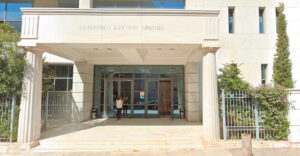
A scent of scandal emerges from a case currently unfolding at the Athens Administrative Court of Appeals and engaging both criminal and administrative justice. The financial stakes reach €100 million. The case originates from a long-standing financial dispute between a well-known hotel group with roots in Crete and the Hotel Chamber of Greece (HCG).
The dispute began 27 years ago, when, ahead of the 2004 Olympic Games in Athens, the hotel group signed a 1999 lease agreement with EOT for a 326-stremma plot in Lagonisi, with a duration of 40 years.
The concession of the land went through many stages and the contract ultimately failed due to delays.

The group, prompted by a letter from the late Aristotelis Divanis, then president of the Hotel Chamber of Greece, addressed to the Ministers of Development and Finance and the CEO of the Hellenic Tourist Properties SA (ETAD), which managed EOT assets, regarding booking practices and prevention of unfair competition, considered that these letters led to the cancellation of the lease agreement between ETAD and the hotel group.
Thus, the group filed a lawsuit/application before the Athens Administrative Court of First Instance against the HCG, claiming lost profits due to the cancellation of the agreement. It demanded €60,925,868 plus an additional €3 million for moral damages due to reputational harm.
After decades, the claimed amount, including legal interest, has risen to €100 million. In fact, as the case will be retried, the amount may exceed €100 million.
Appeal
The lawsuit failed at the first two levels (First Instance and Court of Appeal) and after cassation it reached the Council of State, which in 2023 partially annulled the decision of the Administrative Court of Appeal and remanded the case back to the Athens Court of Appeal, as clarifications of factual circumstances were deemed necessary.
A three-member panel of the Athens Administrative Court of Appeal heard the case again in public session on 19/5/2025, presided over by Appeals Court President A.T., reporting judge A.M., and member judge E.-M.L.
However, after the hearing and while the case was in the deliberation stage, A.T. engaged in a series of repeated changes to the lawful composition of the court, which were recorded in the official minutes of the proceedings.
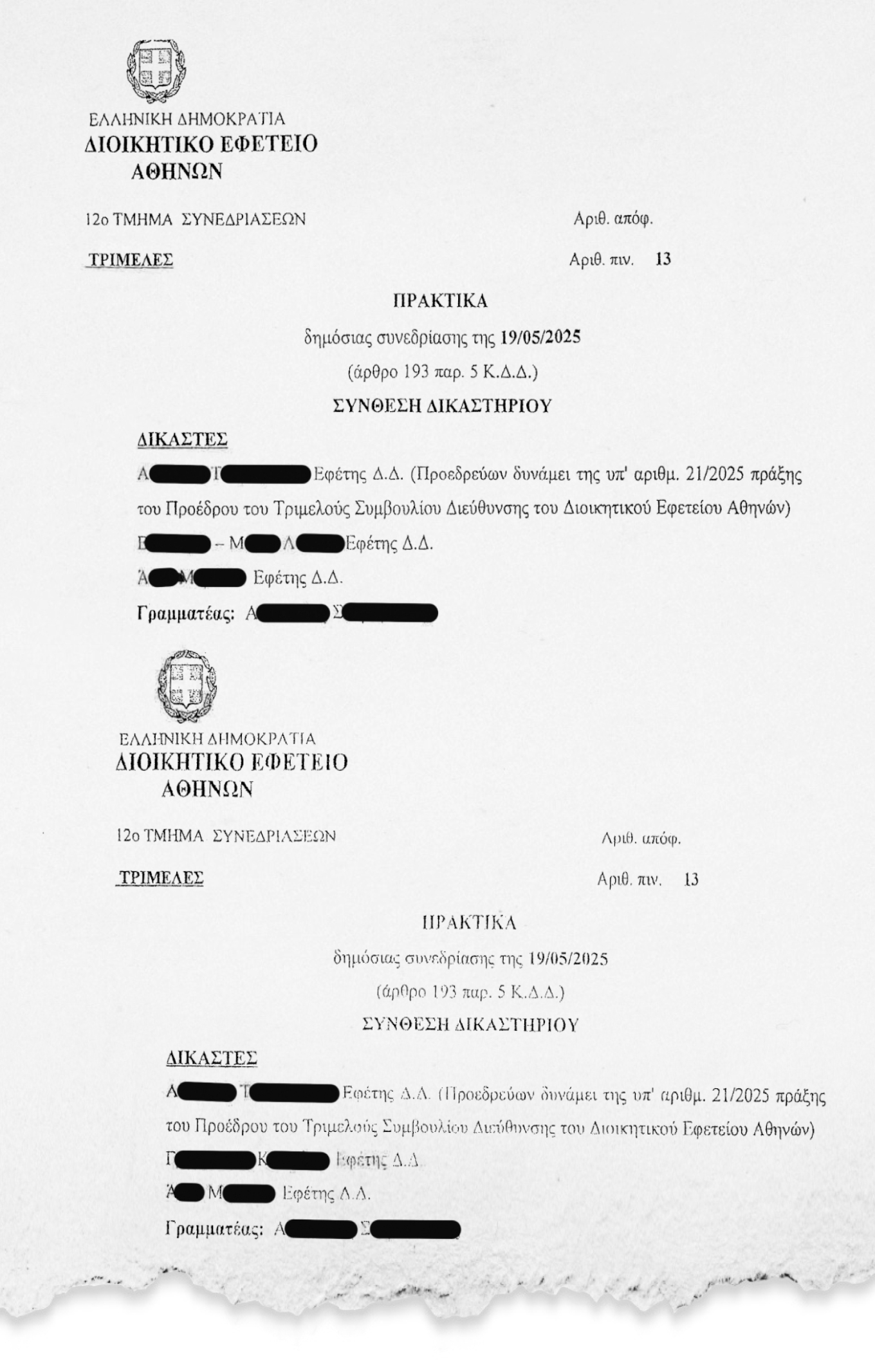
Two of the minutes showing changes in the composition of the court in the hotel case
According to information, at the beginning of the deliberation that started on 19/1/2026, the president informed the other members that he intended to change the composition of the court. After objections, A.T. assured that the composition would remain as it was.
Thus, deliberation began, and the reporting judge A.M. stated she would reject the hotel group’s financial claim.
In contrast, the president stated he had studied the case and held a different view. The third member, E.-M.L., declared she reserved judgment for the next deliberation.
Before the next, second deliberation on 16/2/2026, the president announced he had changed the composition and that E.-M.L. was no longer a member, without her having declared any official impediment or force majeure. She was replaced by G.K.
The other two members objected, and the president reinstated E.-M.L. However, in the next deliberation, the president made another change, claiming that determining the composition was solely his responsibility, triggering new objections from the two other judges.
He was then forced to restore the original composition. The two members filed a report against the president to the Council of State and the General Commission of Administrative Courts, and submitted a request to withdraw from the case; four days later, the president did the same.
Summons for testimony
The E.-M.L. and A.M., as part of a preliminary investigation, have been summoned to testify before the Prosecutor’s Office in the coming days. According to colleagues, the president of the panel may face charges including breach of duty, falsification of judicial documents, and violation of the secrecy of court deliberations.
At the same time, Council of State President Michalis Pikramenos has already initiated disciplinary proceedings regarding the changes in the court’s composition and has assigned the disciplinary file to Councillor Konstantina Lazaraki. It has been emphasised that changes in court composition are impermissible, as they violate the constitutional principle of the lawful judge.

Council of State President Michalis Pikramenos
According to information, President A.T., in a report submitted to the General Commission of Administrative Courts—also communicated to the President of the Council of State—claims that the allegations against him are false and malicious.
The reports claim he attempted to change the composition immediately after the first deliberation, allegedly upon realising the reporting judge’s negative recommendation.
It should be noted that in the past, illegal activity by administrative judges had also been revealed in the courts on Riankou.
Official statement of the General Commission of Administrative Courts
Following a publication on 3 May 2026 in the Sunday edition of PROTO THEMA, we deem it necessary to inform that the reports submitted to the General Commission of Administrative Courts by members of a panel of the Athens Administrative Court of Appeal, along with all relevant documents deemed necessary, were immediately forwarded to the competent disciplinary bodies of the Council of State.
We expect the swift clarification of the case and the attribution of any responsibilities to those found to be involved, so that no shadow is left over administrative judges, with all the adverse consequences this may have for the prestige of justice in general.
Statement of the Association of Administrative Judges
We are following with particular concern the reports that have come to light regarding a case of extremely high financial value, in which there are alleged later interventions in the composition of the court and the official minutes of the hearing.
It must be emphasised that the investigation was initiated by the judges themselves through disciplinary reports and that the competent judicial bodies have immediately taken action.
We call for full transparency and, if judicial officers are found to be involved, for disciplinary and criminal responsibilities to be attributed without any leniency.
Ask me anything
Explore related questions




