





The crisis in the Strait of Hormuz is entering a new phase of tension, with Donald Trump announcing strikes against Iranian vessels and the United Arab Emirates reporting attacks on ships and energy infrastructure, heightening concerns over maritime security and the global energy market.
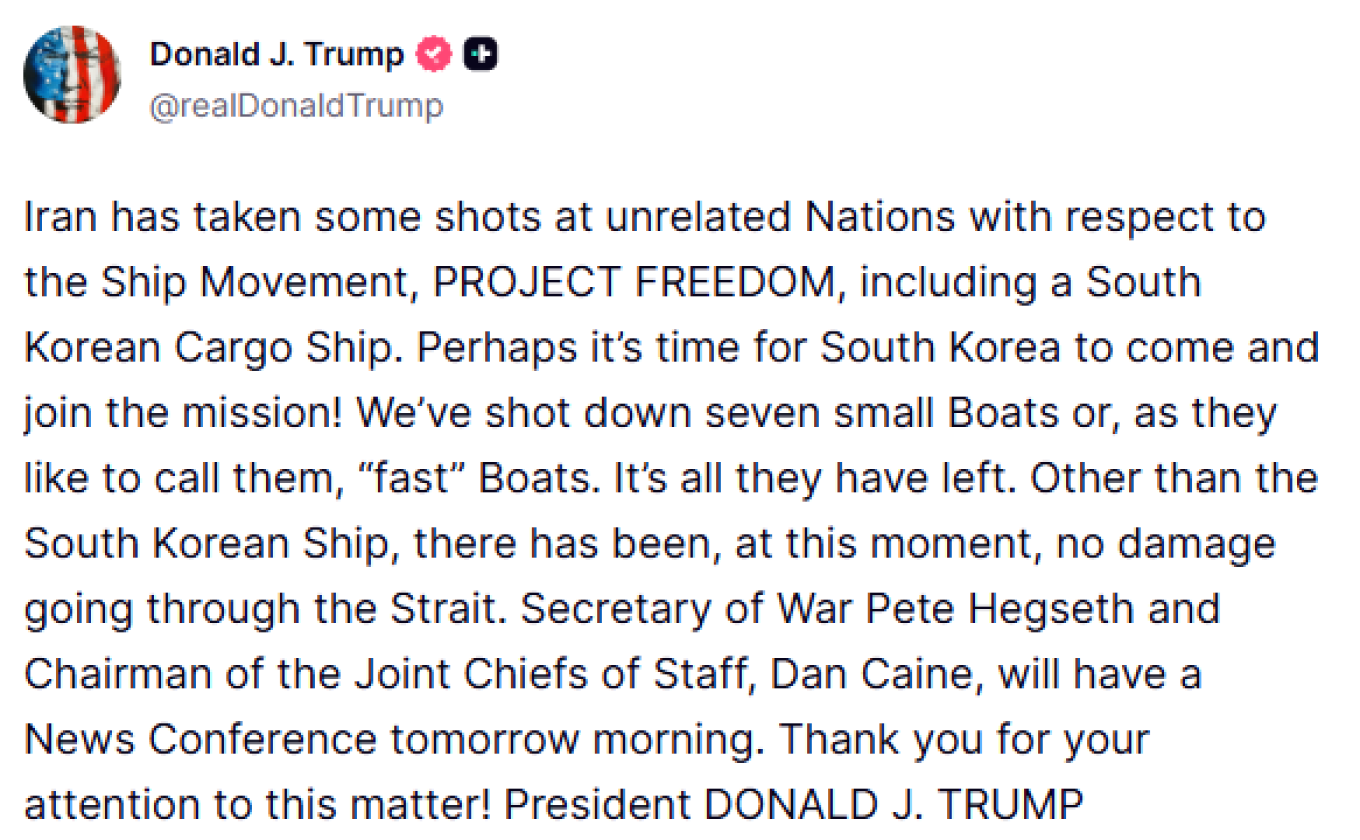
The US president stated that American forces destroyed seven Iranian “speedboats” in the Strait of Hormuz as part of “Project Freedom,” aimed at escorting and removing commercial ships trapped in the area.
“We shot down seven small vessels or, as they call them, ‘fast’ boats. It’s all they have left,” he said, adding that helicopters were used in the operations. Iran denied that such attacks took place.
For his part, Iran’s Foreign Minister, Abbas Araghchi, said via X that developments in the Strait of Hormuz demonstrate that “there is no military solution to a political crisis.”
At the same time, he referred to progress in ongoing talks, highlighting the role of Pakistan, which – as he said – is contributing positively to the process. He also issued a warning to the United States, stressing the risk of becoming entangled once again in a “quagmire” due to the actions of third parties, while making a similar recommendation to the United Arab Emirates.
Concluding, he underlined that the “Freedom Plan” is ultimately turning into a “Deadlock Plan.”
Conflicting accounts of the incidents
Washington claimed that naval destroyers and US-flagged commercial ships crossed the Strait on Monday; however, Tehran described these claims as “completely false,” with Iranian armed forces stating they were limited to warning shots against a US warship – something the US also denied.
Shipping company Maersk announced that one of its US-flagged vessels, the Alliance Fairfax, managed to exit the Persian Gulf under escort by US military forces, without incident and with the crew safe.
The company stated that it was offered the option to evacuate the vessel under military protection as part of the operation being advanced by Washington.
Attacks on ships and energy infrastructure
The United Arab Emirates and South Korea reported attacks on ships in the Strait of Hormuz. At the same time, UAE authorities announced that a tanker linked to state company Adnoc was struck, while an explosion and fire occurred at the oil port of Fujairah, resulting in three injuries.
Authorities said air defense systems were activated, intercepting 12 ballistic missiles, three cruise missiles and four drones.
Abu Dhabi described the attacks as a “dangerous escalation” and stated it reserves the right to respond, while Iranian state media reported that Tehran “does not plan to target the UAE.”
International reactions and energy implications
International leaders condemned the attacks, with French President Emmanuel Macron calling them “unjustified and unacceptable,” and UK Prime Minister Keir Starmer stating that his country will continue to support the defense of its partners in the Gulf.
Brent crude prices exceeded $115 per barrel, rising by more than 5%, amid concerns over the security of energy supply.
The Strait of Hormuz has remained largely closed since February, when the US and Israel launched airstrikes against Iran, with Tehran responding by blocking passage through this strategic maritime route, through which around 20% of the world’s oil and natural gas flows.
Despite the ceasefire announcement in early April, navigation remains restricted, with around 20,000 seafarers on 2,000 ships still stranded in the area.
Trump stated that the US is receiving requests from many countries to release ships that “remain trapped,” warning that force will be used if the operation is obstructed.
In Oman, two people were injured when a residence in the Bukha area, along the Strait of Hormuz coastline, was hit, according to state media.
Qatar condemned the attack on a tanker linked to Adnoc and called for the “unconditional reopening” of the Strait.
Ask me anything
Explore related questions




