





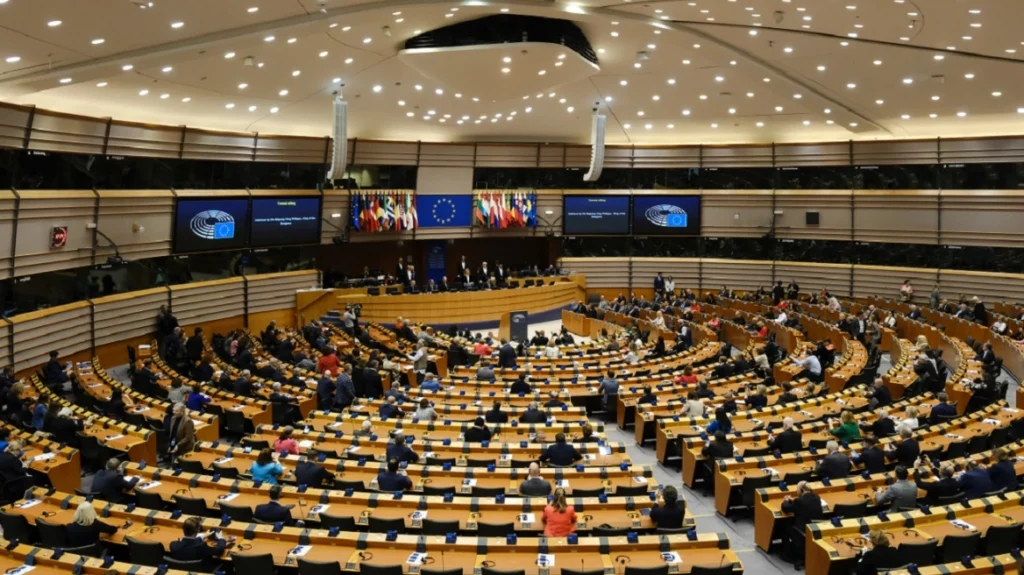
The European Parliament has approved its annual report on Turkey by a wide majority, warning that Ankara is moving further away from the principles, values and strategic interests of the European Union. The report was adopted with 381 votes in favour, 107 against and 171 abstentions.
The report also expresses concern over Turkey’s continued maintenance of the casus belli against Greece and criticises the ongoing violation of the sovereignty and sovereign rights of EU member states, particularly Greece and Cyprus.
The text, drafted by Spanish Socialist MEP Nacho Sánchez Amor, recalls that Turkey’s EU accession negotiations have remained “frozen since 2018” due to concerns relating to the rule of law.
It notes that, because of the “lack of progress” and the “democratic backsliding” recorded in Turkey, “Turkey’s EU accession process cannot be resumed under the current circumstances”.
Particular emphasis is placed on human rights and rule-of-law issues, with the European Parliament describing the situation as “dire” and referring to continuing “democratic regression”. The report also notes that legislative measures and policies remain in force which, according to the Parliament, undermine the rule of law and fundamental rights.
For the first time, the European Parliament’s report strongly criticises the silence of other EU institutions and many member states regarding the erosion of the rule of law in Turkey, urging them to be “more vocal” on the matter.
At the same time, the Parliament encourages the Turkish government, EU institutions and member states to continue working, beyond the frozen accession process, towards a “closer, more dynamic and strategic partnership”. The report examines EU-Turkey relations beyond accession in areas of mutual interest and reiterates its call for the resumption of all relevant high-level dialogues to address shared challenges, including the modernisation of the Customs Union. It also stresses the importance of Turkey fulfilling the outstanding benchmarks required to restart the visa liberalisation process.
Regional Cooperation and Good Neighbourly Relations
The European Parliament expresses support for Greek-Turkish dialogue, including the Mitsotakis-Erdogan summit of February 2026, as a step towards de-escalation in the Eastern Mediterranean. At the same time, it reiterates its call for Turkey to adopt a “constructive rather than assertive or aggressive approach” in the region.
The Parliament criticises Turkey’s promotion of the “Blue Homeland” doctrine, expresses deep concern over the continued maintenance of the casus belli against Greece—which it describes as incompatible with relations between allies and good neighbours—and condemns the ongoing violation of the sovereignty and sovereign rights of EU member states, particularly Greece and Cyprus.
Specific reference is made to violations of Greek airspace, the “political instrumentalisation” of the NAVTEX system, interference in projects of common European interest such as the Great Sea Interconnector and EastMed, objections to Greece’s proposed marine park in the Aegean, and the increase in illegal fishing activities by Turkish vessels within Greek territorial waters.
The European Parliament once again calls on Ankara to fully respect the sovereignty of member states, including their right to delimit Exclusive Economic Zones (EEZs) in accordance with international law and the United Nations Convention on the Law of the Sea (UNCLOS). It also reiterates that the Turkey-Libya memorandum “violates the sovereign rights of third states, is incompatible with the Law of the Sea and cannot produce legal consequences for third countries”.
The Parliament emphasises the need to implement the recommendations of the Venice Commission, particularly regarding minorities such as the Greek Orthodox population of Imbros and Tenedos, as well as respect for the Ecumenical Patriarchate through recognition of its legal personality and the title of Ecumenical Patriarch.
It also expresses deep concern over the lack of protection for World Heritage monuments such as Hagia Sophia and the Monastery of Panagia Soumela, as well as acts of vandalism against minority places of worship, calling for the immediate implementation of UNESCO decisions.
Security and Defence
On security and defence matters, the report underlines Turkey’s strategic and geopolitical importance to both the EU and NATO, recognising its growing role in regions critical to European security, including the Black Sea, Ukraine, the South Caucasus and the Middle East, as well as its contribution to EU crisis-management missions.
The European Parliament supports the further strengthening of practical EU-Turkey cooperation on security and defence where common strategic interests exist. However, it expresses concern over Ankara’s continued obstruction of EU-NATO cooperation through the exclusion of an EU member state and calls on Turkey to end this practice.
The report also records a further deterioration in Turkey’s alignment with the EU’s Common Foreign and Security Policy, which fell from 6% in 2024 to 4% in 2025—the lowest level ever recorded.
While welcoming the intensification of political dialogue and Turkey’s participation in EU missions, the Parliament expresses concern over the increasingly anti-Western stance of the Turkish authorities. It calls on Ankara to remove obstacles that undermine trust among allies, including the continued maintenance of the casus belli against an EU member state, challenges to the sovereignty of other countries and the retention of the Russian S-400 air defence system.
In addition, the report expresses serious concern regarding Turkey’s growing engagement with BRICS+ and the Shanghai Cooperation Organisation, stressing that full membership of BRICS+ would be fundamentally incompatible with its EU accession path.
Despite these reservations, the European Parliament believes that, in light of current geopolitical developments, “opportunities for cooperation with Turkey within the framework of current and future EU security and defence policies should be explored”. At the same time, however, it calls on Ankara “to remove the serious obstacles that undermine trust between partners and allies”.
Cyprus
The European Parliament reaffirms its long-standing position that the only solution to the Cyprus issue is a fair, comprehensive, viable and democratic settlement within the agreed United Nations framework, based on a bicommunal, bizonal federation with a single international legal personality, single sovereignty, single citizenship and political equality, as defined in the relevant UN Security Council resolutions, agreed areas of convergence and the framework of the UN Secretary-General, and in accordance with international law and EU principles and values.
It welcomes recent initiatives aimed at restarting negotiations, including informal UN-sponsored meetings during 2025 and 2026, as well as confidence-building measures between the two communities.
At the same time, it condemns Turkey’s unilateral actions, including the illegal settlement of residents in Varosha and the appropriation of Greek Cypriot properties, while calling for the withdrawal of Turkish troops from the island and respect for the Green Line.
Finally, the Parliament underlines that the prospect of closer EU-Turkey cooperation depends on full compliance with the Copenhagen criteria and Ankara’s constructive contribution to resolving the Cyprus issue, including demilitarisation and the protection of human rights.
The report’s rapporteur, Nacho Sánchez Amor, stated that “Turkey’s EU accession process cannot be restarted under the current circumstances”. He stressed that for the past ten years “we have been waiting for good news” from Turkey, yet there has been an “absolute lack of willingness” to comply with European principles.
He argued that “Turkey is now a genuinely authoritarian country” and asked “what place an authoritarian country can have in the European Union”, while noting that there remains a civil society that seeks democracy rather than authoritarianism.
He added that “we do not want to extinguish their last hope”, but stressed that the rule of law and human rights are prerequisites for EU membership.
Sánchez Amor further stated that it is necessary to build a workable framework for coexistence with Turkey, but that Greece and Cyprus constitute critical and inseparable pillars of that relationship. While security and defence issues remain central, he said, serious trust deficits and departures from the principles of good neighbourly relations continue to exist and must be addressed in a meaningful manner.
Ask me anything
Explore related questions




