





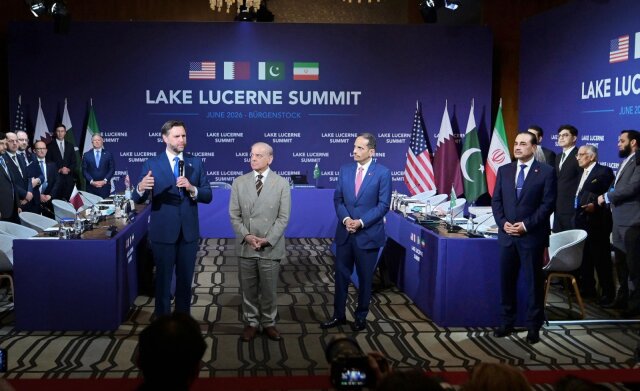
The first round of renewed talks between the United States and Iran ended in Switzerland with public expressions of optimism, although diplomats and analysts warned that the route towards a final agreement remains uncertain and politically fragile.
The negotiations, held at the Bürgenstock resort above Lake Lucerne, are aimed at turning a temporary ceasefire into a more durable settlement and opening the way for a broader agreement between Washington and Tehran within 60 days.
Mediators from Pakistan and Qatar said US Vice President J.D. Vance and the Iranian delegation had made “encouraging progress”, while Swiss authorities described the talks as constructive. The atmosphere around the negotiations, however, remained tense, with leaked accounts from the closed-door discussions suggesting that the next two months could bring delays, setbacks and renewed pressure from both sides.
Vance rejects claims Trump’s Iran threats derailed Swiss talks
The US vice president said Donald Trump’s remarks caused a temporary pause in the negotiations but insisted the talks resumed and made “significant progress”
US Vice President J.D. Vance has rejected claims that Donald Trump’s inflammatory remarks undermined weekend negotiations with Iran, speaking at a press conference in Bürgenstock, Switzerland, after the talks concluded. “No, they did not get in the way of the process,” Vance said.
Trump, who spent the weekend at Camp David, had threatened fresh strikes against Iran during a phone interview with Fox News. He also warned the Iranian president to “be careful what he says” while negotiations were still under way.
Vance acknowledged that Trump’s remarks had led to a temporary interruption in the talks.
🔊PR No: 1️⃣5️⃣1️⃣/2️⃣0️⃣2️⃣6️⃣
Joint Statement by the State of Qatar and the Islamic Republic of Pakistan Regarding the Conclusion of the Lake Lucerne Summit, First High-Level Committee Meeting with Participation of the United States of America and the Islamic Republic of Iran pic.twitter.com/2G3PAf7LVY
— Ministry of Foreign Affairs – Pakistan (@ForeignOfficePk) June 22, 2026
Iranian delegation leaves and then returns
The Iranian delegation, led by Mohammad Bagher Ghalibaf, the speaker of Iran’s parliament, briefly withdrew from the process on Sunday after a social media post by US President Donald Trump, who threatened to resume American strikes against Iran if no agreement was reached.
The Iranian team later returned to the talks, allowing the first round to continue.
The incident underlined the volatility surrounding the negotiations. The Iranian side also refused to take part in a planned handshake and joint photograph with the US delegation, another sign that the talks may have entered a more formal diplomatic phase without losing their confrontational edge.
The Iranian delegation refused to take part in a planned handshake and joint photo-op with the U.S. delegation.
Source: Tasnim pic.twitter.com/Cgpz5LkGTO
— Clash Report (@clashreport) June 21, 2026
Nuclear issue left for later
The 60-day timetable was included in the initial memorandum of understanding signed last week by Donald Trump and the Iranian president. It was intended to give both sides time to address major issues not fully settled in the first agreement.
The most important of these is Iran’s nuclear programme.
The memorandum says Tehran will dilute existing stockpiles of nuclear material close to weapons-grade level. It does not set out how that process will be carried out, nor does it make clear whether Iran will be barred from producing such material in the future.
Despite the importance of the nuclear issue, it did not dominate the first round of talks. Instead, discussions focused mainly on two matters that, in theory, should already have been stabilised: the ceasefire between Israel and Hezbollah in Lebanon and freedom of navigation through the Strait of Hormuz, including for oil tankers.
Alhamdulillah, the First High-Level Committee Meeting under the framework of the Islamabad Memorandum of Understanding has concluded successfully in Bürgenstock, Switzerland.
The discussions took place in a positive and constructive atmosphere and yielded encouraging progress,… pic.twitter.com/uvA0SBKfvf
— Shehbaz Sharif (@CMShehbaz) June 22, 2026
Lebanon and the Strait of Hormuz in the spotlight
srael launched its war against Iran in February in coordination with the United States, although it was not formally part of last week’s initial agreement.
Despite the ceasefire provisions, Israel and Hezbollah continued to exchange attacks in Lebanon. Iran protested against Israeli operations over the weekend and announced that it had closed the Strait of Hormuz, a critical route for global oil shipments that had already been disrupted during the war. The move helped push international oil prices higher.
US officials disputed Iran’s account and said shipping was continuing as normal.
According to mediators from Qatar and Pakistan, the talks produced a communication channel designed to prevent incidents in the Strait of Hormuz, as well as a de-escalation mechanism for Lebanon. They did not provide detailed information on how either mechanism would operate.
Analysts warn against excessive optimism
Some analysts cautioned that the initial positive reaction may be premature.
Karl Weinberg, chief economist at the US firm High Frequency Economics, said in a briefing note that financial markets had responded to the first Trump-Iran agreement with “a classic display of irrational exuberance”.
“This week is expected to bring a return to reality,” he said.
Weinberg suggested that Iran could seek to extend negotiations well beyond the 60-day deadline, possibly even until January 2029, when the next US president takes office.
Uncertainty over the next stage
The stop-start character of the talks has added to uncertainty. Vance had been due to travel to Switzerland on Thursday evening, but cancelled the trip at the last minute after Iran temporarily withdrew from the process in protest against continuing Israeli attacks in Lebanon, according to diplomatic sources.
When the talks were rescheduled for Sunday, the US vice president sounded optimistic. Asked about Lebanon, he told reporters that “things are improving” and that tensions appeared to be easing.
After arriving in Switzerland, however, Vance and his team avoided giving any clear assessment of how far the negotiations had advanced.
By Monday morning, the Iranian delegation had left the resort, while it remained unclear when Vance would depart.
A long road to any final agreement
None of the statements from mediators or Iranian officials suggested that the talks were moving towards the rapid concessions from Tehran that Trump had previously predicted.
Ghalibaf wrote on social media that Iran’s armed forces were “ready to respond” if the United States launched another attack, leaving open the possibility of further escalation.
Even so, statements from the mediators and Swiss authorities suggested that the talks had at least opened a more structured diplomatic process.
Qatar and Pakistan said the discussions had led to the creation of a mechanism for further technical negotiations, while Swiss authorities said the parties had agreed on a roadmap intended to produce a final agreement within 60 days.
“Our goal,” the Swiss authorities said, “is for our diplomacy to contribute to de-escalation, stability and peace.”
Ask me anything
Explore related questions




