





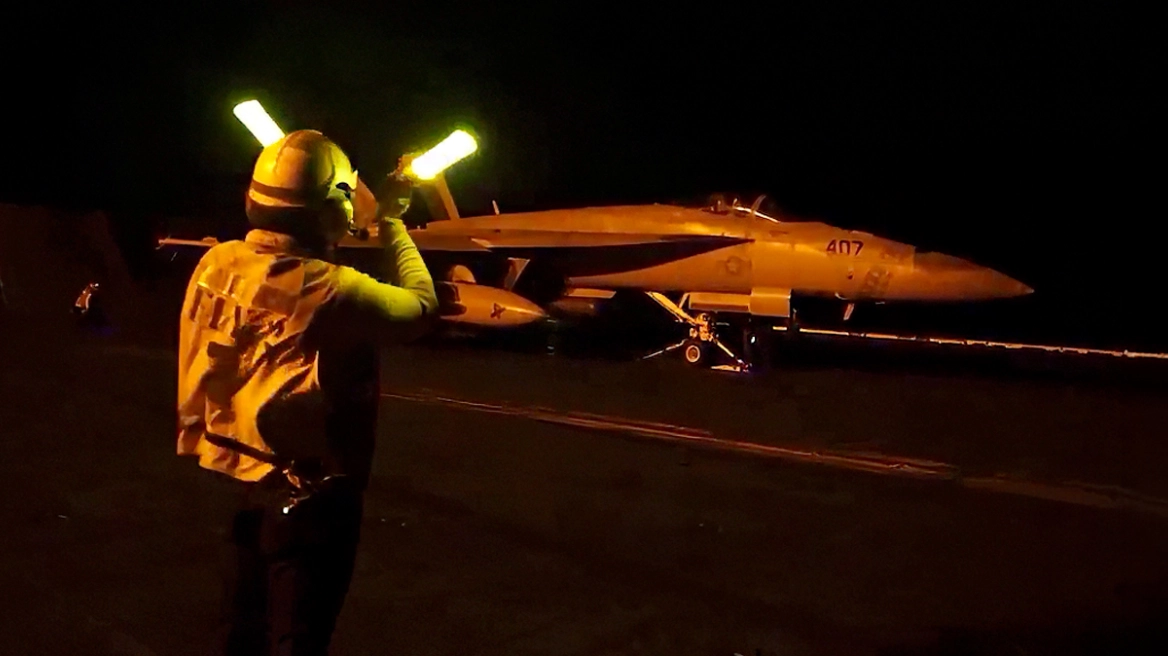
U.S. Armed Forces targeted positions deep inside Iranian territory—and possibly Tehran itself—during the 11th wave of airstrikes against the Islamic Republic, launched in the early hours of Wednesday.
As the cycle of U.S. bombings and Iranian retaliation shows no sign of ending, Yemen’s Houthi movement appears intent on opening a new front in the Red Sea, threatening to choke global trade as two critical maritime chokepoints—the Bab el-Mandeb Strait and the Strait of Hormuz—could effectively be operating at reduced capacity.
Targets Deep Inside Iran
The U.S. Central Command (CENTCOM) strikes against Iran, which began at 2:00 a.m. Greek time on Wednesday, “are designed to continue degrading Iran’s ability to threaten commercial shipping in the Strait of Hormuz,” the U.S. military’s joint command for the Middle East said in a post on X.
This has become CENTCOM’s standard wording for the attacks carried out against Iran in recent days, although it is difficult to explain how all of the reported targets are directly connected to the Strait of Hormuz.
The operation lasted approximately one hour and fifteen minutes, with CENTCOM stating that it struck naval forces, aircraft shelters, drone storage facilities, and military logistics infrastructure.
Reports from Iran indicate that the United States targeted Ilam Province in western Iran, the areas of Chovan and Abdanan, as well as the port of Mahshahr.
Iran’s state news agency IRNA confirmed that explosions shook the provinces of Bushehr, East Azerbaijan, Hamadan, Hormozgan, Khuzestan, and Sistan-Baluchestan.
There also appeared to have been a limited Iranian counterattack, as Kuwait once again activated its air defenses against missiles and drones that reportedly originated from Iran.
What the next phase of military operations will bring remains unclear. However, Donald Trump had already indicated that Iran’s “nuclear stronghold” would be the next target, claiming that Tehran would be unable to prevent such an attack.
For his part, U.S. Secretary of State Marco Rubio argued today that allowing Iran to control the Strait of Hormuz would create “a dangerous precedent” with consequences extending far beyond the Middle East, where military conflict between Washington and Tehran has once again intensified.
“If we created a precedent in the Middle East where a nation-state can decide to control an international shipping route, impose transit fees, and blow up ships that do not pay, we would create a very dangerous precedent that would be repeated in other parts of the world, including this region,” Rubio said during the ASEAN foreign ministers’ meeting in Manila, Philippines.
Anti-Aircraft Fire Over Tehran
For the first time since the latest phase of operations began, air defense systems were activated in Tehran, and explosions were heard in the northeastern part of the city, according to a reporter for the German Press Agency (dpa). The incidents occurred shortly after the U.S. military announced that it was carrying out airstrikes against the Islamic Republic for the 11th consecutive night.
According to dpa, this marks the first time Tehran itself has been targeted since the U.S.–Iran conflict reignited on 7 July.
Oil Prices Climb Again
Against this backdrop, oil prices continued their upward trajectory, reaching a five-week high on Tuesday. Brent crude futures closed at $90.85 per barrel, while U.S. West Texas Intermediate (WTI) reached $84.91 per barrel.
Oil prices continued to rise in Asian trading on Wednesday, with Brent crude reaching its highest level in more than a month.
At around 4:30 a.m. Wednesday, Brent crude was trading 1.2% higher at $92.09 per barrel, its highest intraday price since 11 June. West Texas Intermediate, the main U.S. oil benchmark, rose 1.1% to $85.23 per barrel.
Ask me anything
Explore related questions




