





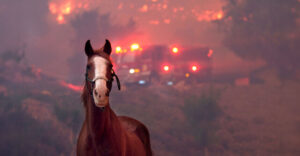
Disoriented roe deer in blazing forests, lizards trapped by the speed of the fire’s spread. Wild animals are paying a heavy price in the unprecedented fires sweeping France, particularly Gironde, in the southwest of the country.
It is still too early to assess the damage caused by the fires. However, the consequences will be “catastrophic,” according to Ecological Transition Minister Monique Barbut, who expects wildlife losses to be “extremely severe”.
In some zones, such as the commune of Le Porge, in Gironde, which was destroyed by fire, “nothing resisted” the flames, said forestry engineer Laurent Tillon, who works for the National Forests Office (ONF, France’s national forestry agency). “The force of the fire and the energy released were enormous,” forestry engineer Tillon said.
As often happens with forest fires, wildlife falls into two categories: animals able to escape, and those trapped by the flames.
Trapped wildlife
Amphibians, insects, reptiles. Many species lack the speed to escape as flames spread rapidly. Among them are endangered animals such as the spadefoot toad, a species found along the Mediterranean and Atlantic coasts; the ocellated lizard, one of Europe’s largest lizards, distinguished by its vivid colouring; and the Etruscan shrew, the world’s smallest mammal.
Insects will also be significantly affected, particularly those at the larval stage and those living in forests, said ornithologist Grégoire Loïs, who works at the National Museum of Natural History in Paris. As a result, the return of songbirds to burnt forests will also be difficult, since they feed mainly on insects. “The area will be completely inhospitable next year,” as the food chain breaks down, ornithologist Loïs explained.
For marine species, ash and toxic smoke particles will prove devastating, specialist Céline Sissler-Bienvenu, an expert in animal protection and crisis management, told AFP (Agence France-Presse). Specialist Sissler-Bienvenu cited the European pond turtle as an example, a species already affected by the 2022 fires.
Animals that escaped no longer have a home
Many fast animals managed to flee before the flames reached them, but that does not mean they are safe. A roe deer or a red deer can clear a two-metre fence in a single leap and reach the road, but panicked animals leaving the forests risk colliding with cars or trains, ornithologist Loïs said.
There are also “secondary” risk factors linked to the toxicity of the smoke, or to plastic particles that birds will inhale, specialist Sissler-Bienvenu said. She was due to travel the following day to the commune of Mézos, in Landes, to help firefighters protect animals.
Those that survived will need to adapt in order to endure. “They will be forced to find a place in other territories, which are already occupied by other animals, and resources are not sufficient for everyone,” ornithologist Loïs said.
The question of reintroducing wildlife will arise at some point in the near future, Minister Barbut said, explaining that “they need a habitat”. “Reintroducing them while forests no longer exist is a complex issue. So, first we need to ensure we have the necessary environment,” Minister Barbut said today, after the cabinet meeting concluded.
Ask me anything
Explore related questions




