





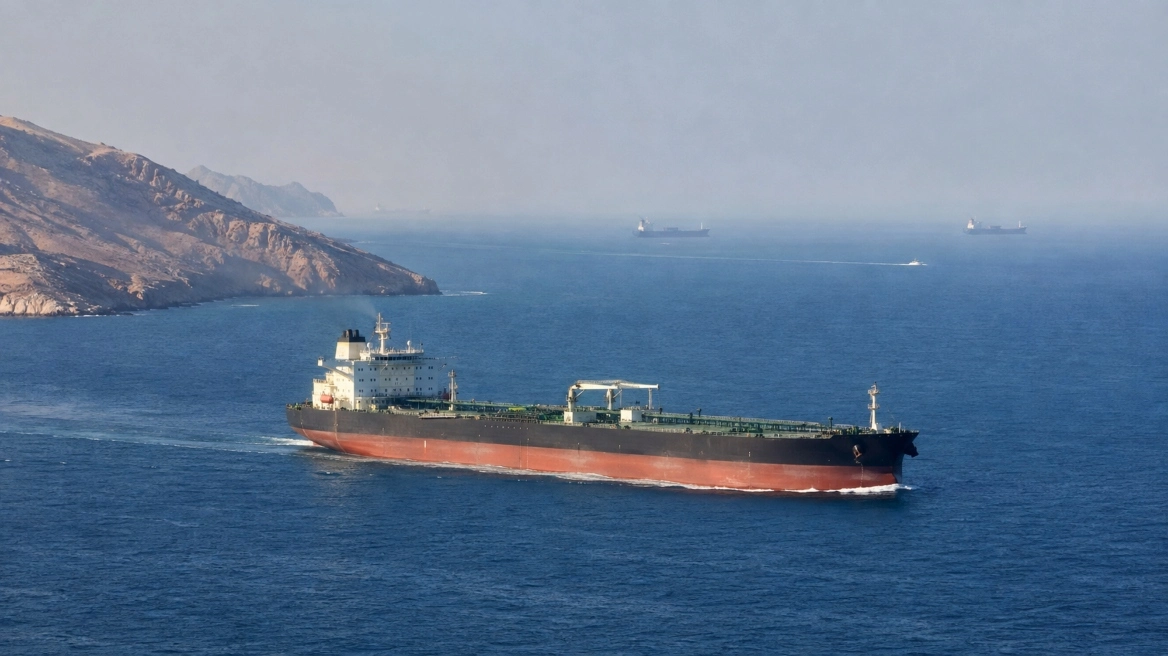
How much oil is still passing through the Strait of Hormuz each day? The answer has become a critical puzzle for the global energy market, as Washington’s estimates differ substantially from the data collected by companies that track ship movements and cargoes.
U.S. Energy Secretary Chris Wright maintains that approximately 9 million barrels per day are leaving the Gulf through the Strait of Hormuz. According to him, an additional 5–7 million barrels per day reach international markets via pipelines and other alternative infrastructure.
This estimate suggests that despite the crisis and the sharp decline in commercial shipping traffic, substantial volumes of crude oil continue to leave the Persian Gulf. The available data, however, do not clearly confirm this picture.
Measurements by Kpler, an international energy market analysis and cargo-tracking company, as well as LSEG (London Stock Exchange Group), the global financial data provider, indicate significantly lower oil flows through Hormuz.
According to their estimates, volumes range from about 1.7 million to 7 million barrels per day. The figures vary depending on the period being analyzed, the information available, and the methodology used by each company.
The gap between the two assessments is considerable. At the lower end of the estimates, the difference from the U.S. figure exceeds 7 million barrels per day. Even the highest estimate from the tracking companies remains about 2 million barrels per day below Washington’s estimate.
The “Invisible” Tankers
At the center of the uncertainty is the widespread deactivation of ships’ Automatic Identification System (AIS) transponders. An increasing number of tankers are passing through the region without publicly broadcasting their location, primarily to reduce their exposure to potential attacks.
Without active AIS signals, tracking companies cannot maintain a complete real-time picture. To identify vessels and estimate their cargoes, they rely on satellite imagery, port data, draft measurements, and other commercial information. This process takes time and cannot eliminate all information gaps.
Part of the discrepancy may also result from differences in the timing of the measurements. A tanker may have departed a Persian Gulf port but not yet passed through the Strait of Hormuz.
Delays, waiting at secure locations, and course changes can therefore significantly affect daily estimates. The issue becomes even more pronounced when combined with the sharp decline in shipping traffic. On Tuesday, Kpler recorded only eight transits through Hormuz, while LSEG counted eleven. Before the conflict, approximately 130–140 vessels passed through the waterway each day.
The number of transits cannot be directly converted into barrels of oil. A fully loaded Very Large Crude Carrier (VLCC) can transport approximately 2 million barrels of crude oil. Consequently, even a relatively small number of large tankers can move substantial volumes of oil.
However, the dramatic drop in overall shipping traffic makes it difficult to reconcile the 9 million barrels per day estimate with the activity visible at sea. On the same day, of the eight vessels identified by Kpler, seven entered the Gulf and only one departed. The sole outbound vessel was a bulk carrier transporting coal, not an oil tanker.
The discrepancy is more than just a technical disagreement between different sources. It has direct implications for estimates of global oil supply, commercial inventories, and crude prices.
If actual flows are close to 9 million barrels per day, Gulf exports are continuing on a much larger scale than visible shipping activity suggests. If, on the other hand, flows are closer to the lower levels reported by Kpler and LSEG, significant quantities of crude oil are failing to reach the market, increasing the risk of tighter supply.
The same uncertainty also affects the shipping market. Traders and shipowners face difficulties estimating how many cargoes are currently in transit, how many tankers remain inside the Gulf, and how much shipping capacity will be required in the coming weeks.
Until public visibility of vessel movements is restored or more complete loading data become available, the 9 million barrels per day figure will remain more of an official estimate than a fully verified assessment. For a market that reacts even to small changes in supply, this information gap is itself a significant source of risk.
Ask me anything
Explore related questions




