





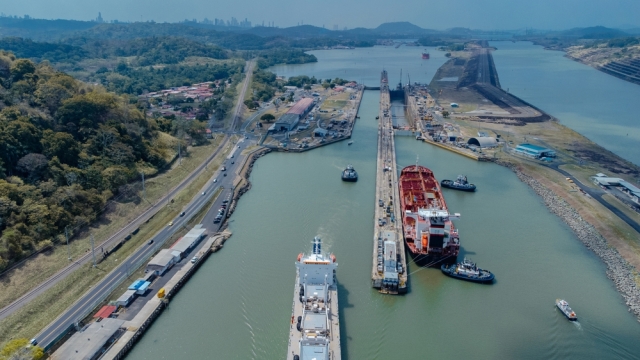
The government of Panama declared a state of emergency yesterday, Tuesday, because of both rainfall patterns and severe droughts attributed to the El Niño phenomenon, which has already resulted in an announced reduction in traffic through the Panama Canal linking the Atlantic and Pacific oceans.
El Niño is a natural phenomenon that occurs periodically, every two to seven years. Surface waters in the central and eastern Pacific around the equator warm up, causing dramatic changes for months in wind patterns, atmospheric pressure and rainfall on a global scale. The climate becomes warmer and drier in some places and colder and wetter in others, while extreme weather events are triggered.
The decision to declare a state of emergency in Panama is due to “the need to be ready to deal with whatever may happen” because of the phenomenon, Interior Minister Dinoska Montalvo explained during a press conference.
The measure will allow administrative procedures to be accelerated in order to address the consequences of El Niño, which is estimated could be the strongest on record this year.
Because of the lack of rainfall, the Panama Canal announced that, starting September 3, it will reduce ship transits from 36 to 34 vessels of all types and, subsequently, from September 15, to 32, the competent authority announced last week.
Around 5% of the volume of goods transported by sea worldwide passes through the 80-kilometer-long canal; the United States and China are among its principal users.
Further north, El Salvador also declared a “red alert” yesterday because of drought attributed to El Niño, which has already resulted in crop losses.
“A red alert is hereby declared due to drought (…) throughout the entire territory,” El Salvador’s civil protection authority said, as the Central American country faces widespread drought and recorded 14 temperature records in August.
The measure includes, among other things, close monitoring of water resources and crops, identifying communities in a state of emergency, and strengthening epidemiological surveillance, the authority clarified.
The lack of rainfall in El Salvador has led to declining water-source levels and crop losses. According to the country’s association and chamber representing small and medium-sized agricultural producers, the first grain harvest will suffer production losses of approximately 20%.
Earlier, the Agriculture Ministry announced food assistance for farming households affected by the drought.
El Salvador lies partly within Central America’s “Dry Corridor,” a dry strip of land particularly vulnerable to extreme climate events. This is also the case in parts of Honduras, where the southern and western regions have suffered losses of corn and bean crops. The government in Tegucigalpa placed almost 80% of the country’s territory under an alert status.
The United Nations World Food Program (WFP) recently estimated that Central America will “likely” be “the region that will be hardest hit in terms of relative food insecurity” because of El Niño. The phenomenon, compounded by human-caused climate change and rising global temperatures, is expected to be the “most intense” observed in more than a century, a specialist from the UK’s Met Office warned on Friday.
Ask me anything
Explore related questions




