





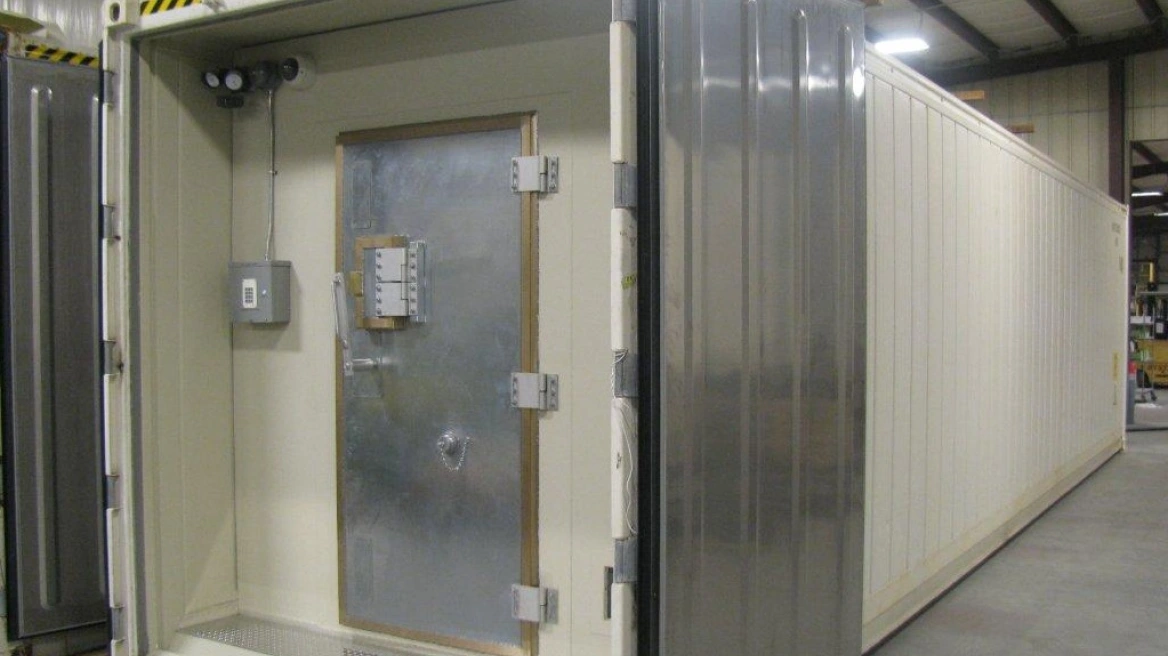
The U.S. Air Force C-17 Globemaster III that carried CIA Director John Ratcliffe to Moscow on Tuesday was equipped with the newest classified airborne command center of the U.S. armed forces.
It is a specially designed unit that functions as a mobile facility for handling highly classified information, known as a Sensitive Compartmented Information Facility (SCIF), allowing the CIA chief to conduct classified communications even while inside Russian airspace.
The system, known as the Roll-On Conference Capsule, or ROCC, officially entered operational service in 2026. The mission to Moscow’s Vnukovo Airport thus appears to have been one of its first operational deployments and possibly the first time it was used on a mission to Russia.
Flight Data First Revealed the Mission
Open-source intelligence analysts and air-traffic observers detected the flight before there was any official government confirmation.
Data from Flightradar24 showed that a U.S. Air Force Boeing C-17A Globemaster III, with the call sign RCH4555 and tail number 07-7181, took off from Riga, Latvia, at approximately 8:50 a.m. Moscow time and landed at Vnukovo International Airport at around 10:04 a.m. local time.
Video circulating on social media showed the gray transport aircraft on its final approach. In one of the videos, a bystander can be heard jokingly commenting, “We’re under attack.”
CBS News was the first outlet to confirm the purpose of the flight. Sources familiar with the matter said that Ratcliffe was in Russia for meetings, in his first known in-person visit to the country since taking over as head of the CIA.
Neither the U.S. nor the Russian government publicly commented on the nature or purpose of the visit. The CIA also declined to comment, while Kremlin spokesman Dmitry Peskov told reporters that he had no information regarding the particular aircraft.
The C-17’s full route, reconstructed from publicly available flight-tracking data, shows that the mission was carefully planned.
The aircraft flew on August 22 from Joint Base McGuire-Dix-Lakehurst in New Jersey to Joint Base Lindsey Graham in South Carolina. The following day, it moved to Joint Base Andrews in Maryland, from where it departed for Riga. It remained there for two days before making the final leg of the flight to Moscow.
What Is the ROCC and Why Does It Matter?
Joint Base Andrews, just outside Washington, is home to the 89th Airlift Wing, which operates the U.S. Air Force’s Special Air Mission fleet.
These are the aircraft responsible for transporting the President, Vice President, members of the administration, and senior foreign officials. The special ROCC units are also based there.
The ROCC is a mobile command center consisting of two specially configured capsules that can be loaded onto a C-17 using a standardized Steel Eagle pallet, without requiring modifications to the aircraft. Once inside, the two units are connected to create a fully operational mobile command center.
The first capsule contains the senior official’s area, with a private workstation, two seats, a sofa that converts into a bed, and a private lavatory.
The second contains a meeting and staff workspace, with a large display, four workstations, and six swivel seats.
When connected to the aircraft’s systems, the ROCC provides those on board with highly secure voice communications, data transmission, and videoconferencing capabilities from anywhere in the world — even, as this mission demonstrated, over Russian territory.
A “Flying” Center for Classified Communications
The ROCC’s communications package allows it to qualify as a mobile SCIF under Intelligence Community Directive 705, which establishes the standards for facilities where classified information is handled.
In practice, this means that a senior official inside the ROCC can conduct the same highly classified conversations they would have at the CIA headquarters in Langley, Virginia, while flying toward Moscow.
Achieving these standards required years of design, engineering development, and testing. The ROCC replaced an older system consisting of two modified Airstream trailers, known as “Silver Bullets,” which had been in use since the early 1990s.
The older systems were deemed no longer compliant with modern aviation requirements, with shortcomings in areas such as crashworthiness, evacuation capability, resistance to severe turbulence, and electrical systems.
By contrast, the ROCC is fully certified to allow personnel to remain inside it during all phases of flight.
Before final approval was granted, the U.S. Air Force Life Cycle Management Center conducted seat testing, crash-load analyses, rapid-decompression tests, and testing of components in an explosive environment.
One of the final design changes involved the original nine-seat conference table, which was deemed to pose a risk of head injuries in the event of severe turbulence. For this reason, three seats were removed and the table was replaced with modular workstations.
The U.S. Air Force’s official announcement regarding the ROCC’s operational integration was published on July 21, 2026, just five weeks before the mission to Moscow.
How the C-17 Is Protected Against Missile Threats
The choice of the C-17 for a high-profile mission in potentially dangerous airspace is not accidental. The Globemaster III is equipped with a range of defensive systems that make it suitable for sensitive operations in high-risk environments.
A key active self-protection system is the Large Aircraft Infrared Countermeasures System, known as LAIRCM. The system was developed by Northrop Grumman as an evolution of the AN/AAQ-24(V) Directional Infrared Countermeasure and operates autonomously, without requiring intervention from the crew.
When ultraviolet and infrared sensors detect a missile launch, an automated mechanism turns toward the incoming threat and emits a powerful, modulated laser beam toward the missile’s infrared guidance sensor.
The beam is intended to “blind” the sensor or feed it deceptive signals, causing the missile to deviate from its course.
The system is particularly important during takeoff and landing, when a large and relatively slow transport aircraft is more vulnerable to man-portable air-defense systems, or MANPADS.
In addition to LAIRCM, the C-17 also has other countermeasures, such as flares and chaff, as an additional layer of protection.
The U.S. “Flying Embassy”
The C-17 also has significant operational capabilities for missions of this kind.
It can carry a payload of up to 164,900 pounds, or approximately 74,800 kilograms, and can land on a runway approximately 1,067 meters long and just 27.4 meters wide.
At the same time, it can cover distances of more than 6,200 nautical miles without refueling, or approximately 11,500 kilometers.
Ask me anything
Explore related questions




