





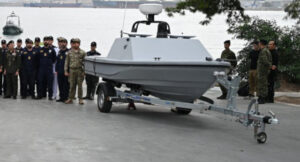
The Hellenic Navy has unveiled a new Greek-designed and built unmanned surface vessel capable of carrying out surveillance and reconnaissance missions as well as launching attacks against enemy ships. Named Pyrpolitis, the system was developed entirely by Greek naval personnel and is intended to strengthen the fleet’s operational capabilities, with the ultimate aim of producing it in large numbers.
The vessel was unveiled on Tuesday (13 October) at the Skaramangas Naval Base during the inauguration of the Joint Training Centre for Unmanned and Autonomous Maritime Systems, attended by Defence Minister Nikos Dendias.
A distinctive feature of the new vessel is its ability to combine intelligence gathering and maritime surveillance with attacks on surface targets. It also has built-in autonomous capabilities, which are undergoing the final stages of testing.
According to the Defence Ministry, Pyrpolitis is a project of the Hellenic Navy General Staff, with its design, development and construction carried out entirely by the Navy.
The vessel is just five metres long and can reach speeds exceeding 40 knots, equivalent to approximately 74 kilometres per hour, according to Greek public broadcaster ERT. It has a high degree of operational endurance, although specific figures for its range and mission duration have not been disclosed.
What sets it apart from a conventional unmanned surveillance craft is its ability to conduct one-way attack missions. In such operations, the vessel itself becomes the weapon, carrying an explosive payload towards its target.
How ‘Pyrpolitis’ can be deployed
The new Greek unmanned surface vehicle (USV) has been designed to perform a range of maritime missions without requiring a crew on board. Its capabilities include intelligence gathering, surveillance of maritime areas and target reconnaissance.
Its potential use in offensive operations, however, is what makes the programme particularly significant from an operational perspective.
Speaking at the unveiling, Dendias described it as a vessel capable of “gathering intelligence, conducting surveillance and reconnaissance, and operating — as its name suggests — as a craft capable of attacking floating targets”.
Dendias also said that some of the fleet’s surveillance and patrol duties could be transferred to unmanned and autonomous systems, significantly reducing the number of days naval personnel are required to spend at sea.
Why the vessel is called ‘Pyrpolitis’
The name is a deliberate reference to the fireships used during the Greek War of Independence in 1821. At the time, Greek sailors used small vessels loaded with flammable materials and explosives to attack the larger warships of the Ottoman fleet.
The fireship crews would approach their target, attach their vessel to the enemy ship and ignite it before escaping in a small boat.
Two centuries later, the same basic concept — using a small craft to strike a much larger ship — has taken on a technologically advanced form.
The modern Pyrpolitis requires no crew on board and can be directed towards its target using its onboard navigation and control systems.
Ask me anything
Explore related questions




