





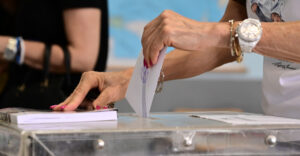
In another opinion poll, this time conducted by Opinion Poll for Action24, New Democracy remains above the psychological threshold of 30%, although it has lost 0.7 percentage points, standing at 30.3%. It leads the second-placed ELAS by 14.4 percentage points. PASOK remains in third place but is narrowing the gap with Alexis Tsipras’s party, while, for the first time, the “Alliance of Greeks” party—whose support has been declared by Ilias Kasidiaris—is recorded at 3.5% in voting-intention estimates.
The Opinion Poll survey, presented on Action24’s main evening news bulletin, was conducted between October 7 and 12 amid the energy crisis and rising prices.
“The survey also captures Marco Rubio’s visit and the atmosphere it generated. Naturally, the results also reflect the efforts of the political parties during an informal, prolonged and intense pre-election period, characterized by polarization and heated political confrontation,” Opinion Poll’s analysts noted.
Voting estimates
In the voting estimate, New Democracy stands at 30.3%, down 0.7 percentage points from the September survey, while ELAS follows at 15.9%. The gap between them is therefore 14.4 percentage points.
PASOK is in third place with 12.3%, compared with 12.1% previously, narrowing its gap with ELAS to 3.6 percentage points, from 3.8% in September.
The remaining parties are as follows:
- KKE: 7.2%, up from 6.8%
- Hellenic Solution: 6.8%, down from 7.3%
- Course of Freedom: 5.1%, down from 5.4%
- ELPIDA: 4.5%, down from 4.8%
- Voice of Reason: 3.5%, up from 3.3%
- Alliance of Greeks: 3.5%, appearing in the survey for the first time
MeRA25 is recorded at 2.7%, SYRIZA at 1.7%, and NIKI at 1.1%, while “Other party” accounts for 5.6%.
The Spartans, Democrats and New Left do not appear separately because their percentages are below 1%; their votes are included under “Other party.”
Voting intention among valid ballots
In voting intention among valid ballots, the results are:
- New Democracy: 25.5%
- ELAS: 13.3%
- PASOK: 10.4%
- KKE: 6.1%
- Greek Solution: 5.8%
- Course of Freedom: 4.3%
- ELPIDA: 3.8%
- Voice of Reason: 2.9%
- Alliance of Greeks: 2.9%
- MeRA25: 2.2%
- SYRIZA: 1.5%
- NIKI: 0.9%
- Other: 4.7%
- Undecided: 15.7%
Based on these voting estimates, Parliament would comprise nine parties, with seats distributed as follows:
| Party | Seats |
|---|---|
| New Democracy | 122 |
| ELAS | 48 |
| PASOK | 37 |
| KKE | 21 |
| Greek Solution | 20 |
| Course of Freedom | 16 |
| ELPIDA for Democracy | 14 |
| Voice of Reason | 11 |
| Alliance of Greeks | 11 |
Who is considered the most suitable prime minister?
Asked who would be the most suitable prime minister, 27.4% chose Kyriakos Mitsotakis, while 26.5% answered “Nobody.” Alexis Tsipras received 13.1% and Nikos Androulakis 7.1%.
Compared with September, Mitsotakis’s rating fell from 27.9% to 27.4%, Tsipras’s from 13.9% to 13.1%, and Androulakis’s from 7.4% to 7.1%. In contrast, the share choosing “none of them” rose from 24.9% to 26.5%.
Among the other political leaders, the ratings were:
- Kyriakos Velopoulos: 3.7%
- Zoe Konstantopoulou: 3%
- Maria Karystianou: 2.6%
- Afroditi Latinopoulou: 2.3%
- Dimitris Koutsoumbas: 2.2%
Potential support for a Samaras party
Asked about the possibility of voting for a party led by Antonis Samaras, 3.6% said they would be very likely to do so, while 8.2% said they would be fairly likely. The combined figure is 11.8%.
This indicates little change: the combined figure was 11.5% in September, including 3.6% who were very likely to vote for such a party, and 11.7% in June, including 3.8% who were very likely to do so.
Assessment of Marco Rubio’s visit
Regarding Marco Rubio’s visit to Greece, 48.6% believe it strengthened, or probably strengthened, Greece’s national positions, while 47% hold the opposite view.
The most positive responses came from New Democracy voters, at 77.7%, and PASOK voters, at 63.6%.
Asked about the energy alliance with the United States, including references to the Vertical Corridor and hydrocarbon drilling, 55.9% believe it strengthens national security, compared with 40.8% who disagree.
Energy costs and the cost-of-living crisis
Rising prices and inflation are by far the most important problems facing citizens, cited by 59% of respondents. The economy and economic growth come next at 27.2%, followed by the energy crisis and the cost of fuel, heating and electricity at 21.2%.
This ranking highlights the importance of economic issues in households’ daily lives. Rising prices are not viewed as an isolated problem but as part of broader concerns about income, the cost of living and the economy’s prospects.
Particularly striking is the finding that 58.5% of respondents say their standard of living has deteriorated over the past year, while 32.9% say it has remained unchanged. Just 8% report an improvement.
At the same time, the energy crisis and rising fuel prices are causing significant concern about household finances. Some 42% expect a very negative impact, while 41.3% expect a fairly negative impact. In total, more than eight in ten citizens anticipate a substantial financial burden.
These findings highlight the central challenge facing economic policy: the impact of prices and energy costs on disposable income and people’s everyday lives.
Who is responsible for rising prices?
Asked about the causes of persistent and increasing price rises, 50.4% attribute the problem to the government’s inability to address it. Another 22% believe it is primarily due to external international factors, such as wars, while 25.9% say both factors are responsible.
In the same context, 76.2% believe the government is responding too slowly and showing a lack of urgency, rather than monitoring the problem effectively and intervening promptly. Just 21% believe the government is keeping track of the situation and intervening in time.
Economic dissatisfaction is therefore accompanied by clear criticism of the timing, adequacy and effectiveness of the government’s response.
Support measures assessed against the scale of the problem
The survey records varying levels of approval for individual measures concerning energy costs, outstanding debts and household protection.
Extending the existing 72-installment framework to 120 installments for older debts owed to the state receives the highest positive assessment, at 60.3%.
It is followed by the introduction of stricter rules for loan servicers, aimed at protecting borrowers who meet their obligations from seizures or foreclosures, at 55.6%, and keeping heating oil prices below €1.75 per liter, at 53.6%.
By contrast, the subsidy provided through the distribution network for diesel fuel receives a positive or somewhat positive assessment from 43.8%, while 50.8% rate it negatively or somewhat negatively.
The overall assessment of the package of measures is even more revealing. A total of 59.5% believe the measures will not make a significant difference given the scale of the problem. Another 29.7% believe they are moving in the right direction but that more radical interventions are needed. Just 8.1% believe they provide relief to households and businesses.
The key finding is that assessments of the measures are not determined solely by whether individual interventions are viewed positively or negatively. The overriding question is whether they are sufficient to address the actual scale of the financial burden.
At the same time, 58.7% believe the European Union needs to mount a coordinated response to the energy crisis, including relaxing restrictions governing public spending to make it easier for countries to introduce additional measures. Meanwhile, 37.7% believe an individual country can address the crisis on its own by taking the necessary steps.
Finally, the assessment of the European response so far is overwhelmingly negative: 80.5% believe the European Union is not responding, or is probably not responding, promptly and in a coordinated manner to the effects of the energy crisis. Just 15.5% express a positive view.
Ask me anything
Explore related questions




