





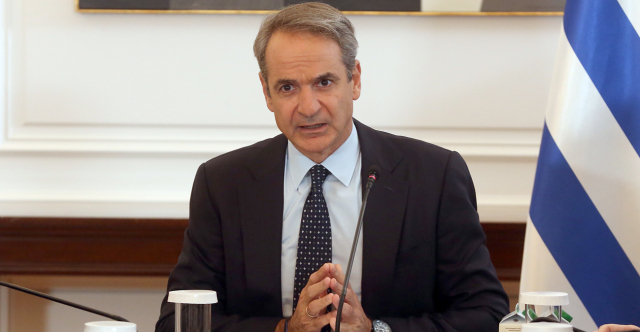
Kyriakos Mitsotakis has no intention of allowing Alexis Tsipras to take ownership of the banner of “lawfulness everywhere.” The former prime minister is attempting to revive the familiar political divide, choosing corruption as the battleground for a head-on confrontation. But at the Maximos Mansion, there is no willingness to hand him either the playing field or the initiative. And with the Greek FBI celebrating its second anniversary, the government has a record ready to present: 259 criminal organizations and groups dismantled, thousands of arrests, and major tax-evasion cases.
The prime minister is expected to continue the heated exchange during his morning radio interview on Alpha 9.89, just hours before attending an event marking the second anniversary of the Directorate for Combating Organized Crime. He has already made clear at the Cabinet meeting where he intends to target Alexis Tsipras, accusing him of hypocrisy and bringing up the changes to the Criminal Codes shortly before the 2019 elections, which, he argued, allowed certain defendants to get off with “a slap on the wrist.”
Taking Up the Challenge
The spark was Alexis Tsipras’s article in the Messinia newspaper Eleftheria. At the Cabinet meeting, Kyriakos Mitsotakis took up the challenge, delivering the pointed remark: “Some hypocrites should not be surprised by the lawlessness around us.” He argued that the illegal activities now coming to light did not begin recently, but are now being exposed and prosecuted, describing the effort as an “open war” against the deep state.
Alexis Tsipras responded on Best TV, calling Kyriakos Mitsotakis the “high priest of corruption.” The characterization carries considerable political weight, as it echoes the famous phrase “high priest of entanglement,” which Costas Karamanlis had used against Costas Simitis during another period of fierce political confrontation.
Pavlos Marinakis chose to respond with a phrase that further intensified the clash. He accused Alexis Tsipras of presenting himself “as if he had emerged from a political virgin birth” and invited him to attend the event reviewing the work of the Directorate for Combating Organized Crime. The invitation had an unmistakable political edge: to counter the former prime minister’s accusations with the major cases handled by the Greek FBI.
Caught in the Net
At the afternoon event at the Athens Concert Hall, Kyriakos Mitsotakis will appear alongside Citizen Protection Minister Michalis Chrysochoidis, who played a decisive role in establishing the agency in October 2024.
According to the government, the figures for the agency’s first two years reveal the scale of the Greek FBI’s operations. The Directorate for Combating Organized Crime handled 1,510 serious and organized crime cases, made 3,254 arrests, and saw 814 defendants remanded in custody.
Behind these figures are networks involved in fuel and cigarette smuggling, extortion, and fraud. Above all, there are cases in which the involvement of individuals working in tax offices, urban planning departments, prisons, and municipal police forces was investigated. The Maximos Mansion is highlighting these cases to counter the image of a state that allows illegal activity to go unchecked.
The Big Fish
The government’s banner of “lawfulness everywhere,” raised at the Thessaloniki International Fair in 2023, also extends to financial crime. The Independent Authority for Public Revenue (AADE) has identified €720 million in fictitious invoices issued by 147 businesses, networks involving hundreds of “front men,” and cases of tax evasion worth millions.
According to the Ministry of Finance, the estimated annual benefit from tackling tax evasion reached €2.2 billion in 2025. The government links this additional fiscal space to the possibility of introducing further tax cuts and strengthening social policy, seeking to demonstrate that the fight against illegal activity has a direct impact on people’s everyday lives and their wallets.
There is, however, also a “loophole” that the Maximos Mansion is keeping firmly in the political debate. It concerns a provision introduced last June, which the opposition voted against and which restricted the ability to give suspects advance warning in certain cases of serious tax evasion. According to the government’s position, the change allowed the authorities to act without alerting in advance those who were under investigation.
Ask me anything
Explore related questions




