





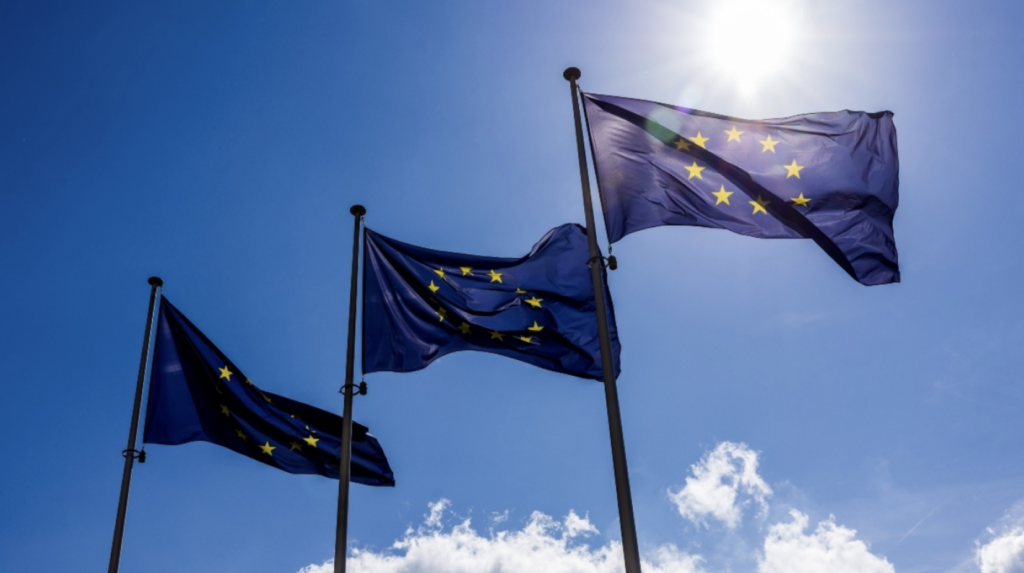
The European Union has adopted a tougher stance than ever towards countries seeking to join the bloc, according to its enlargement report published yesterday, against the backdrop of the war in Ukraine, hybrid threats targeting member states and geopolitical upheaval in the Middle East.
The Turkey-Libya memorandum
A central concern for Brussels, running throughout the report, is the full alignment of candidate countries – as well as countries with close ties to the EU – with democratic values, international law and the bloc’s foreign policy. This comes at a time when the European Commission appears to be fully aligned with Greece on issues of national concern, as was evident during the appearance of Greek Foreign Minister George Gerapetritis at the United Nations, when he condemned the illegal Turkey-Libya memorandum in the presence of the EU representative, Stavros Lambrinidis.
It is worth noting that the Commission, through Mr Lambrinidis, fully backed the Greek position. The same view is set out in the Progress Report, which stresses that the illegal memorandum violates the sovereign rights of third countries, is incompatible with the Law of the Sea and cannot produce legal effects for other states.
More broadly, the report assesses the progress made by countries seeking EU membership, identifying Turkey as a case of democratic backsliding. Turkey’s alignment with EU foreign policy principles is described as ‘very low’, according to Euronews, while ‘circumvention of EU sanctions against Russia remains significant. Turkey has made some progress, but it needs to make greater progress’, a European official said.
The sticking points
Among the main obstacles to closer relations between the EU and Turkey is, of course, Ankara’s position on the illegal occupation of northern Cyprus. Other key concerns include overflights over Greek islands, violations of Greek national airspace and territorial waters, Turkish challenges to Greece’s claims in the Aegean and eastern Mediterranean, and the illegal Turkey-Libya memorandum.
The report also notes that, although Greek-Turkish relations have improved overall since 2023 and no unauthorised Turkish drilling has taken place in the eastern Mediterranean, the situation in the Aegean remains complex. Particular attention is drawn to the casus belli – the threat of war – declared by Turkey’s Grand National Assembly in 1995 in response to a possible extension of Greek territorial waters in the Aegean to 12 nautical miles.
The Commission recalls that this right is provided for under Article 3 of the United Nations Convention on the Law of the Sea (UNCLOS), noting that Turkey’s casus belli continues to strain bilateral relations.
The report also refers to Turkish demands for the demilitarisation of Greek islands, the general maritime navigation notices issued by Ankara and challenges which, it says, indirectly call into question Greek sovereignty, sovereign rights and jurisdiction. The inclusion of the ‘Blue Homeland’ doctrine in Turkish school textbooks is also described as a cause for concern.
The electricity cable also on the agenda
Given the EU’s involvement and funding of the Great Sea Interconnector (GSI), the electricity link between Greece and Cyprus, Brussels records that Turkey has continued to obstruct research activities required for the project’s implementation. The issue is placed within the wider context of problems that continue to affect energy cooperation in the region.
Finally, the report also refers to Turkey’s reaction to the transfer of a Patriot missile battery to a Greek island – Karpathos – as part of efforts to counter the Iranian missile threat, as well as tensions triggered by the deployment of Greek F-16 fighter jets to Cyprus following a drone attack on the British bases. These incidents highlight how easily regional crises can once again strain Greek-Turkish relations.
North Macedonia also comes under scrutiny
Brussels has also taken issue with North Macedonia’s position on the Prespa Agreement. The Progress Report states that ‘cooperation with Greece continues, particularly on issues relating to the economy, infrastructure and energy connectivity, tourism and culture.
‘Good-faith implementation of bilateral agreements, including the Prespa Agreement, remains essential. Members of the government and senior officials occasionally disregard the Agreement, including by failing to use the country’s constitutional name, which could affect good-neighbourly relations.’
The emphasis on the ‘essential’ nature of implementing the Agreement runs up against the stance adopted by officials in the neighbouring country. North Macedonia’s Prime Minister, Hristijan Mickoski, along with government officials and MPs from the right-wing ruling VMRO-DPMNE party, regularly use the name ‘Macedonia’ in their public statements, omitting the designation ‘North’.
Ask me anything
Explore related questions




