





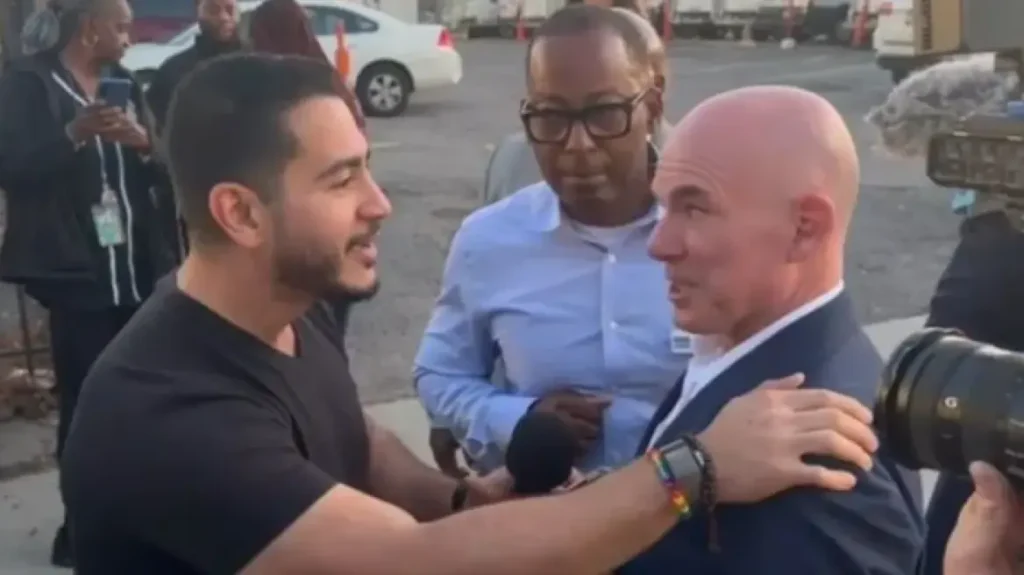
An exchange between newly elected Democratic Senator for Michigan Abdul El-Sayed and Sky News’ US correspondent has sparked widespread reactions on social media, with footage of their confrontation going viral attracting more than eight million views.
The incident took place last Tuesday, on the day of the US midterm elections, outside a polling station in Detroit. El-Sayed, who subsequently won election to the US Senate representing Michigan, approached the location where the British broadcaster’s television crew was filming. However, rather than answering the journalist’s questions, he began asking in a quite provocative and aggressive manner why he should give an interview to a British news organisation.
“Are you registered to vote in Michigan?” he asked. When James Matthews replied that he was not, El-Sayed continued: “Then why should I care about talking to you? I don’t care what you think or what questions you want to ask.” At one point during the confrontation, the candidate placed his hands on the journalist’s shoulders and told him: “Do you know how many votes I want to get in Britain? Zero. I am never going to run for office in Britain.”
Matthews countered that US elections have consequences for the entire world, but El-Sayed persisted, this time mocking the British broadcaster’s reach. “Nobody watches Sky News in the United States. Only people in Britain watch it, and here, about five people,” he said, asking the journalist to stop following him. “I’m not chasing you, I’m asking you questions,” Matthews replied.
Journalist responds following online backlash
Two days later, Sky News correspondent James Matthews addressed the incident in an article, describing El-Sayed’s reaction as ill-judged for a politician who usually handles his dealings with the media confidently. “All news is local now,” he wrote wryly, noting that the video had already surpassed eight million views – far more than the “five viewers” El-Sayed had attributed to Sky News.
Matthews explained that the television crew had spent days trying unsuccessfully to secure an interview with the candidate. In the end, he remarked, while the journalists were looking for him, El-Sayed unexpectedly appeared right in front of them.
The British journalist acknowledged that politicians prefer to speak to domestic media outlets, as that is where their voters are, noting that similar practices are followed in the UK. However, he argued that US senators do not represent only local interests, since their decisions have an impact on international developments.
With regard to El-Sayed in particular, Matthews noted that he had expressed an interest in joining the Senate Foreign Relations Committee, which plays an important role in shaping US foreign policy. “The responsibilities of American lawmakers extend far beyond the borders of the United States,” he stressed, explaining why he considers it entirely legitimate for foreign journalists to ask them questions.
Despite his criticism, Matthews acknowledged that the election campaign in Michigan had been particularly tough. He also referred to the attacks El-Sayed had faced, including from Donald Trump, highlighting the presence of Islamophobic attacks in American political discourse.
Concluding his article, Matthews argued that El-Sayed’s electoral success now comes with the responsibility of engaging with the media, including international outlets. As he noted, now that the pressures of the election campaign are over, the senator may be more willing to communicate with audiences outside the US, who have every reason to be interested in the decisions made by American politicians.
Ask me anything
Explore related questions




