





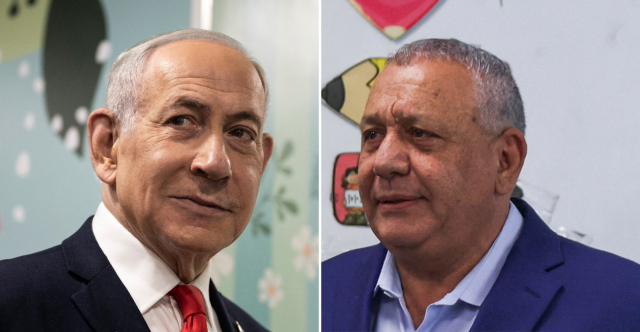
The most significant development in Israel’s post-election period has not come from either of the two main political blocs vying for power, but from a section of the electorate that has remained on the sidelines of government coalitions for decades. Strengthened by an unprecedented electoral performance, Arab parties are now declaring their readiness to support Gadi Eisenkot in his efforts to oust Benjamin Netanyahu, even without joining his government.
The proposal creates an unusual political situation. The former chief of staff of the Israel Defence Forces, who leads the Yashar party and has brought together the main opposition forces around him, now has the opportunity to seek the premiership with the backing of parliamentary groups holding a combined 67 seats. However, several of those prepared to nominate him for prime minister refuse to participate in the same governing arrangement.
This contradiction explains why, one week after Israel’s 27 October elections, Netanyahu still has political room for manoeuvre, despite his alliance having lost its parliamentary majority.
The arithmetic of the new Knesset illustrates the scale of the deadlock. The coalition of nationalist and religious parties supporting the outgoing prime minister holds 53 seats. The Jewish political forces seeking to replace him have 48. The remaining 19 seats belong to the two Arab electoral lists: 11 to the Joint List and eight to Mansour Abbas’s Ra’am.
A parliamentary majority requires 61 of the Knesset’s 120 seats. Eisenkot, therefore, cannot form a majority government on his own with his existing partners, but neither can Netanyahu continue governing without seeking additional support.
From political isolation to an offer of cooperation
Ahmad Tibi, one of the most recognisable figures in Israel’s Arab political representation, was the first to clearly outline the new strategy. In interviews with CNN, Israel’s Channel 12 and the Associated Press, he said the Joint List was prepared to support an opposition government aimed at ending Netanyahu’s rule.
This is not an offer to join a cabinet. Arab MPs appear willing to provide parliamentary support, vote in favour of the formation of a new government or enable its establishment by abstaining from crucial votes.
The distinction is significant. The Joint List wants to exert influence without assuming political responsibility for military operations and foreign policy decisions with which it disagrees. At the same time, it is seeking to turn its electoral gains into concrete commitments on security, equality and public services in Arab communities.
Joint List leader Yousef Jabareen described the current situation to British newspaper The Guardian as a historic opportunity to change political direction. The significance of his remarks lies in his willingness to accept pragmatic cooperation with Israeli Zionist political forces, despite fundamental disagreements over the character of the state, the occupation of the West Bank and the Palestinian issue.
Ra’am follows a different political tradition. Under Mansour Abbas, it had already joined the Bennett-Lapid government coalition in 2021, setting an important precedent for an Arab party’s participation in Israel’s executive government.
On 4 November, it officially announced that it would recommend Eisenkot to President Isaac Herzog to form a government. The consultation process followed on 5 November, while Reuters reported that both Arab political groupings had come out in support of Eisenkot.
This represents a decisive shift. The Arab vote is no longer functioning solely as a means of opposing Netanyahu’s policies but is now playing an active role in the process of choosing Israel’s next prime minister.
The 67 seats do not constitute a governing majority
The biggest obstacle to implementing the plan lies within Eisenkot’s own camp. Avigdor Lieberman, leader of Yisrael Beiteinu, has made clear that he will support giving Eisenkot the mandate to form a government, but has no intention of joining a minority government dependent on the tolerance or support of Arab parties.
Former prime minister Naftali Bennett also faces serious political difficulties in such a scenario. Cooperation with Arab parties conflicts with commitments and positions he has put forward to an electorate with a strong centre-right identity.
By contrast, Yair Golan, leader of the Democrats, has publicly defended the possibility of political cooperation with Arab factions, rejecting their exclusion on the grounds of national identity.
Eisenkot himself has set conditions for cooperation in government: recognition of Israel as a Jewish and democratic state, acceptance of its fundamental principles and a clear position towards Hamas. These conditions represent a significant obstacle, particularly for the Joint List.
The Arab side counters that a clear distinction must be made between joining a government and providing external parliamentary support for it.
This disagreement is not merely a technical matter. It will determine whether Eisenkot can make use of the 19 Arab seats without breaking up the alliance he has assembled with Bennett, Lieberman, Golan and Lapid.
The five politicians agreed on 3 November to coordinate their efforts and begin negotiations to form a government. However, they did not present a joint, workable solution to the problem of securing a parliamentary majority.
This is also the main reason why Israel’s political deadlock persists, despite the emergence of a theoretical 67-seat anti-Netanyahu bloc.
The 49-seat plan and the minority government paradox
One of the most significant revelations of recent days has come from Israeli newspaper Yedioth Ahronoth and its website, Ynet. According to a report by Amir Ettinger, Eisenkot has allowed discussions to explore a plan to establish a minority government that could be sworn in with the support of just 49 MPs.
The plan is based on a crucial feature of Israel’s parliamentary procedure: an initial confidence vote does not necessarily require 61 affirmative votes, but rather more votes in favour than against.
Under this scenario, the opposition’s 48 MPs would support the government, with one additional affirmative vote from Yoav Segalovitz of Ra’am. They would face 46 MPs from Netanyahu’s camp, while 25 MPs – the 11 from the Joint List, seven from Ra’am and seven from the ultra-Orthodox United Torah Judaism party – would abstain. Such an outcome would allow an Eisenkot government to be formed by 49 votes to 46.
The plan is not an agreed solution. On the contrary, it would require an understanding between political forces with vastly different starting positions, while Eisenkot’s party has not confirmed that it has adopted the proposal.
Nevertheless, it reveals that alternative solutions beyond traditional governing alliances are being explored behind the scenes. Arab parliamentary representatives and the ultra-Orthodox could, through coordinated abstentions, enable a government to take office without joining it.
The political viability of such a government is a separate matter. Every crucial vote, from the budget to national security decisions, would require fresh negotiations. The majority that would allow Eisenkot to take power would not automatically guarantee his ability to remain in office.
Ultra-Orthodox parties once again emerge as kingmakers
The second major political front concerns the ultra-Orthodox parties, particularly United Torah Judaism, which holds seven seats.
On 5 November, the party decided not to recommend either Netanyahu or Eisenkot for prime minister, depriving the outgoing premier of the automatic support of a traditional ally.
The decision reduces Netanyahu’s presidential recommendations to 46, assuming his remaining partners support him, and creates a greater distance between his camp and Eisenkot’s.
United Torah Judaism’s position does not amount to joining the opposition. It primarily reflects the ultra-Orthodox parties’ desire to secure guarantees regarding exemptions from military service for students at religious schools.
The problem for Eisenkot is that compulsory military service for the ultra-Orthodox is a central demand of a significant section of the opposition, particularly Lieberman.
In practical terms, any agreement with United Torah Judaism would require concessions on an issue that has become a defining battleground in Israel’s political disputes.
The Jerusalem Post points out that the ultra-Orthodox parties have every reason to keep their options open. As long as neither bloc has a majority, their negotiating power increases.
Meanwhile, proposals have begun to emerge publicly within Shas for a national unity government involving both Netanyahu and Eisenkot, potentially including a rotation of the premiership between them. The discussion reflects the search for a way out of the deadlock, rather than the existence of a mature political agreement.
The historical precedent of Yitzhak Rabin
Ahmad Tibi’s reference to Yitzhak Rabin is no coincidence. In the 1990s, Rabin relied on external parliamentary support from Arab parties to keep his government in power and advance the policy behind the Oslo Accords.
The current situation bears certain similarities, but also profound differences. Israeli society has shifted further to the right, while the 7 October 2023 attacks and the wars that followed have strengthened reservations about any form of cooperation with Arab political factions.
It is precisely this long-term shift that the Financial Times examines in its analysis of the rightward trajectory of Israeli politics. The electorate’s growing conservatism, the demographic expansion of religious communities and the weakening of the traditional peace agenda have narrowed the scope for a broad centre-left majority.
The result is a strategic deadlock for Netanyahu’s opponents. They can assemble enough MPs to prevent him from governing, but struggle to agree on the terms of their own administration.
The attempt to cooperate with Arab parties is therefore linked to a broader question: can Israel’s political system create alternative governing majorities without relying exclusively on traditional Zionist and religious factions?
Netanyahu’s strategy and the challenge to the legitimacy of the Arab vote
Benjamin Netanyahu is seeking to shift the confrontation away from the arithmetic of the Knesset and towards the legitimacy of potential governing alliances.
His political argument presents a government dependent on Arab parties as a threat to Israel’s security and national identity.
At the same time, Likud and figures within the governing camp have made allegations of possible electoral fraud, vote-buying and foreign interference aimed at increasing Arab participation.
These allegations have not been substantiated as evidence of any distortion of the overall election result. The chairman of the Central Elections Committee, Supreme Court Justice Noam Sohlberg, has made clear that the integrity of the electoral process has not been compromised.
His intervention carries particular institutional significance, as allegations of a stolen election are emerging at a time when Israel is facing the possibility of a transfer of power following prolonged political and social polarisation.
President Isaac Herzog has also condemned sweeping attacks against Arab parties and their voters, defending the legitimacy of their participation in the parliamentary process.
Netanyahu’s strategy serves two parallel objectives. On the one hand, it strengthens resistance among right-wing opposition parties to cooperation with Arab factions. On the other, it increases the political cost Eisenkot would incur if he chose to rely on their votes.
Time continues to work in favour of the incumbent prime minister. Until a new government is formed, he remains head of the caretaker government, while his opponents’ failure to reach an agreement could lead either to fresh elections or to the search for a different parliamentary majority.
The Arab vote and Israel’s next political model
The Associated Press focuses its analysis on the different strategy now being pursued by representatives of Israel’s Arab citizens.
Tibi acknowledges that an Eisenkot government would not necessarily bring the wars to an end, accept the creation of a Palestinian state or abandon the policy of expanding settlements in the West Bank.
He argues, however, that replacing Netanyahu could create the conditions for improving the everyday lives of Arab communities, particularly in areas such as crime, policing, public investment and house demolitions.
This political approach has a clear pragmatic dimension. Arab parties are seeking to secure specific concessions from the central government without abandoning their national and ideological positions.
Their historic electoral achievement of 19 seats gives them greater negotiating power than in any previous post-election situation.
The question, however, is not simply how these seats can be used. It also concerns the extent to which Arab political forces can be recognised as legitimate and substantive partners in the formation of governments.
This is where Eisenkot faces his greatest political test. The former general is seeking to present himself as the leader of a new era of national unity, institutional stability and political reconstruction. To succeed, he will have to cooperate either with parties he has ruled out or with forces deeply opposed to key policy commitments made by his allies.
The scenarios for the coming days
The government formation process now passes to President Isaac Herzog, who must decide by 11 November which political leader to task with the initial mandate to form a government. The designated candidate will initially have 28 days to form a government, with the possibility of a further 14-day extension.
Eisenkot appears to be the frontrunner for the first mandate, particularly following the support of the Arab parties and the neutral position adopted by United Torah Judaism.
There are four main possibilities: the formation of a minority government with external support or abstentions from Arab and ultra-Orthodox parties; the creation of a broader government involving ultra-Orthodox factions; a national unity agreement with Likud; or a return to the ballot box.
Each scenario would require significant political concessions.
Eisenkot may need to abandon some of his pre-election red lines. Lieberman will have to decide whether removing Netanyahu from power takes priority over excluding Arab and ultra-Orthodox parties. Bennett will have to weigh the political cost of entering another unlikely alliance, while Arab factions will need to decide how much support they can offer without losing the trust of their electorate.
The election result has created a parliamentary majority against the continuation of the current governing coalition, but not an agreed majority in favour of a specific government programme.
That is the fundamental difference between the electoral defeat of a coalition and the actual possibility of replacing it.
Netanyahu has lost his majority, but he has not yet lost power. Eisenkot has a greater chance of receiving the mandate to form a government, but does not yet have a credible agreement on how to govern.
The Arab factions, for their part, have made clear that they do not intend to remain passive observers of the post-election negotiations.
For the first time with such parliamentary strength, representatives of approximately one-fifth of Israeli society can decisively influence the choice of the country’s next prime minister.
Whether the 19 seats will lead to political change or become yet another element of Israel’s political deadlock will depend primarily on the decisions of the parties that say they are determined to remove Netanyahu but have so far failed to agree on how to replace him.
Ask me anything
Explore related questions




