





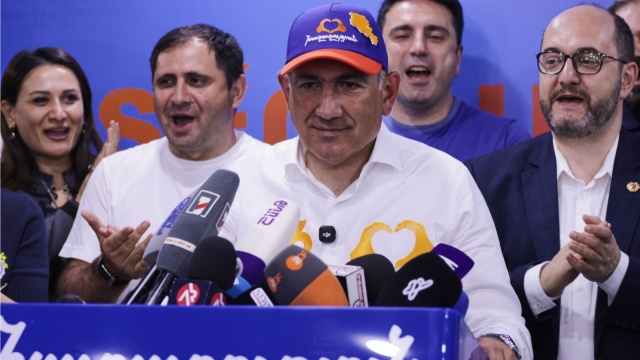
Armenian Prime Minister Nikol Pashinyan announced today that his country could submit its application for EU membership by 2028, a move that is fuelling tensions between the Caucasus nation and Russia.
Relations between Moscow and Yerevan deteriorated significantly following Armenia’s military defeat by Azerbaijan in 2020 and, subsequently, Baku’s occupation of the disputed Artsakh (Nagorno-Karabakh) enclave in 2023.
Accusing its Russian ally of failing to provide adequate protection, Armenia, a former Soviet republic, has since been turning towards the West.
“We have begun a process aimed at creating an alternative, so that our people have the opportunity to choose,” Pashinyan said at a press conference.
“This process will ultimately lead us, in 2027 or 2028, to formally submitting an application to begin EU accession negotiations as a full member,” he added.
He nevertheless clarified that Armenia does not currently intend to withdraw from the Eurasian Economic Union, a trade bloc comprising Russia and its allies.
Moscow has repeatedly stated that Yerevan’s accession to the EU while remaining in the Eurasian Economic Union would not be possible. It has also called for a referendum in Armenia on the government’s intention to turn towards the West.
Nikol Pashinyan also said that his country had “lost interest” in the Collective Security Treaty Organisation (CSTO), a Russian-led military alliance in which Armenia has frozen its participation.
Earlier this year, Russia imposed trade restrictions on Armenian agricultural exports and threatened to review the discounts on Russian energy supplies to Yerevan.
Russia is Armenia’s largest trading partner and a key market for its exports. Many Armenians live and work in Russia, while Yerevan depends on Moscow for its supplies of arms and energy.
Ask me anything
Explore related questions




