





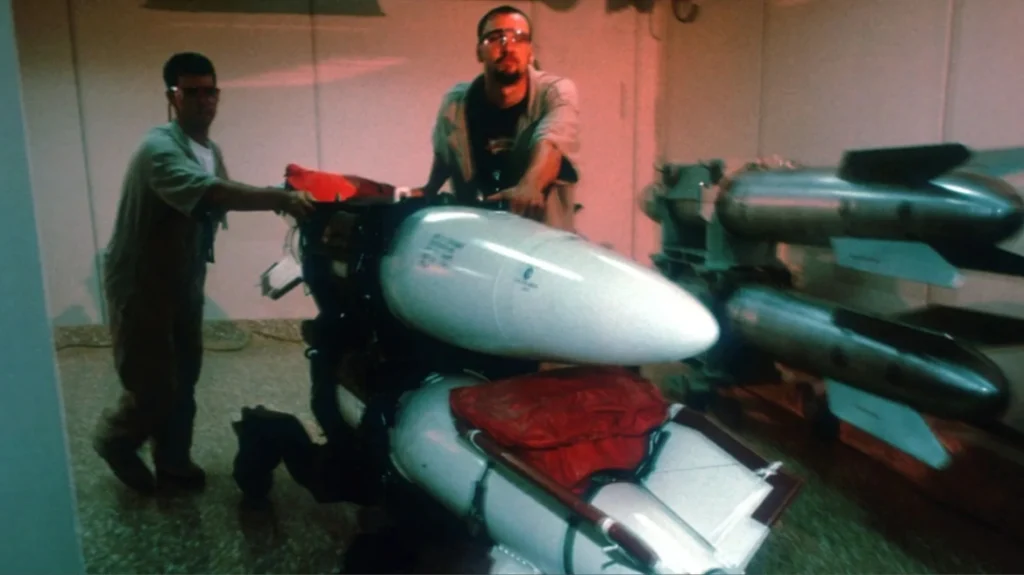
A previously unknown US nuclear bomb, designated the B94, has appeared in a document from the US Senate Appropriations Committee, raising questions about its capabilities and intended mission. It is the first new designation for an air-delivered nuclear bomb in more than three decades.
The document provides for $77.108 million in funding for fiscal year 2027, without offering any information about the weapon’s characteristics or operational purpose. According to expert assessments, it could be a new nuclear system designed to destroy heavily fortified underground facilities, such as those operated by Iran.
The development of such weapons is also linked to the United States’ need to be able to strike strategic facilities in Russia and China, both of which are expanding their underground military infrastructure. However, US authorities have not confirmed any connection between the new bomb and a specific development program.
The revelation in the 179-page document
The existence of the programme came to light through an examination of the US budget proposal for fiscal year 2027. As the specialist website The War Zone (TWZ) revealed on 16 November, the new designation appears in the explanatory report of the Senate Appropriations Committee concerning the funding bill for Energy and Water Development.
The Committee recommends allocating $77,108,000, with the entire amount representing new funding, as no allocation is recorded in the corresponding column for 2026.
The funding falls under the activities of the US National Nuclear Security Administration (NNSA), specifically within the category covering the management and modernisation of the nuclear arsenal. The same section includes programmes such as W80-4, W87-1, W93 and B61-13.
Particularly striking is the fact that the 179-page report contains no explanatory reference to the new weapon beyond the specific line in the funding table. No information is provided about its explosive yield, technical specifications, operational purpose or development timeline.
The possibility of a nuclear weapon designed to destroy underground facilities
According to The War Zone, the only known programme that appears to fit the general description of the new bomb is the Nuclear Deterrent System-Air-delivered (NDS-A), an air-delivered nuclear system currently under development.
Work on this particular programme began at least as early as 2022, while the NNSA has confirmed that its development is progressing rapidly.
The system is intended to deal with particularly hardened and deeply buried targets that are difficult to destroy using conventional munitions.
Such weapons, known as “bunker busters”, are designed to strike facilities protected by thick layers of earth, rock or reinforced concrete.
An NNSA spokesperson told The War Zone that “NDS-A will provide the President with additional nuclear options for holding hard and deeply buried targets at risk, ensuring adversaries cannot place their most valuable strategic assets beyond the reach of US nuclear forces”.
The same agency stressed that “the programme is progressing rapidly, and further information will be made public when doing so serves the strategic interests of the United States”.
Nuclear weapons expert Jeffrey Lewis assessed that “the designation suggests a specialised earth-penetrating nuclear weapon”.
However, there has been no official confirmation that the new programme appearing in the budget is identical to NDS-A.
Existing nuclear bombs and the capabilities of the new weapon
The United States already has the B61-11 nuclear bomb in its arsenal, specifically designed to destroy targets located deep beneath the ground.
Its maximum explosive yield is estimated at between 340 and 400 kilotons, depending on the source, while the number of these bombs in the US arsenal is believed to be fewer than 100.
At the same time, the US possesses the B83-1, one of its most powerful nuclear bombs, with a maximum yield of approximately one megaton. Although it does not have the specialised penetration capabilities of the B61-11, its considerably greater explosive yield allows it to be used against heavily fortified facilities and large-area targets.
According to The War Zone, the NDS-A currently under development could be intended to replace the B61-11, the B83-1 or even both. Another possibility being considered is that it could combine features of previous designs, such as the B83’s very high explosive yield and the precision-guidance capabilities found in the newer B61-12 and B61-13 variants.
The latter has already begun entering the US arsenal. It has a greater explosive yield than the B61-12, on which it is based, although it does not offer the same deep-penetration capabilities as the B61-11. The B61-12 was the first version of this bomb family to acquire a precision-guidance system.
However, no design or model of the NDS-A has been presented so far, and it remains unknown what technology it will use or what its actual operational capabilities will be.
From Iran’s underground bunkers to the strategic facilities of Russia and China
The development of new nuclear weapons designed to destroy underground facilities is not exclusively about Iran. It forms part of a broader strategic environment, as Russia and China have invested heavily in the construction and expansion of fortified military infrastructure.
A characteristic example is Kosvinsky Kamen, a vast underground complex in Russia’s northern Ural Mountains, which serves as a major hub of the country’s nuclear command-and-control infrastructure.
The facility has been constructed beneath a mountain and is believed to be capable of supporting the continued operation of the Russian leadership and command systems in the event of a nuclear strike or another major crisis. According to The War Zone, the need to address a target of this kind is believed to have been a major factor influencing the development of the B61-11.
Similarly, China is expanding its underground military infrastructure, constructing large arrays of intercontinental ballistic missile silos. In recent years, the construction of a new, particularly large underground command centre near Beijing has also come to light.
Iran and North Korea are making similar investments, seeking to protect critical military facilities from potential conventional strikes by the United States or other adversaries.
In Iran’s case, a notable example is the underground Pickaxe Mountain facility, which presents considerable challenges when it comes to striking it with conventional weapons.
The discussion has taken on additional significance following statements by Iranian officials earlier in November, according to which it would be a “miracle” if the United States did not use a nuclear weapon against this particular facility.
However, The War Zone points out that the prospect of an actual US nuclear strike against Pickaxe Mountain is considered extremely remote, for a number of different reasons. Therefore, the reference to the Iranian facility serves as an example of the operational challenges facing US strategy, rather than an indication that a specific nuclear attack has been decided upon or is being planned.
The previous program that was cancelled in 2005
The effort to develop a new nuclear weapon with earth-penetrating capabilities is not unprecedented for the United States.
In the past, the US military had considered developing a modified version of the B83 with capabilities similar to those of the B61-11, as well as a new system that would replace the latter.
These efforts led to the Robust Nuclear Earth Penetrator (RNEP) programme, which aimed to develop a particularly powerful nuclear weapon capable of destroying deeply buried targets. However, the programme was officially cancelled in 2005.
To date, it has not been clarified whether the technology or the results of that earlier effort are being used in the new system.
What the new designation means for the US nuclear arsenal
Under the US nuclear weapons classification system, the letters preceding the number indicate how the weapons are delivered and used.
The designation “W” identifies a nuclear warhead that can be fitted to a missile, torpedo or artillery shell. By contrast, the designation “B” refers to a bomb carried and released by an aircraft.
When the United States upgrades an existing nuclear weapon, it retains the original number and adds a new numerical suffix.
A characteristic example is the B61 bomb family, which includes different versions, ranging from the B61-3 and B61-4 to the newer B61-12 and B61-13. Despite significant technological changes, these bombs remain part of the same family without receiving an entirely new designation.
Therefore, assigning a new number suggests that US authorities are treating the programme in question as a separate weapons system rather than simply an upgrade of an older model.
The first new nuclear bomb designation since 1991
The last time the United States assigned an entirely new designation to a nuclear bomb was with the B90 programme.
This was a nuclear bomb intended for submarine and other targets, the development of which was cancelled in September 1991 as part of the nuclear arms restrictions that followed the end of the Cold War.
Since then, US nuclear strategy has relied largely on modernising existing systems rather than creating entirely new bomb families.
Before the current revelation, the most recent new designation for a nuclear weapon of any category was the W93, a nuclear warhead under development for Trident II ballistic missiles launched from submarines.
How the reference to the unknown weapon was discovered
The relevant entry was initially identified by Eliana Johns of the Federation of American Scientists while examining US budget data.
Jeffrey Lewis, from Stanford University’s Center for International Security and Cooperation, subsequently brought its existence to public attention.
As of 16 November, no official US government website contained any reference to the B94.
Searches of the NNSA’s news website, its official information on the nuclear arsenal, and planning documents concerning the maintenance and modernisation of the arsenal produced no results.
As a result, the only known official record remains the reference in the Senate Appropriations Committee document, with no further clarification about the programme behind it.
Ask me anything
Explore related questions




