





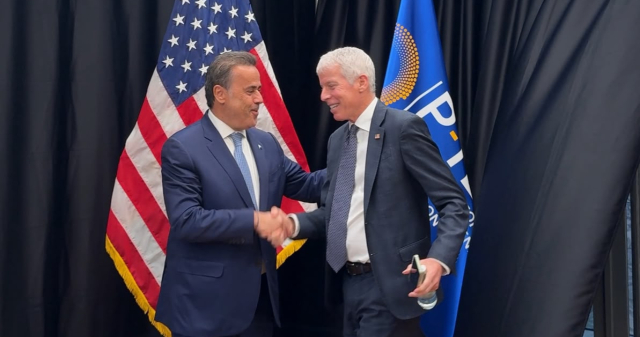
The Greek presence at the 7th Partnership for Transatlantic Energy Cooperation (P-TEC) Summit in Warsaw concluded with a bilateral meeting between Minister of Environment and Energy Stavros Papastavrou and US Secretary of Energy Chris Wright.
The meeting focused on Greece’s strategic role as an energy gateway to Southeastern and Central Europe, through further strengthening energy cooperation between Greece and the United States and making full use of the Vertical Corridor.
The two ministers discussed the next steps towards reducing Europe’s dependence on Russian natural gas and the prospect of using Greek infrastructure to supply Central Europe with American natural gas, transported from Greece through Bulgaria and Serbia. Particular emphasis was placed on the need to address technical and commercial obstacles so that the Vertical Corridor can operate at full capacity and serve as a reliable alternative route for energy supplies.
At the same time, the need to accelerate electricity interconnections was highlighted as a key prerequisite for a more integrated, secure and competitive European energy market. By strengthening its interconnections with neighbouring countries and advancing new international projects, Greece is emerging as an energy bridge connecting the Eastern Mediterranean with Southeastern and Central Europe.
Minister of Environment and Energy Stavros Papastavrou said:
“Greece and the United States are turning their strategic energy cooperation into action. Through the Vertical Corridor, American LNG can reach Southeastern and Central Europe via Greece, making a substantial contribution to reducing dependence on Russian natural gas. At the same time, we are investing in electricity interconnections across Southeastern Europe and the Eastern Mediterranean, which connect markets, strengthen security of supply and make energy more competitive. Greece is consolidating its role as a strategic energy gateway to Central Europe.”
Earlier, Mr Papastavrou delivered the keynote address at a roundtable discussion entitled ‘Strengthening Transatlantic LNG Trade as a Foundation for Energy Security’, which focused on strengthening transatlantic trade in liquefied natural gas (LNG) and the prospects for the Vertical Corridor. The event was organised by the Atlantic Council Global Energy Center.
In his remarks, the minister highlighted the progress made since last year’s P-TEC Summit, which was held in Athens. Significant energy agreements were signed at the summit, while discussions focused on implementing, through the Vertical Corridor, the EU decision to diversify Europe’s energy architecture away from Russian natural gas – an area in which the EU and the United States are in full agreement.
One year on, the nine countries and eleven Transmission System Operators (TSOs) involved in the Vertical Corridor, as the minister pointed out, “meet regularly, cooperate, have improved the regulatory framework, doubled the actual volume of natural gas transported and expanded the initiative to include Serbia and North Macedonia”.
“This is particularly important for two reasons. One is regional stability. The other is energy security,” he said.
On the sidelines of P-TEC, Mr Papastavrou also held bilateral meetings with his Polish counterpart, Miłosz Motyka, and Hungary’s Minister of Energy, István Kapitány. The discussions examined prospects for further strengthening bilateral energy cooperation, with particular reference to the significant investments made by Greece’s Public Power Corporation (PPC) in both countries, as well as opportunities for new investments and synergies.
Earlier, the Greek minister had held bilateral meetings with Slovakia’s Deputy Prime Minister and Minister of Economy, who is also responsible for energy affairs, Denisa Saková; Bulgaria’s Minister of Energy, Iva Petrova; Romania’s Minister of Energy, Dumitru Chisăliță; and Croatia’s Minister of Economy, responsible for energy affairs, Ante Šušnjar.
During the meetings, the ministers agreed to undertake joint initiatives ahead of the December Energy Council, calling on the European Union to allow greater flexibility for targeted and temporary measures under the national escape clause.
The aim is to enable governments to finance energy support measures for citizens and businesses, thereby safeguarding social cohesion and strengthening competitiveness amid the severe energy crisis.
Ask me anything
Explore related questions




