





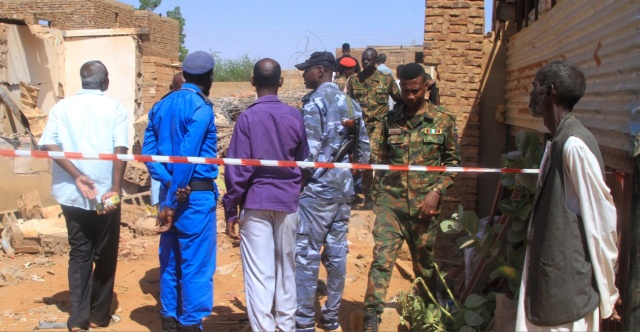
New drone strikes hit Khartoum in the early hours of Sunday (22 November), causing damage to homes and a United Nations building where staff members were present. The Sudanese army has accused Ethiopia of allowing the drones to take off from its territory, while residents have described scenes of panic and extensive damage across neighbourhoods of the capital. Latest reports put the death toll at at least four, although authorities had not initially announced any casualties.
Khartoum has been under the control of the Sudanese Armed Forces since March 2025, when the regular army recaptured the city from the paramilitary Rapid Support Forces (RSF), with which it has been at war since April 2023.
According to eyewitnesses cited by Agence France-Presse (AFP), powerful explosions could be heard across various parts of Khartoum and its outskirts between 2am and 4.30am (local time and Greek time).
Residents reported that drones had struck homes, causing serious material damage.
In Omdurman, Khartoum’s twin city, images captured by AFP showed the extent of the destruction. A brick house had been flattened, while furniture, household items and clothing lay scattered among the rubble.
Yasser Hassan, a local resident, described the anguish of people struggling to find safe shelter amid the war.
“People who had come to this house had been looking for somewhere to stay for a long time, and now they were caught off guard by a drone that bombed them. Where exactly are people supposed to go?” he said.
El Nour Adam Ibrahim gave a similar account, describing the constant sense of insecurity experienced by residents.
“An attack can happen while you are sleeping. You can wake up and discover that your children are gone. It is truly tragic. We cannot be sure of anything,” he said.
UN building damaged while staff were inside
A United Nations facility in a residential neighbourhood of Khartoum was also hit in the strikes.
The UN Office for the Coordination of Humanitarian Affairs (OCHA) announced on the social media platform X that the building had sustained damage while staff members of the international organisation were inside.
In its statement, OCHA stressed that the facility was located in a residential area and described as “unacceptable” the fact that UN personnel had been exposed to such a serious risk.
The attack has raised fresh concerns about the safety of humanitarian workers, who continue to operate in the country despite the extremely dangerous conditions.
Sudanese army accuses Ethiopia
A source in Sudan’s regular army told AFP that the drones which struck Khartoum had taken off from Bahir Dar Airport in Ethiopia.
“The drone attack in the early hours of the morning is a continuation of Ethiopian aggression against Sudanese territory,” the military source claimed.
The Sudanese government has repeatedly accused Addis Ababa of supporting the paramilitary Rapid Support Forces, including by allowing drones to be stationed and launched from Ethiopian facilities.
Ethiopia rejects the allegations, and there has been no independent confirmation of the origin of the drones used in this particular attack.
In early November, Sudan announced that it had appealed to the UN Security Council and the African Union, denouncing what it described as a “blatant attack” by Ethiopia.
For its part, Addis Ababa has accused the Sudanese Armed Forces of supporting rebels from the Tigray People’s Liberation Front (TPLF), an allegation denied by Sudan’s army-aligned government.
Saudi Arabia has also weighed in, announcing that it “strongly condemns” the attacks on Khartoum and reiterating its support for Sudan’s “legitimate institutions”.
More than 1,630 civilians killed by drones in 2026
The use of unmanned aerial vehicles has become one of the most devastating features of the war in Sudan.
Both the regular army and the Rapid Support Forces are increasingly using drones, which can strike targets hundreds of kilometres away without exposing their operators to direct danger.
This shift in military operations has come at a particularly heavy cost for the civilian population.
According to figures released by the United Nations last Tuesday (17 November), almost 75% of confirmed civilian deaths resulting from military operations in Sudan during 2026 were caused by drone strikes.
This amounts to more than 1,630 people, with the organisation clarifying that the actual death toll is believed to be significantly higher.
Just last week, a drone strike attributed to the regular army killed 15 people, including four children, in a village in West Kordofan state.
A government forces counter-offensive is under way in the area, aimed at recapturing territory held by the paramilitary forces.
Kordofan at the centre of the war
The wider Kordofan region, which is rich in natural resources and of considerable strategic importance, has become one of the main battlegrounds of the conflict over the past year.
It lies between central and eastern Sudan, which are controlled by the regular army, and the western region of Darfur, which is under the control of the Rapid Support Forces.
The war between the two sides broke out in April 2023 and has caused enormous loss of life.
According to estimates by humanitarian aid workers, at least 200,000 people have been killed, a figure considered conservative.
The United Nations describes the consequences of the conflict as the world’s worst humanitarian crisis, with millions of people forced to flee their homes and large parts of the country facing severe shortages of food, medicine and basic services.
The increasingly frequent use of drones, including in residential areas far from the main front lines, is further worsening living conditions and undermining civilian safety.
Ask me anything
Explore related questions




