





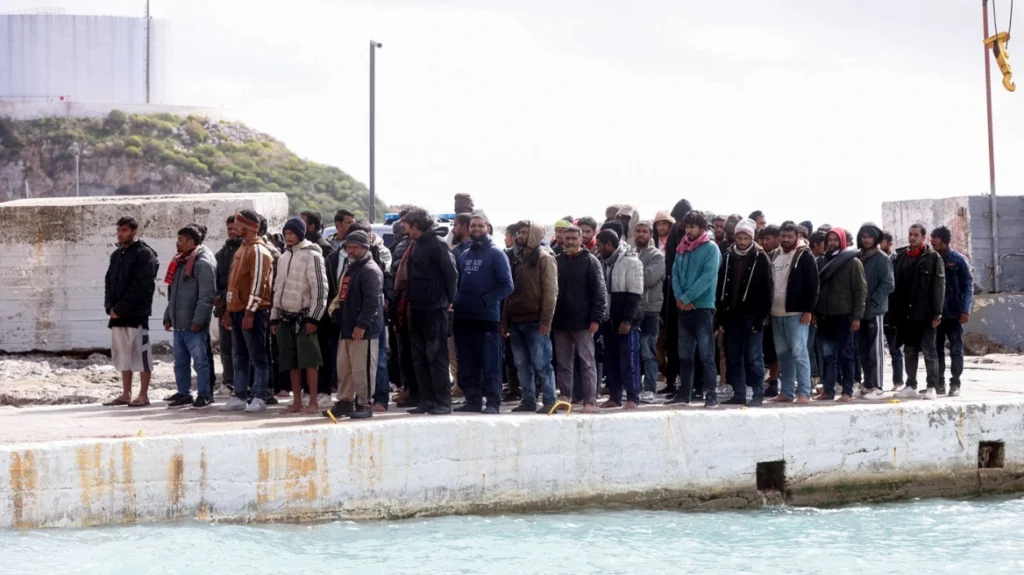
Greece and eight other European Union countries are calling for a revision of the European rules governing refugee family reunification, in a joint letter to the European Commission. They argue that the current framework does not allow member states to respond effectively to the growing pressure on public services and reception infrastructure.
The letter, dated 13 November 2026, is signed by the ministers responsible for migration in Greece, Austria, Italy, the Netherlands, Poland, the Czech Republic, Finland, Bulgaria and Luxembourg.
It is addressed to European Commissioner for Home Affairs and Migration Magnus Brunner, whom the ministers are asking to launch a process for a targeted revision of Directive 2003/86/EC, which regulates the right to family reunification for third-country nationals.
On behalf of Greece, the joint appeal is co-signed by Migration and Asylum Minister Thanos Plevris, who has spoken from the outset of his tenure about the need to tighten the framework both in Greece and across Europe.
The initiative comes just days after the announcement that five European countries, including Greece, were cooperating with Rwanda to establish a return hub for migrants whose asylum applications have been rejected.
These are, however, two separate initiatives. One concerns the return of people who have no right to remain in the EU, while the latest appeal concerns the family reunification of people legally residing in European countries, including recognised refugees.
What the Nine Countries Are Asking the European Commission to Do
The ministers argue that European countries which have received large numbers of migrants and refugees face additional challenges when people already settled in their territory exercise their right to family reunification.
In their letter, they point out that, since 2015, the EU has faced significant migratory pressures, with large numbers of asylum applications placing a corresponding burden on national reception systems. According to the signatories, the consequences are not confined to the processing of asylum applications but extend to key areas of social policy.
Particular emphasis is placed on education. Schools, especially in urban areas, have been required to accommodate large numbers of children within a short period of time, some of whom had received no previous schooling or had only limited access to education.
The nine countries also cite pressure on housing, healthcare, childcare and services designed to support integration into the labour market.
Their conclusion is that national measures are insufficient and that a common European response is needed. “We are convinced that national measures alone cannot provide a sustainable solution,” they state.
For this reason, they are asking the Commission to review the existing legislation and introduce targeted amendments that would give member states greater scope to impose restrictions.
What Is Family Reunification and Who Does It Apply To?
Family reunification is an established legal procedure that allows third-country nationals who are legally resident in an EU member state to request that certain family members be allowed to join them in the same country. The main categories of eligible family members include a spouse and minor, unmarried children.
Recognised refugees are subject to more favourable provisions than other categories of migrants, taking into account the fact that they are often unable to return safely to their countries of origin to live with their families.
Depending on residence status, the category of applicant and national legislation, different requirements may apply concerning income, accommodation, insurance and proof of family relationships.
The current European framework provides specific safeguards for refugees, limiting the additional requirements that can be imposed on them. It is this status that the nine governments wish to review, arguing that greater flexibility is needed to manage migratory flows.
What Could Change in Practice?
The most important point to clarify is that the joint letter does not immediately impose any new restrictions on family reunification. The nine countries are asking the European Commission to propose changes to the legislation.
The content of any potential restrictions will depend on the Commission’s proposals and the subsequent European legislative process.
What the signatories are seeking is a common legal basis that would enable member states to address the pressures which, in their assessment, arise from the application of the current rules.
Consequently, for the time being, there is no automatic change to the requirements applying to families that have already submitted an application or are planning to seek reunification.
The Example of Austria
Austria is among the countries that have already introduced restrictive measures. The Austrian government temporarily suspended family reunification procedures for significant categories of people granted international protection, citing particularly high levels of pressure on its education and social systems.
Since August 2026, new rules have been in force, including a quota system for family members of people entitled to international protection.
Greece’s Role in the New Initiative
Greece’s participation confirms the government’s decision to support initiatives aimed at tightening specific aspects of European migration policy.
Athens is no longer limiting its interventions to border protection, speeding up asylum procedures and increasing returns. Through the new letter, it is also taking part in the debate over the family reunification framework.
Thanos Plevris’s participation in the joint initiative is particularly significant, as Greece is both a frontline country of entry and a country in which recognised refugees reside who may, subject to the applicable requirements, request reunification with members of their families.
At the same time, Greece is part of the separate group of five countries that have begun consultations with Rwanda on the creation of a Return Hub.
The two initiatives form part of the broader debate on EU migration policy, but they have different objectives and concern different categories of people.
Ask me anything
Explore related questions




