





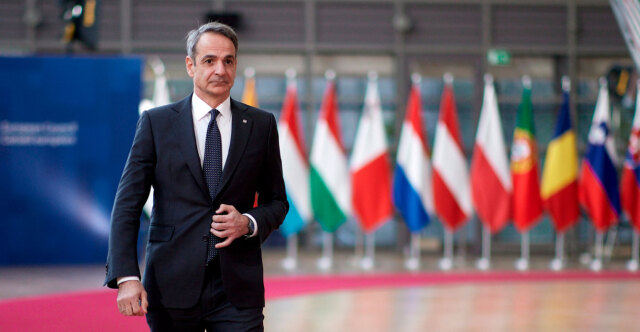
At a particularly critical juncture for the future funding of the European Union’s key needs (namely Cohesion, defence, the Common Agricultural Policy, etc.), the leaders of the 27 member states are meeting in Brussels on 26 and 27 November, with the new Multiannual Financial Framework (MFF) for 2028–2034 as the main item on the agenda. The European Council summit is taking place amid mounting funding needs for the Union, as well as significant differences between member states over the size and allocation of the next budget.
At the centre of discussions is a new compromise proposal presented by European Council President António Costa on 21 November, in an effort to narrow the gap between countries calling for stricter fiscal discipline and those insisting on maintaining strong funding for traditional European policies, such as the Common Agricultural Policy (CAP) and Cohesion Policy.
The proposal envisages a reduction of approximately €204 billion in current prices compared with the European Commission’s initial plan, bringing the overall framework down to around €1.78 trillion. President Costa is nevertheless seeking to present a budget that combines the EU’s new strategic priorities – competitiveness, security, defence and its international presence – with the preservation of policies that support regions and the agricultural sector.
According to the proposal, funding for competitiveness is set to increase by 120% and for defence by 232% compared with the current MFF. Research and innovation programmes, migration management and the protection of external borders will also receive increased funding. At the same time, the European Council president argues that the CAP and Cohesion Policy will continue to constitute the largest funding pillar of the new budget. However, the overall reductions compared with the Commission’s initial proposal are raising concerns about the actual level of funding for traditional policies.
Disagreements over the size and allocation of funds
Reactions to Costa’s proposal are coming from both sides of the negotiations. Countries that contribute more to the EU budget continue to consider the overall level of spending too high, while states that rely more heavily on European funding are expressing concerns over cuts to Cohesion and agricultural policy.
Poland, the Czech Republic, Hungary, Slovakia and Austria have been particularly critical. The five countries are coordinating their responses, calling for changes to the proposal, with an emphasis on preserving funding for agriculture and regional development. Poland is also linking the debate to the security needs of the EU’s eastern flank, while the Czech Republic has expressed reservations about the funding allocation model. Member states also have differing approaches to financing Ukraine.
On the other hand, the more fiscally conservative countries insist on limiting national contributions and keeping the overall budget under control. Germany, in particular, has linked discussions on the new MFF to the need for all 27 member states to participate in financing Ukraine’s needs.
The French bargaining and Macron’s warning
France’s position, and that of President Emmanuel Macron personally, is of particular interest. He appears to consider the European Council president’s proposal broadly aligned with French demands, just months ahead of the next presidential election. Specifically, these include the proposed levy on major digital companies (as part of the EU’s own resources), protection of agricultural subsidies from cuts (a key red line for Paris), the introduction of new European revenue streams aimed at reducing national contributions, and the postponement of approximately €10 billion in payments linked to the EU’s post-pandemic debt.
The digital levy has long been a French priority, with Paris arguing that major technology companies should contribute more towards financing European policies. This is also supported by a majority of MEPs. At the same time, protecting the CAP is particularly important for France, one of the largest recipients of agricultural subsidies.
Despite the concessions, however, the French government has described the proposal as “deeply disappointing”, arguing that it cannot serve as the basis for an agreement. Paris considers the overall cuts excessive and the guarantees for maintaining agricultural funding insufficient.
Pressure intensified further on 25 November, when President Macron warned that France did not consider it feasible to continue negotiations beyond December if an agreement had not been reached by then. The warning is also linked to the French presidential election in spring 2027, which is expected to narrow the political room for manoeuvre for a European compromise.
The French side insists that not a single euro should be lost from the current funding France receives through the CAP. At the same time, it has expressed reservations about the digital levy, as its implementation requires agreement among member states and there is no guaranteed timetable yet. Thus, despite the fact that President Costa’s proposal includes elements that address French priorities, Paris continues to seek stronger guarantees.
New own resources also at the centre of discussions
One of the key issues at the summit is the creation of new revenue sources for the European budget. President Costa’s proposal includes five new own resources: revenues from digital services provided by major companies, non-recycled electronic waste, tobacco products, the Carbon Border Adjustment Mechanism (CBAM) and the Emissions Trading System (ETS). According to him, these new sources, together with existing ones, could generate approximately €60 billion annually.
However, the proposal concerning tobacco products (cigarettes, tobacco, etc.) does not in itself constitute an increase in VAT or a direct increase in the retail price of cigarettes, although it is linked to the broader European debate on revising tobacco taxation.
The proposal aims to reduce the EU’s dependence on national contributions, but questions remain over the approval, implementation and actual yield of the new taxes. The European Parliament is calling for greater ambition, particularly regarding the contribution of major digital platforms, stressing that new European responsibilities should not be financed through further cuts to farmers, regions and social programmes.
European Parliament raises the bar
Costa’s proposal is not provoking reactions from national governments alone. During the debate held in the European Parliament on 25 November, representatives of the political groups strongly criticised the size and structure of the proposed budget.
The Parliament’s rapporteurs on the MFF, Siegfried Mureșan and Carla Tavares, argued that the compromise proposal does not meet the EU’s increased needs and ambitions. Mureșan warned that the European Parliament could not support a proposal that, in his assessment, would lead to a weaker Europe, while Tavares stressed that compromise must not mean a retreat from European ambition.
Similarly, the rapporteurs on own resources, Danuse Nerudova and Sandra Gomez Lopez, called for a more ambitious revenue system, with meaningful contributions from major digital platforms. They also warned that new resources could not be used to fund a smaller budget or further cuts to key policies.
Commissioner Piotr Serafin also pointed out that Costa’s proposal represents a larger budget as a percentage of Gross National Income than the level agreed in 2020.
The Greek dimension and what is at stake at the summit
For Greece, the negotiations are particularly important, as maintaining adequate funding for Cohesion Policy and the CAP is directly linked to the development prospects of its regions and the sustainability of the primary sector. Funding for infrastructure, transport, water supply, civil protection, social services and business investment depends to a large extent on the ability to make use of European funds.
At the same time, a key issue is the new model for managing funds through national and regional plans. Greece has a vested interest in maintaining a meaningful role for regional authorities in designing and implementing programmes, so that funding reflects the actual needs of each area. Protecting the CAP, after all, does not automatically mean that Cohesion Policy will receive equivalent protection.
With the Commission’s green light for the Greek budget, the prime minister is heading to the extraordinary European Council summit with a clear red line: any further cuts to Cohesion Policy and Common Agricultural Policy funding. Government sources acknowledge António Costa’s efforts to bridge diametrically opposed positions and note that several Greek demands have been incorporated into the new negotiating text (Negobox), but make clear that Cohesion and the Common Agricultural Policy cannot withstand any further cuts.
The Greek objection goes beyond the scope of a national demand. At the Maximos Mansion, officials identify a fundamental contradiction in European planning. While leaders acknowledge, including on the basis of the Draghi report, the need for more investment and raise the bar for competitiveness, security and strategic autonomy, they are limiting the means available to achieve these objectives.
Costa’s proposal reduces the budget by €180.6 billion compared with the Commission’s initial proposal, with the Czech Republic and Hungary having already expressed their opposition. On the revenue side, however, Athens has secured a negotiating gain. Kyriakos Pierrakakis’s initiative for pan-European coordination of future 6G spectrum auctions has been incorporated into the new Negobox, opening up a potential source of European revenue worth €12–15 billion.
European turbulence
While Costa is attempting to bridge the differences between European governments, another rift is opening up in the European Parliament. As Politico reported yesterday, the Socialists and Liberals have frozen talks with the European People’s Party (EPP) on a political agreement, in the wake of cooperation between the European centre-right and the far right.
The development is not directly linked to today’s summit. Nevertheless, even if the European Council president succeeds in achieving agreement among the 27 by December, the European budget will require the consent of a Parliament in which traditional majorities can no longer be taken for granted.
Finally, Ukraine’s financing for 2027 and the following years is also on the summit agenda. The European Commission has proposed up to €45 billion in additional financial support for 2027, on top of the €90 billion support loan for 2026–2027. The issue is expected to trigger further disagreements, as member states do not share a common approach to allocating the relevant costs.
The summit on 26 and 27 November is not certain to produce a final agreement. It will, however, be a crucial milestone in shaping the compromise António Costa is seeking, with the aim of reaching an agreement among the 27 by the end of 2026. Even then, the process will require the consent of the European Council.
Ask me anything
Explore related questions




